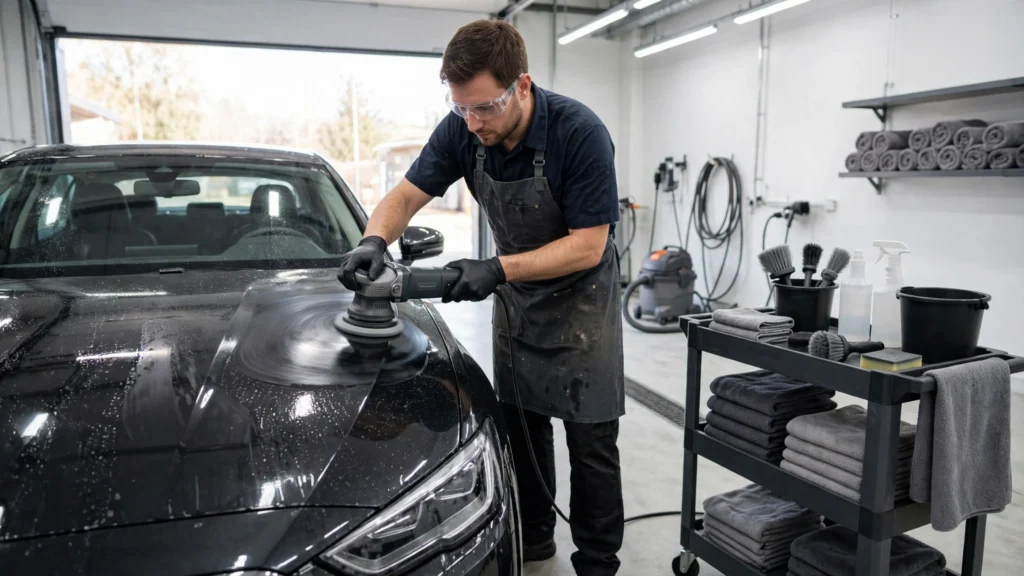
A driver doesn’t book auto detailing the way they buy a car wash. They search with a specific problem in mind: “interior detailing near me,” “ceramic coating Brampton,” “pet hair removal car” — then they compare packages, prices and photo proof across three shops, and book with the one that looks most careful. Some want a showroom shine before selling; others want the winter salt and the kids’ crumbs gone for good. The shop that answers their exact job wins them.
This guide covers SEO for auto detailing shops in 2026: how package pages decide bookings, how photo proof separates real detailing from a car wash, and how to turn your Google Business Profile into a steady flow of booked packages all year.
1. Start with the map: package decisions happen on your profile
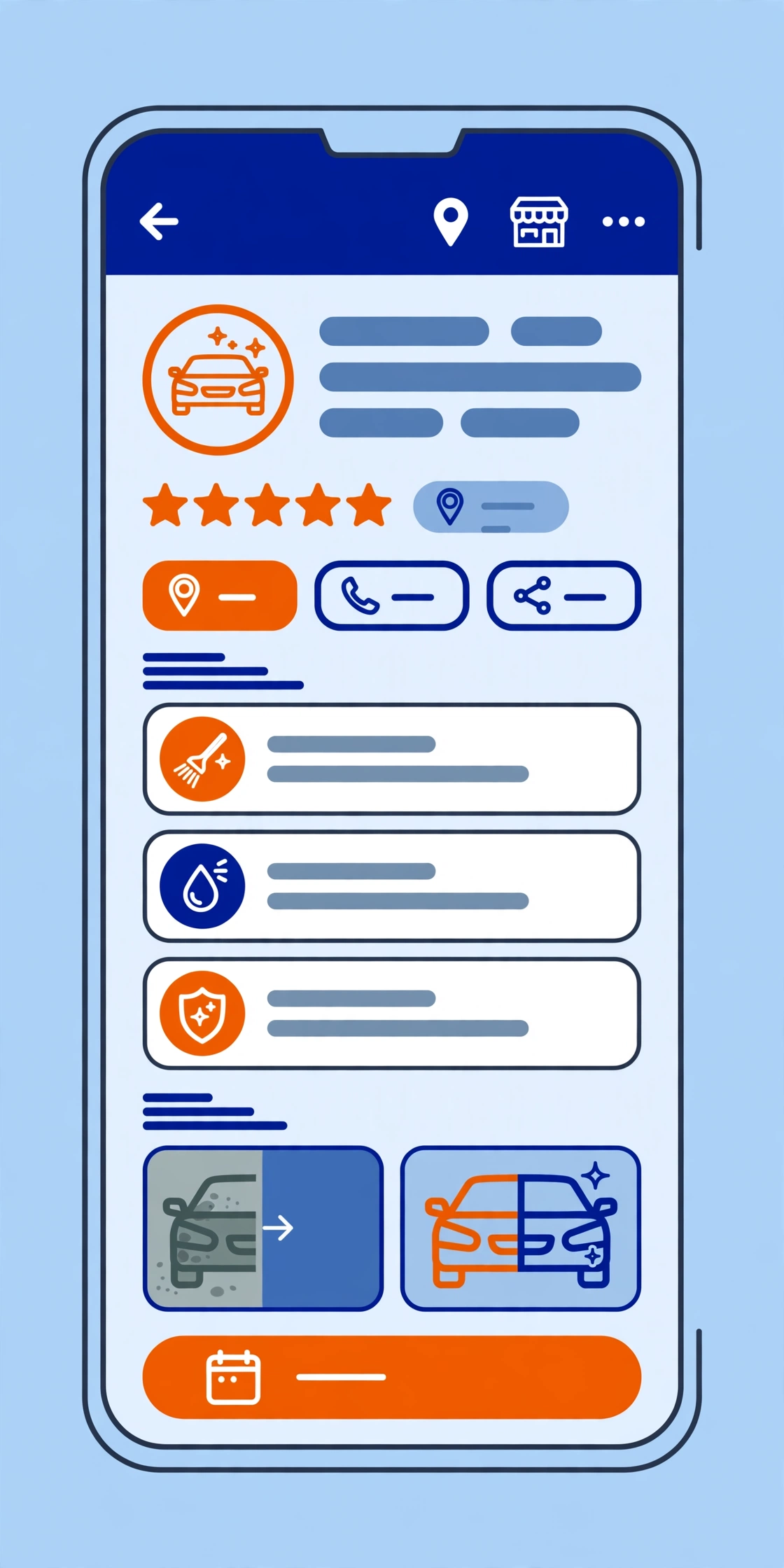
The shortlist for a detailing shop forms on Google, mostly on a driver’s phone in the driveway or the parking lot. Your Google Business Profile is where your shop makes or misses that shortlist:
- Categories: “Auto detailing service” as primary, with “Car wash” added only if you genuinely offer it — and never as the primary, or Google will treat you as a wash.
- Packages named individually: interior detailing, exterior detailing, ceramic coating, paint correction, engine bay — listed as services, so you appear for the package search, not only “detailing near me.”
- Photos of real work: before-and-after shots of your actual jobs — filthy interiors, corrected paint, coated panels beading water. Drivers are trusting you with their second-biggest asset; show them proof, not a logo.
- Booking path in one tap: booking link or phone current, and the price range stated identically on your profile and your website.
- Hours that match drivers’ lives: early drop-off, evening pickup and weekend availability stated accurately — for detailing shops, when you can take the car is a ranking feature, because it’s when drivers search.
2. Package pages: how drivers actually search
Nobody searches for “vehicle appearance services.” They search by job and by package. Build for both:
- Interior pages: full interior detailing, leather cleaning and conditioning, pet hair removal, odour removal — what’s included, how long it takes, and what a filthy interior realistically becomes.
- Exterior pages: wash and wax, paint decontamination, headlight restoration, wheel and tyre detailing — the steps, the products where relevant, and how long the result lasts.
- Ceramic coating pages: the premium job, written carefully — preparation, layers, cure time, warranty terms in plain words, and honest expectations about what a coating does and doesn’t do.
- Paint correction pages: swirl and scratch removal for the owner who notices everything — before-and-after proof, the multi-stage process explained simply, and realistic outcomes for older paint.
Each page carries pricing or how pricing works, the time the car is with you, and the booking next step. It’s the same page-per-search discipline behind our guide to SEO for towing companies — drivers comparing local auto services reward the shop that answers their exact job, for their exact car, first.
Don’t overlook the vehicle-type side, either. SUVs and trucks, luxury and classic cars, fleet and commercial vehicles are searched separately, often by the highest-value — and most loyal — customers. If your shop handles them, each deserves at least a strong section with prices and what’s different about the job. Vehicle-type pages also solve a driver’s quiet worry about whether you’ll treat their car properly: a page that says you know their model, in those words, is honest marketing.
3. Photo proof: the evidence that separates detailing from car washes
Detailing is a visual trade, and the search results know it. A shop with dated, real before-and-after photos of its own work outranks a shop with stock images every time — because drivers can see the difference between a wash and a detail, and so can Google’s image search. Photograph every job type you want to rank for: the stained seats, the corrected bonnet, the coated panel shedding water, the engine bay that looks new again. Name the files and captions honestly — the package, the vehicle, the result — and let the gallery do the selling your words can’t.
Photo proof carries a second, quieter benefit: price confidence. A driver who has seen what a full interior detail actually achieves stops comparing your price to the drive-through wash down the road, because the gap is visible. Reviews that mention the photos (“looked exactly like the pictures, better even”) close the loop for the next driver. Keep the gallery current and real; a gallery of someone else’s work is the fastest way to lose a customer on pickup day.
What this looks like in Brampton
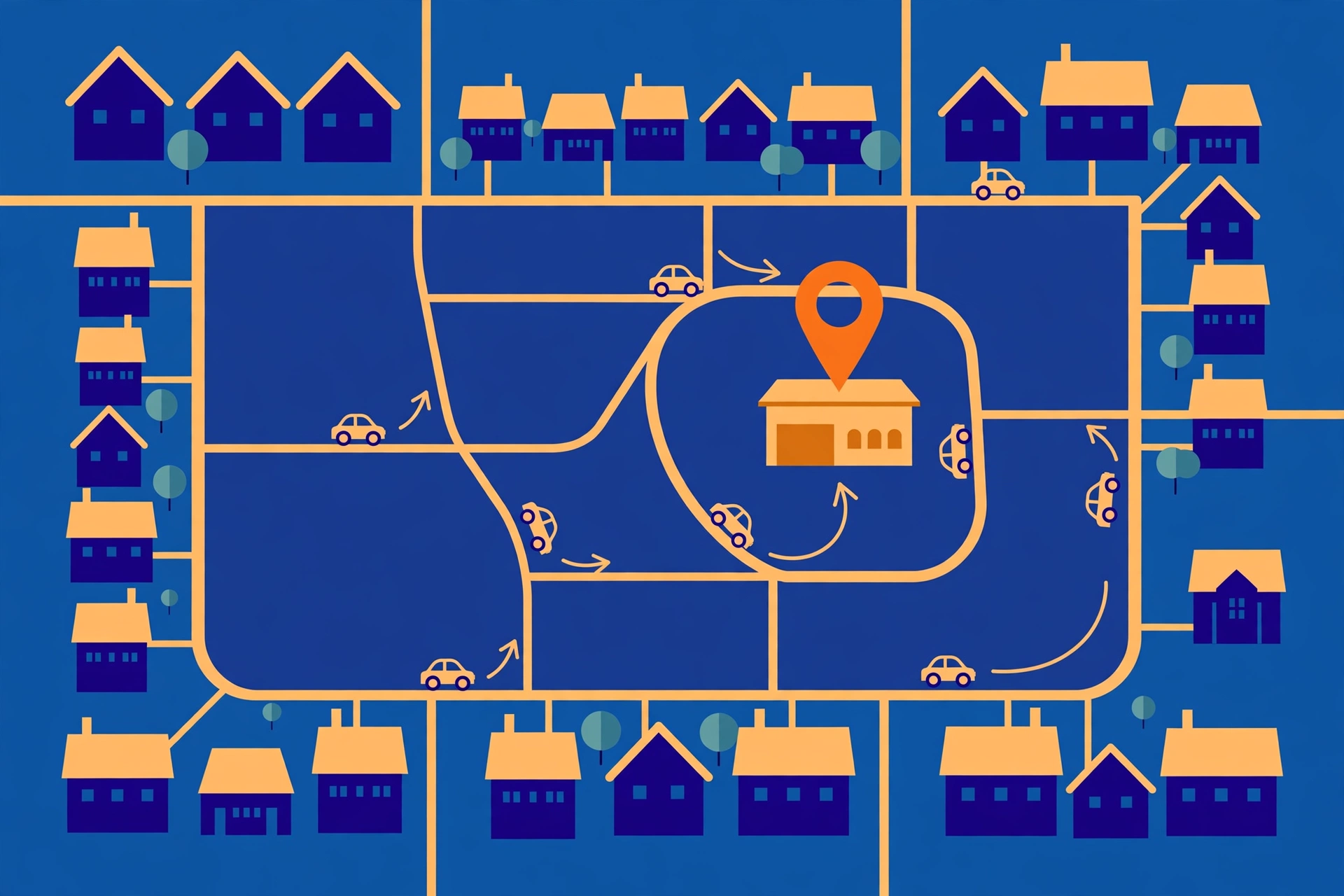
Brampton’s detailing shops serve one of the most car-dependent cities in Canada, where long commutes, winter road salt and family-sized SUVs keep interiors busy all year — from Springdale and Castlemore to Fletcher’s Meadow, Mount Pleasant and Bramalea. Demand spans the full range: interior details after winter, ceramic coatings for new-car owners, paint correction for enthusiasts, and fleet work for the businesses along the city’s industrial corridors. A shop that publishes honest pages for the packages it truly offers captures searches its generic competitors never see.
The calendar is the strategy: the spring clean-up surge when the salt finally lifts, the pre-summer shine before road trips, the autumn protection push before the snow returns, and the winter months where interior work and gift bookings carry the shop. Brampton drivers ask other drivers first — workplace and neighbourhood networks are powerful here — and reviews that name the package and the vehicle (“full interior on my SUV, pet hair gone, smells new”) are the deciding evidence for the next owner on the street.
4. Reviews: read like references, because they are
Detailing is a trust purchase — you hand over the keys — and drivers vet accordingly. They read for care, attention to detail, on-time delivery, and whether the result matches the photos. The asking moments are at pickup, when the owner sees the car for the first time: a short message with a one-tap link, timed to the reveal. Reviews naming the package and the vehicle answer the next driver’s precise questions. Reply warmly and briefly to every one; your tone in replies is read as your shop’s attitude to cars, by owners deciding whether to trust you with theirs.
5. AI search: the driver’s research assistant
Drivers increasingly start with an AI tool: “how much does ceramic coating cost,” “interior detailing vs car wash,” “pet hair removal car near me.” The answers are assembled from complete, consistent content — package pages with honest pricing and time estimates, coating warranty terms in text, before-and-after proof, and fees stated identically on your site, profile and directories. Shops with real pages get summarised accurately and recommended by package and neighbourhood; shops with a one-page site leave the assistant nothing accurate to say, and it says something about a competitor instead. The same logic applies to the questions drivers ask each other — “is ceramic coating worth it” or “who does good interior detailing near me” — and the shop whose pages answer those questions in plain words is the one that gets named.
6. Your website: built to book packages
A detailing shop website has one job — move a driver from comparing to a booked package:
- Booking in one tap: visible on every page, working on a phone in under a minute, with drop-off questions answered on the spot (how long, do you need the keys, is there a waiting area).
- Pricing without fog: full package prices, or at minimum the structure — by vehicle size, what’s included at each tier, add-ons described honestly. Price surprises are the leading cause of cancelled bookings and bad reviews.
- Photo galleries linked from every package page: the driver researching ceramic coating should see your coating work in one click.
- Availability that respects reality: booking slots and lead times updated promptly; a stale calendar quietly reads as a disorganised shop.
7. The seasonal rhythm that keeps bays full
Detailing SEO runs on the seasons. Late winter: spring clean-up packages, interior pages and profile posts live before the salt lifts. Spring: review asks after the first big details; ceramic coating content ready before new-car season. Summer: road-trip and show-car content published early; fleet pages live before autumn contracts. Autumn: protection packages and gift bookings opened while owners think ahead. Shops that run this calendar spend April detailing, not wondering where the bookings went.
8. What to measure so you know it’s working
Measure bookings per package: booking requests from each package page, your visibility for “[package] near me” and “auto detailing [your area],” and vehicle-type demand — a waitlisted coating slot is a signal to feature, not hide. Track booking-to-completion by package for a season and you’ll see which searches bring customers who return twice a year. Repeat business is the metric underneath all of it: SEO that fills bookings with well-matched drivers shows up in spring as a full diary, not a full inquiry inbox.
Geography is the other quiet signal. Drivers will cross a city for a trusted detailer but not for an ordinary wash, so note which neighbourhoods your customers actually travel from — then let your pages and reviews speak to those areas by name.
9. Mistakes that quietly cost detailing shops their spring
The recurring ones: one generic “services” page for every package, so specific searches land nowhere. No photos of your own work, so drivers can’t tell you from a car wash. Pricing hidden or vague, breeding the cancellations and reviews shops fear. Booking that exists by phone only, with no online path. A spring surge met with winter’s outdated hours. And silence between seasons — no new photos, reviews or posts — so each busy season starts from zero against shops that never stopped.
Frequently Asked Questions (FAQ)
How do auto detailing shops rank for “detailing near me”?
With a complete Google Business Profile — packages listed individually, real before-and-after photos and steady reviews — backed by a dedicated page for each package, each with pricing guidance, photo proof and a booking path.
Does each package really need its own page?
Yes. Drivers search by job (“ceramic coating near me,” “pet hair removal car”). A page written for that exact search ranks for it and converts far better than one combined services page.
How do detailing shops separate themselves from car washes?
With package pages, real before-and-after photos and reviews that name the job — and by keeping “car wash” out of your primary category. The difference has to be visible in search, not just in the bay.
When should a detailing shop publish seasonal content?
Before each surge: spring clean-up content live in late winter, coating content before new-car season, protection packages before autumn. Visibility takes weeks to build; publishing during the surge misses it.
How do detailing shops get reviews that help?
Ask at pickup, when the owner first sees the car, with a one-tap link, and make it easy for drivers to name the package and vehicle. Reply warmly to all of them, and never buy reviews.
Get a free SEO audit of your website
A 120 point crawl, a competitor gap map and a 90 day roadmap, ready in 48 hours. Free, with no obligation.

SEOelinks is a Brampton-based SEO agency helping service businesses across Canada and worldwide win organic search. Our strategists publish the same field-tested playbooks on technical SEO, local visibility and AI search that we run for clients every day.
More about SEOelinks →