An HVAC click on Google Ads costs about $38 in Canada. During a February cold snap or a July heat wave, it costs more — and you are bidding against every other contractor in the city at the exact moment demand spikes. HVAC SEO is how you stop renting that demand. This guide covers the seasonal keyword model, the map-pack mechanics that decide emergency calls, and the site structure that lets one company rank across an entire service area.

The seasonality problem nobody plans for
HVAC demand is not steady, and that single fact should shape your entire SEO calendar. “Furnace repair” searches climb from October, spike with the first hard freeze, and collapse by April. “AC installation” starts stirring in May and peaks in the first heat wave. Meanwhile “heat pump rebate” and “furnace replacement cost” run year-round as people research a purchase months before making it.
The mistake is building content in the season you need it. Rankings take 8–16 weeks to mature, so a furnace page published in November is competing for traffic it will not capture until the following winter. The fix is a calendar that runs six months ahead of demand.
The six-month-ahead content calendar:
| Build in | Ranks for | Target pages |
|---|---|---|
| Mar–May | Summer cooling demand | AC repair, AC installation, ductless mini-split, AC tune-up |
| Jun–Aug | Fall/winter heating demand | Furnace repair, furnace replacement, heat pump conversion |
| Sep–Nov | Spring IAQ and maintenance | Duct cleaning, humidifiers, air quality, maintenance plans |
| Dec–Feb | Next year’s commercial and rebate content | Rebates and financing, commercial RTUs, boiler service |
Keyword strategy: emergency, planned, and research intent
HVAC searches split cleanly into three buying modes, and they want completely different pages.
Emergency intent
“No heat”, “furnace not working”, “emergency AC repair”, “24 hour HVAC near me”. These convert within minutes, on a phone, usually while the person is cold or overheating. The page needs the phone number above the fold, response-time language (“technicians dispatched within 2 hours”), and nothing else competing for attention. Do not send this traffic to your home page.
Planned-purchase intent
“Furnace replacement cost”, “best heat pump for Ontario winters”, “new AC installation quote”. These searchers convert over two to eight weeks and compare three to five companies. They need real numbers, equipment comparisons, financing details and rebate information — the pages that establish you as the informed choice.
Research and maintenance intent
“How often to change furnace filter”, “why is my AC freezing up”, “what does AFUE mean”. Low commercial value per visit, high value in aggregate: this content earns links, builds topical authority for the money pages, and puts you in front of a homeowner before they need you. It is also where AI answer engines pull from, and being the cited source there matters more every quarter.
The map pack decides your emergency calls
For “furnace repair near me”, the three map results absorb the overwhelming majority of clicks on mobile. Getting there is a function of proximity, prominence and relevance — and for HVAC, one of those is more controllable than most contractors realise.
Categories and services
Set your primary category to HVAC contractor, then add the specific secondaries you genuinely offer: air conditioning repair service, furnace repair service, heating contractor, air duct cleaning service. Each secondary category makes you eligible for a different set of queries. Then populate the services list to mirror your website’s service pages exactly — same names, same order.
Service area vs storefront
Most HVAC companies should be a service-area business: hide the address, define the cities you actually drive to. Listing a warehouse you never meet customers at as a storefront is a suspension risk, and suspensions during peak season are catastrophic. Keep the service area realistic — twenty cities on one profile dilutes relevance and rarely helps.
Reviews that mention the job
A review saying “great service” is worth far less than one saying “replaced our furnace in Brampton the same day it died”. Ask techs to request the review on-site, right after the customer sees the finished work, and let people describe the specific job. Aim for a steady drip — five to ten a month beats a burst — and reply to every one within 48 hours.
What a consistent local programme looks like over one season:
Month 1 — outside the pack on core “near me” terms
Month 3 — pack position 3 in home city, ranking organically in two neighbours
Month 6 — pack position 1 in home city entering peak season
Site architecture: service × city, done properly
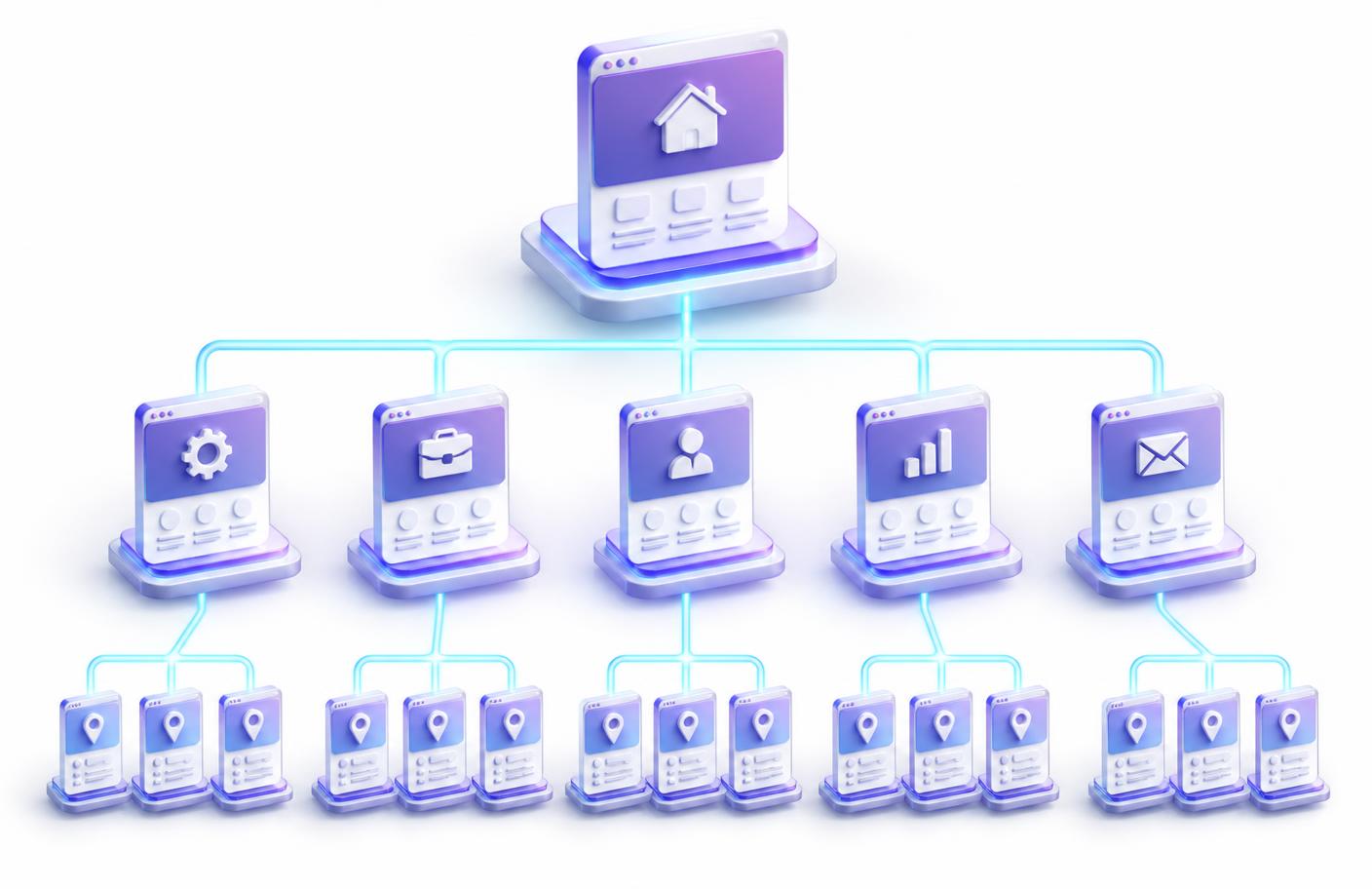
The scalable structure is a service-by-city matrix with real hubs. Each service gets a parent page; each city you truly serve gets a child page beneath the relevant service; every page links up to its parent and sideways to its siblings.
/
├── /furnace-repair/
│   ├── /furnace-repair/brampton/
│   └── /furnace-repair/mississauga/
├── /ac-installation/
│   ├── /ac-installation/brampton/
│   └── /ac-installation/caledon/
├── /heat-pumps/
└── /maintenance-plans/
The failure mode is templated city pages — the same 600 words with the city name find-and-replaced across 30 URLs. Google identifies that pattern instantly and it now suppresses the whole cluster. A city page earns its place only if it contains something true and specific: the housing stock in that area, typical equipment ages, local permit or rebate details, your actual response time to that area, and jobs you have completed there.
What a high-converting service page contains
- Phone number and booking CTA visible without scrolling, on mobile first.
- Response-time promise and service hours, stated plainly.
- Price ranges — a diagnostic fee, a typical repair band, an installation range. Contractors resist this; the ones who publish ranges consistently convert better because they filter tire-kickers and win trust.
- Brands serviced and licence/certification numbers, including TSSA and gas fitter credentials where applicable.
- Real photos of your crew and completed installs — not stock imagery of an unbranded van.
- Financing and current rebate programmes, kept up to date.
- Six to ten FAQs pulled from your dispatch calls.
Technical foundations for contractor sites
Mobile speed during an emergency
Your emergency traffic arrives on cellular, often on older phones, from someone with a failing furnace. If the page is not usable in about two seconds, they hit back and call the next result. Strip the hero video, compress and lazy-load images below the fold, and cut the plugin count. Measure on a throttled 4G profile, not on your office fibre.
Click-to-call that actually tracks
Every phone number should be a tel: link, and every one should fire a tracked event. Without call tracking you cannot tell which pages produce jobs, which means you cannot make a single confident budget decision. Use dynamic number insertion so organic calls are separated from ads and direct.
Schema for local services
Mark up the home page as HVACBusiness with address, hours, and service area; use Service markup on each service page; add FAQPage where you have a genuine FAQ block; and add AggregateRating only if the reviews are on your own site and visible. Emergency availability belongs in openingHoursSpecification, not just in a headline.
Indexation and seasonal pages
Do not delete your AC pages in winter or your furnace pages in summer. They need to stay indexed and accumulating authority year-round. Keep them live, refresh them ahead of their season, and let internal links from the home page rotate to whichever cluster is currently in demand.
Content that earns links in a trade vertical
Contractors have an advantage most businesses do not: genuinely useful, visual, first-hand expertise. Turn it into linkable assets.
- Cost guides with real local numbers — “what furnace replacement actually costs in the GTA, by system size” is cited by journalists, forums and AI answers because almost nobody publishes real figures.
- Rebate explainers — provincial and federal efficiency programmes change constantly, and a maintained, accurate page becomes the reference everyone links to.
- Diagnostic content with photos from your own jobs — “what a cracked heat exchanger looks like” is impossible for a content mill to fake.
- Supplier and manufacturer dealer pages — being listed as a certified dealer is a legitimate, high-value link most contractors never claim.
Tracking the numbers that pay for the programme
Weighting by job value changes strategy completely. Installation keywords have lower volume than repair keywords but can be worth ten to forty times more per lead. Once you attribute revenue rather than leads, the budget almost always shifts toward replacement and installation content — and margins follow.
SEO or Google Ads for HVAC?
| Google Ads | SEO | |
|---|---|---|
| Speed | Leads today | 8–16 weeks to traction |
| Cost per click | ~$38, higher in peak season | Falls toward zero as rankings hold |
| When you stop paying | Volume stops that day | Traffic persists and compounds |
| Peak-season behaviour | Costs spike exactly when you need volume | Rankings hold regardless of demand |
The practical answer for most contractors: run ads for emergency terms where speed wins the job, and build organic for the planned-purchase and maintenance clusters where margins live. Over 18 months the ad budget should shrink as a percentage of revenue, not grow.
Brampton’s HVAC market: old furnaces, new subdivisions, extreme seasons
Brampton sits in a climate pocket that punishes HVAC equipment: humid summers that strain air conditioners and winters cold enough to expose every weakness in a furnace. The city’s housing split defines the work. Bramalea and other established neighbourhoods hold thousands of homes built in the 60s through 80s, many still on original ductwork and running their second or third furnace — searches here are “furnace replacement cost Ontario,” “no heat,” and “why is my upstairs cold.” Meanwhile the northwest subdivisions, part of the city’s push toward 113,000 new homes by 2031, run high-efficiency systems where demand centres on maintenance plans, smart thermostats, and indoor air quality. With 189,086 dwellings and counting, plus a median age of 36 — young families sensitive to both comfort and energy bills — the highest-converting Brampton HVAC content answers cost questions honestly in CAD, explains Ontario’s energy rebate programs plainly, and segments advice by housing age. A 1972 Bramalea bungalow and a 2023 Mount Pleasant semi need completely different guidance, and Google rewards the page that knows which one it is talking to.
Frequently asked questions
How much does HVAC SEO cost?
Serious contractor SEO in a competitive metro runs about $1,500–$5,000 CAD per month depending on how many services and cities you target. Against a $38 click cost and installation jobs worth thousands, the break-even is usually one to two extra installs per month.
How long does HVAC SEO take to work?
Map pack improvements and long-tail service pages typically show movement in 8–12 weeks. Competitive “near me” repair terms in a large metro take six to nine months. Plan content six months ahead of the season you want it to perform in.
Do I need a separate page for every city I serve?
Only for cities you genuinely work in and can write differently about. Five substantial city pages beat thirty templated ones. Add cities as you accumulate real jobs, photos and reviews there.
Should HVAC pages show prices?
Publish ranges rather than exact quotes — a diagnostic fee, a typical repair band, an installation range by system size. It improves conversion, reduces wasted dispatches, and it is one of the few things that reliably differentiates you from competitors who hide everything behind a form.
What about seasonal Google Business Profile posts?
Worth doing. Post maintenance reminders ahead of each season, current rebates, and finished-job photos. They do not directly move rankings much, but they lift engagement and conversion from the profile, which is where a large share of emergency calls originate.
When do Brampton homeowners search for HVAC help most?
Two spikes: the first deep cold snap (furnace failures, no-heat emergencies) and the first sustained heat wave (AC breakdowns). Smart operators publish furnace maintenance content in early fall and AC tune-up content in spring, so the pages are already ranking when the spikes hit.
Do energy rebates really drive HVAC searches in Ontario?
Yes — rebate-related queries (“furnace rebate Ontario,” “heat pump incentive”) carry strong intent because the searcher has already decided to spend. Pages that explain current provincial programs in plain language, with eligibility basics, consistently outperform generic equipment pages. Keep them updated; programs change.
Find out what your HVAC site is missing before next season
We’ll audit your service pages, map pack position and city coverage, then hand you a prioritised build plan mapped to the seasonal calendar. Month to month, cancel anytime.
Related reading: our local SEO guides and the SEOelinks approach to technical SEO.

SEOelinks is a Brampton-based SEO agency helping service businesses across Canada and worldwide win organic search. Our strategists publish the same field-tested playbooks on technical SEO, local visibility and AI search that we run for clients every day.
More about SEOelinks →