Most landscaping companies are booked solid in June and staring at an empty calendar in March. SEO is the only marketing channel that fixes that asymmetry permanently: it compounds through the off-season, it captures homeowners at the exact moment they decide to spend, and unlike paid ads it does not stop the day you stop paying. This guide is the full playbook we use to take Canadian landscaping and lawn care companies from invisible to the top three map results in their service area.

Why landscaping is one of the best industries for SEO
There are industries where SEO is a grind — national e-commerce, SaaS, insurance — and industries where it is close to unfair. Landscaping sits firmly in the second category, for four structural reasons that have nothing to do with how clever your agency is.
First, the search intent is extraordinarily commercial. Nobody types “lawn care near me” out of curiosity. They type it because their grass is twelve inches tall, because they just closed on a house with a wrecked yard, or because their neighbour got interlock done and now their driveway looks tired. The distance between the query and the credit card is measured in days, not months. Compare that to a query like “how to grow grass” — informational, low value, and mostly served to people who intend to do it themselves.
Second, the competition is thin and technically weak. Walk through the first page of results for almost any Canadian city plus “landscaping” and you will find sites built in 2016, hosted on shared plans that take five seconds to load, with no service-area pages, no schema, and a Google Business Profile that has not been touched since the pandemic. Ranking against a national brand with a 200-person content team is hard. Ranking against a two-truck operation whose website was built by a cousin is not.
Third, the geography naturally fragments the market. A landscaper in Brampton does not compete with a landscaper in Halifax. You are competing for a radius, and radii are winnable. The total number of businesses genuinely fighting for “landscaping Mississauga” is usually under twenty, and only five or six of them are doing anything deliberate.
Fourth, the job values are high enough to justify the work. A single interlock patio contract in the GTA runs $18,000 to $40,000. A commercial snow and grounds maintenance contract can be six figures annually. If SEO brings you two extra hardscape projects a year, it has paid for itself several times over. That economics is what makes a proper program — not a $300/month “SEO package” — rational.
How homeowners actually search for landscaping
Before you can build the site, you need to understand the shape of demand. Landscaping search is not one keyword — it is five distinct intent tiers, and each one needs a different type of page. Treating them all the same is the single most common strategic mistake we see.
Tier 1: Emergency and urgency queries
“Emergency tree removal”, “storm damage cleanup“, “same day snow removal”, “fallen branch removal near me”. These convert at the highest rate of anything in the industry — often 30% or more of clicks turn into a phone call — but volume is spiky and weather-dependent. They reward two things: a phone number visible above the fold on mobile, and a page that loads before the person gives up and calls the next result.
Tier 2: Direct service queries
“Lawn care Brampton”, “interlocking Mississauga”, “sod installation Oakville”, “landscaping company near me”. This is the core of the business. The searcher knows what they want and is picking a vendor. Each of these deserves its own dedicated page — not a bullet on a combined services page.
Tier 3: Cost and comparison queries
“How much does interlock cost per square foot”, “sod vs seed cost”, “landscaping prices Ontario”, “is artificial turf worth it”. These sit slightly earlier in the buying cycle but they are gold, because they are where trust is built. A landscaper who publishes honest, specific pricing ranges wins the mental shortlist before the quote request ever happens. Most competitors refuse to publish pricing, which is exactly why doing it is an advantage.
Tier 4: Design and inspiration queries
“Backyard landscaping ideas Ontario”, “front yard interlock designs”, “low maintenance garden Canada”, “modern patio ideas”. Lower intent, higher volume, and enormously useful for building topical authority and gathering email addresses. These pages also earn the links that make your money pages rank.
Tier 5: Maintenance and seasonal queries
“When to aerate lawn Ontario”, “spring cleanup checklist”, “fall fertilizer schedule”, “when to cut back perennials Zone 5”. Recurring, predictable, and perfect for capturing homeowners who intend to DIY but half of whom eventually decide the job is bigger than their Saturday.
| Intent tier | Page type | Primary goal | Typical conversion |
|---|---|---|---|
| Emergency | Fast landing page, phone-first | Immediate call | 25–35% |
| Direct service | Service × city page | Quote request | 6–12% |
| Cost / comparison | Long-form guide with real numbers | Shortlist inclusion | 2–5% |
| Design / inspiration | Gallery + project story | Email capture, links | 1–3% |
| Seasonal maintenance | Checklist / calendar article | Return visit, brand recall | 1–2% |
The map pack is the whole game
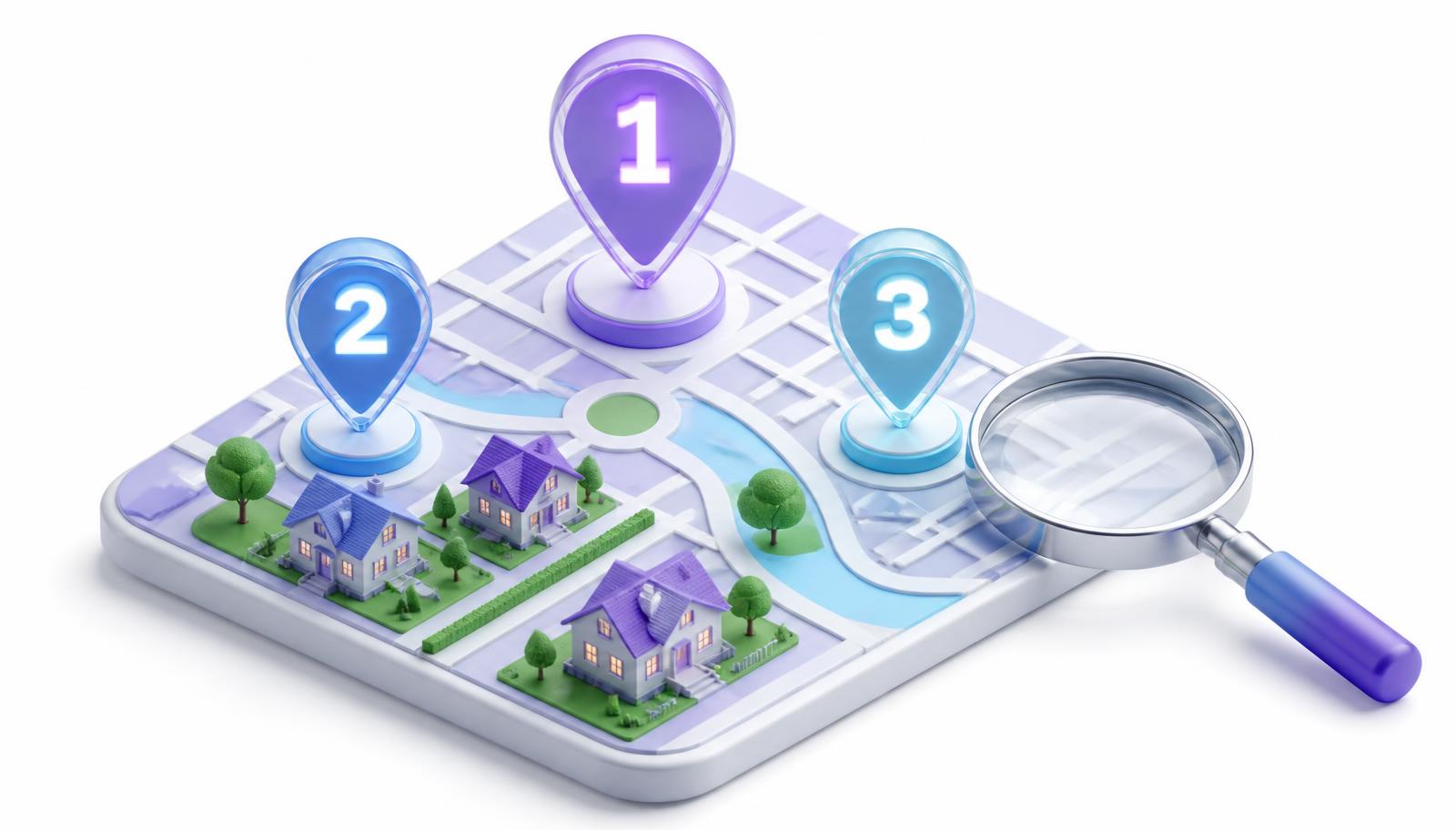
On a mobile search for “landscaping near me”, the local pack — the map with three business listings — occupies the majority of the first screen. Organic blue links start somewhere around the second or third scroll. This is not a subtlety, it is the entire structure of local search: if you are not in the three-pack, you are competing for the traffic that the three-pack did not absorb.
Map pack ranking is driven by three factors that Google has been reasonably transparent about: relevance (does your profile and site clearly match the query), distance (how far is your business from the searcher), and prominence (how well known and well reviewed are you). You cannot change distance. You can absolutely change the other two, and most of your competitors have not tried.
Getting your Google Business Profile genuinely right
Not “claimed”. Right. There is a large gap between the two, and closing it is usually the fastest ranking win available to a landscaping company.
- Primary category. Choose the most specific accurate one — “Landscaper”, “Lawn care service”, “Snow removal service”, “Landscape designer”. The primary category carries far more weight than secondary ones, so it should match your highest-value service, not your broadest description.
- Secondary categories. Add every service you genuinely offer, but do not stuff. Five to eight relevant categories is typical for a full-service company.
- Service areas. If you serve customers at their location and do not have a storefront, hide your address and define service areas by city. Listing twenty cities you have never worked in dilutes relevance; list the eight to twelve you actually serve.
- Services list. Fill in every individual service with a 200–300 character description. Almost nobody does this. It is a direct relevance signal and it takes an afternoon.
- Photos. Twenty minimum, geotagged where possible, uploaded steadily rather than in one batch. Before-and-after pairs perform best. Profiles with regular photo activity see materially more direction requests than dormant ones.
- Posts. One per week during season. Seasonal offers, completed projects, booking availability. They are short-lived but they signal an active business.
- Q&A. Seed it yourself with the ten questions you answer on every sales call, then answer them from the business account. If you leave it blank, competitors and randoms will fill it with misinformation.
- Hours and holiday hours. Accurate, including seasonal closures. Nothing kills trust faster than “open now” attached to a phone that nobody answers.
The NAP consistency audit nobody wants to do
Your Name, Address and Phone number must match character-for-character across your website, Google Business Profile, Yelp, Bing Places, HomeStars, Houzz, Better Business Bureau, Facebook, Apple Maps, and every local directory you have ever been listed in — including the ones a previous agency created and forgot about. “Suite 4” versus “#4”, an old cell number, a previous address from before you moved shops: each inconsistency is a small confidence penalty, and they accumulate. Budget one full day, build a spreadsheet, fix every entry, and re-check it annually.
Reviews: the compounding asset
Review count and velocity correlate with map pack position more strongly than almost any other controllable factor, and review content itself is indexed. A review that says “they redid our interlock driveway in Brampton and it looks incredible” is a relevance signal for “interlock Brampton” in a way that no amount of on-page optimisation replicates.
The system that works is boringly simple and almost nobody runs it consistently:
- Ask in person, at the moment of highest satisfaction — walking the finished job with the homeowner, not three weeks later by email.
- Follow up with a text containing a direct review link within two hours. A text gets roughly five times the response rate of an email.
- Ask them to mention the specific service and the city in their own words. Never script it — scripted reviews read as fake to both humans and Google.
- Respond to every single review inside 48 hours, positive and negative. Responses are public evidence of how you handle problems.
- Target a steady drip — four to eight per month — rather than thirty in one week. Velocity spikes look manufactured.
On negative reviews: never argue, never blame the customer, never mention legal action. Acknowledge, state what you did to fix it, offer to continue offline. A well-handled one-star review has sold more jobs than most companies realise, because prospects read it as proof that you do not disappear when things go wrong.
Relative influence on map pack position for service-area landscaping businesses, based on patterns across our Canadian local SEO accounts. Directional, not absolute.
Site architecture: the service × city matrix
Here is the mistake that caps 90% of landscaping websites: one page called “Services” that lists eight services in bullet points, and one page called “Areas We Serve” that lists twelve city names. That structure gives Google exactly one weak signal for each of ninety-six possible service-and-city combinations, and it will rank for approximately none of them.
The correct structure is a matrix. Every service gets a parent page. Every service you want to rank for in a specific city gets a child page. The parent page explains the service in depth; the child page proves you actually do it there.
/interlocking/
/interlocking/brampton/
/interlocking/mississauga/
/interlocking/caledon/
/lawn-care/
/lawn-care/brampton/
/lawn-care/mississauga/
/sod-installation/
/sod-installation/brampton/
/snow-removal/
/snow-removal/brampton/
The obvious objection is that this creates dozens of near-duplicate pages, and if you build them lazily, it does — and Google will treat them exactly as the doorway pages they are. The difference between a matrix that ranks and a matrix that gets ignored is whether each city page contains genuinely local substance:
- Named projects in that city. “We rebuilt a 640 sq ft flagstone patio off Kennedy Road in Brampton in May 2025.” Photos of that job, not stock.
- Local conditions. Soil type, drainage patterns, frost depth, the specific bylaw that governs driveway widening or tree removal in that municipality. Brampton’s tree protection by-law and Mississauga’s are not the same document, and saying so proves you work there.
- Local pricing reality. Permit costs, disposal fees, and access constraints differ by municipality and materially affect quotes.
- Reviews from customers in that city, embedded with the neighbourhood named.
- An embedded map showing a real project radius, not a generic city centre pin.
A city page built this way runs 700–1,200 words and takes about two hours to produce properly. Build them in priority order — highest-value service in your densest city first — and add three or four a month. Twenty excellent city pages beat two hundred templated ones, every time, and templated ones actively risk a thin-content penalty across the whole site.
Internal linking that actually moves rankings
Every city page links up to its service parent and sideways to two or three adjacent services in the same city (“many Brampton interlock clients also book spring cleanup”). Every blog article links down to the two most relevant service pages using descriptive anchor text — “interlocking in Mississauga”, never “click here”. Your homepage links to your five highest-value pages, not to all forty. This is free, it takes an hour a month, and it is the single most underused ranking lever in local SEO.
The seasonal content engine

Landscaping demand is violently seasonal, and the biggest tactical error in the industry is publishing seasonal content during the season. By the time you post “spring cleanup services” in April, the pages that will rank were indexed in January. Search engines need lead time: a new page typically takes six to twelve weeks to settle into its real position, and seasonal queries begin climbing four to six weeks before the season starts.
So the calendar inverts. You write about spring in January. You write about snow in August. Here is the publishing calendar we run for Canadian landscaping clients:
| Publish in | Target season | Content focus |
|---|---|---|
| January – February | Spring | Spring cleanup checklists, aeration and overseeding timing, when to remove winter protection, early booking offers, patio design planning |
| March – April | Early summer | Sod vs. seed, irrigation startup, garden bed design, mulch types and costs, first-cut scheduling |
| May – June | Peak summer | Hardscape project guides, interlock and retaining wall cost breakdowns, drought-tolerant planting, lawn disease identification |
| July – August | Fall and winter | Fall cleanup, aeration timing, winter fertilizer, snow contract pre-booking, tree pruning windows |
| September – October | Winter | Snow removal contracts, salt vs. brine, winterizing irrigation, ice damage prevention, plant protection |
| November – December | Next spring | Year-in-review project galleries, next-season design trends, early-bird booking, budgeting guides |
Two more rules make this engine work. First, never delete or duplicate seasonal pages — update the same URL every year with fresh dates, new photos and revised pricing. A page that has ranked for “spring cleanup Brampton” for four consecutive springs is far stronger than a new one published each January. Second, every seasonal article must link to a money page. An article about fall aeration timing that does not link to your lawn care service page is a missed conversion and a wasted internal link.
Technical SEO for landscaping sites
You do not need enterprise technical SEO. You need a small number of things not to be broken. In our audits of landscaping websites, the same six issues appear over and over.
1. Speed, specifically on mobile
The typical landscaping site is a photo gallery pretending to be a website. Twelve full-resolution 4MB JPEGs of finished patios, uploaded straight from a phone, on a page that takes nine seconds to render on LTE in a driveway. Compress everything to WebP under 200KB, serve responsive sizes, lazy-load anything below the fold, and set explicit width and height attributes to stop layout shift. This alone routinely takes a site from a Lighthouse score in the thirties to the eighties.
2. Mobile call-to-action placement
More than 70% of landscaping searches happen on a phone. The phone number must be a tappable tel: link, visible without scrolling, and sticky on scroll. A quote form should be reachable in one tap. Contact information buried in a footer is the most expensive design decision a contractor can make.
3. Structured data
Implement LocalBusiness schema (or the more specific LandscapingBusiness type) with your NAP, hours, service areas, price range and geo coordinates. Add Service schema on each service page and FAQPage schema on any page with a question block. Where you have genuine collected reviews, mark them up — but only real ones; fabricated review markup earns manual penalties.
4. Indexation hygiene
Most landscaping sites carry dead weight: old service pages from work you no longer do, duplicate city pages from a previous agency, paginated gallery URLs, and tag archives with one post each. Crawl the site, redirect or remove what is obsolete, and keep your sitemap to pages you would genuinely want a customer to land on.
5. HTTPS, canonicals and the four-URL problem
Your site should resolve on exactly one URL. Not http and https, not www and non-www, not with and without trailing slashes. Pick one, 301 everything else to it, and set self-referencing canonicals. This is a fifteen-minute fix that half of the industry has never done.
6. Core Web Vitals in the real world
Aim for Largest Contentful Paint under 2.5 seconds, Interaction to Next Paint under 200 milliseconds and Cumulative Layout Shift under 0.1 — measured on field data in Search Console, not on a lab test run from your office fibre connection. Field data is what Google actually uses.
Links and local authority
Landscaping is not a link-heavy industry, which is precisely why modest link building produces outsized results. You do not need two hundred referring domains. You need twenty to forty genuinely local, genuinely relevant ones, and they exist in places most agencies never look.
- Supplier and manufacturer pages. Unilock, Techo-Bloc, Permacon, Belgard and most nursery wholesalers maintain “certified installer” or “where to buy” directories. If you are a certified installer and not listed, that is a high-authority, perfectly relevant link sitting unclaimed.
- Local associations. Landscape Ontario, the Canadian Nursery Landscape Association, your regional board of trade and chamber of commerce all publish member directories.
- Municipal and community sites. Sponsoring a minor hockey team, a community garden, or a school fundraiser usually comes with a sponsor page link. These are cheap, real, and hyper-local.
- Local media. Regional papers and community news sites run seasonal service stories constantly — spring cleanup advice, storm preparation, winter salt alternatives. Being the quotable local expert is a repeatable link source; pitch a specific angle with real data, not a press release.
- Complementary trades. Pool installers, deck builders, fence companies, arborists and property managers all serve your customer without competing with you. Reciprocal referral pages are natural and defensible.
- Project features. Design blogs, Houzz ideabooks and regional home magazines will publish a genuinely striking transformation with good photography. This is the highest-return use of your project photos.
What to avoid: bulk directory packages, guest posts on generic “home improvement” blogs with no audience, private blog networks, and anyone selling “500 backlinks for $99”. These do not work in local search and they create cleanup work later.
What to measure — and what to ignore
Rankings are a diagnostic, not a goal. Nobody deposits a keyword position. Track these instead:
| Metric | Where | Why it matters |
|---|---|---|
| Calls from GBP | Business Profile insights | Direct revenue signal from map pack visibility |
| Direction requests | Business Profile insights | Strong proxy for local prominence in your radius |
| Form submissions by landing page | GA4 + form tool | Tells you which service × city pages actually earn |
| Call tracking by source | Call tracking number | Separates organic from ads, referral and repeat |
| Quoted value from organic | Your CRM | The only number that proves ROI |
| Close rate by channel | Your CRM | Organic leads typically close higher than paid |
| Impressions by query cluster | Search Console | Early warning of growth or decline, weeks before traffic moves |
Set up a simple rule: every lead source gets tagged at intake, and every quote gets a value. Within one season you will know precisely what an organic lead is worth to your business, and that number ends every argument about marketing budget.
A realistic 12-month timeline
Anyone promising page one in thirty days is selling you something. Here is what actually happens when the work is done properly, based on the pattern we see repeatedly across Canadian contractor accounts.
Typical share of year-one organic lead volume achieved, by stage. Growth is back-loaded — which is exactly why starting in the off-season matters.
- Months 1–2. Technical fixes, GBP overhaul, NAP cleanup, review system launched, first four service pages rebuilt. Map pack movement often begins here because GBP changes propagate quickly.
- Months 3–4. City page matrix begins, seasonal content engine starts, first local links landed. Long-tail queries start converting.
- Months 5–6. Core service × city pages reach page one for lower-competition combinations. Review count crosses the threshold where map pack position stabilises.
- Months 7–9. Competitive head terms in your primary city start moving into the top five. Organic becomes a meaningful share of booked work.
- Months 10–12. The compounding kicks in: seasonal pages ranked last year come back stronger, link profile matures, and off-season lead flow becomes predictable rather than hopeful.
Nine mistakes that cost landscapers rankings
- One page for every city. A list of twenty city names on one page ranks for none of them.
- Stock photography. Google can tell, and so can homeowners. Your own project photos are your single biggest differentiation asset and they cost nothing but a phone.
- Hiding pricing entirely. Ranges build trust and filter out tire-kickers. “Contact for pricing” on every page reads as evasive.
- Going dark in the off-season. October to February is when rankings are won for the following spring.
- Keyword stuffing city names. “Landscaping Brampton, landscaping Mississauga, landscaping Caledon” in the footer of every page is a 2011 tactic that now actively hurts.
- Ignoring the Google Business Profile after claiming it. It is a living channel, not a form you fill in once.
- Buying review packages. Filtered, penalised, and increasingly obvious to consumers.
- Rebuilding the website without redirects. The most common cause of a sudden traffic collapse we get called about. Map every old URL to a new one before launch.
- Judging SEO on month two. The channel is back-loaded by nature. Judging it before month six is like judging a lawn three days after seeding.
Landscaping in Brampton: small lots, hard winters, year-round demand
Brampton’s landscaping market has a shape most agencies miss: it is really two businesses. Summer is design, sod, interlock, and garden beds — shaped by the city’s lot split. New subdivisions in the northwest sit on compact lots where the winning offer is low-maintenance design; established neighbourhoods like Heart Lake and Bramalea have larger lots with mature trees and room for full transformations. Winter is the other half: in a city of 189,086 dwellings, residential snow removal is a recurring-revenue engine, and “snow removal Brampton” is one of the most contested seasonal terms in the GTA. Then there is the demographic edge few competitors target: with 52.4% of residents identifying as South Asian and a strong culture of growing food at home, edible gardens and vegetable-bed installs are a genuine differentiator — the landscaper whose gallery shows them wins a segment rivals do not even pitch. For SEO, that means separate seasonal service lines for landscaping and snow, lot-size-aware content, and photo proof from real Brampton properties.
Frequently asked questions
How long does landscaping SEO take to produce leads?
First map pack movement often appears within four to eight weeks, driven by Google Business Profile and review work. Meaningful, consistent organic lead flow typically arrives between months four and six, and the strongest results land in months nine to twelve as seasonal content matures and links accumulate.
Should I run Google Ads at the same time?
In year one, usually yes. Ads cover the gap while organic builds, and the search term data from ads tells you which service and city combinations are worth building pages for. As organic strengthens, most clients shift budget away from ads for their core services and keep paid for emergency and weather-driven spikes.
How many city pages should I build?
Only for cities you genuinely serve and can prove you serve with real projects, reviews and local detail. For most landscaping companies that is eight to fifteen. Build them in order of revenue potential, three or four per month, rather than launching forty thin ones at once.
Does snow removal SEO work the same way?
The structure is identical but the calendar is inverted and the urgency is higher. Snow contract research happens in September and October; emergency clearing searches spike within hours of a storm. Site speed and phone visibility matter even more, because a homeowner with a blocked driveway will not wait for a slow page.
Can I do this myself?
Genuinely, yes — the Google Business Profile work, review system and project photography are the highest-impact items and they require diligence rather than expertise. The parts that reliably need help are technical fixes, the service × city architecture, and sustaining a publishing calendar through a season when you are on site twelve hours a day.
What does landscaping SEO cost in Canada?
Credible local programs generally run $1,500 to $4,000 per month depending on the number of cities, services and the competitiveness of your market. Below roughly $1,000 a month, there is not enough time in the budget to produce genuine local content, which is why cheap packages default to automated directory submissions that do nothing.
Should a Brampton landscaper market snow removal separately?
Absolutely — treat it as its own service line with its own page. Winter searches (“snow removal Brampton,” “snow plowing contract”) peak November through February and convert on reliability signals: contracts, response-time promises, reviews from the previous winter. Bundling it as a footnote on a landscaping page wastes the highest-intent seasonal traffic of the year.
What kind of landscaping photos actually win jobs in Brampton?
Real before-and-afters from Brampton lots — ideally showing both compact new-subdivision designs and larger established-lot transformations. Photos captioned with the neighbourhood build local relevance no stock gallery can match, and they feed the Google Business Profile, where visual proof drives calls.
We will audit your Google Business Profile, site architecture, review velocity and top three competitors, and send you a prioritised action list — free, no obligation, no lock-in.
Get your free AI SEO auditSEOelinks is a technical and local SEO agency based in Brampton, Ontario, working with contractors and service businesses across Canada. Month-to-month, cancel anytime, no ranking guarantees — just the work that produces them.

SEOelinks is a Brampton-based SEO agency helping service businesses across Canada and worldwide win organic search. Our strategists publish the same field-tested playbooks on technical SEO, local visibility and AI search that we run for clients every day.
More about SEOelinks →