Top SEO Mistakes Killing Your Website Traffic
A detailed guide to the SEO errors that reduce rankings, weaken trust, and stop organic traffic from growing.

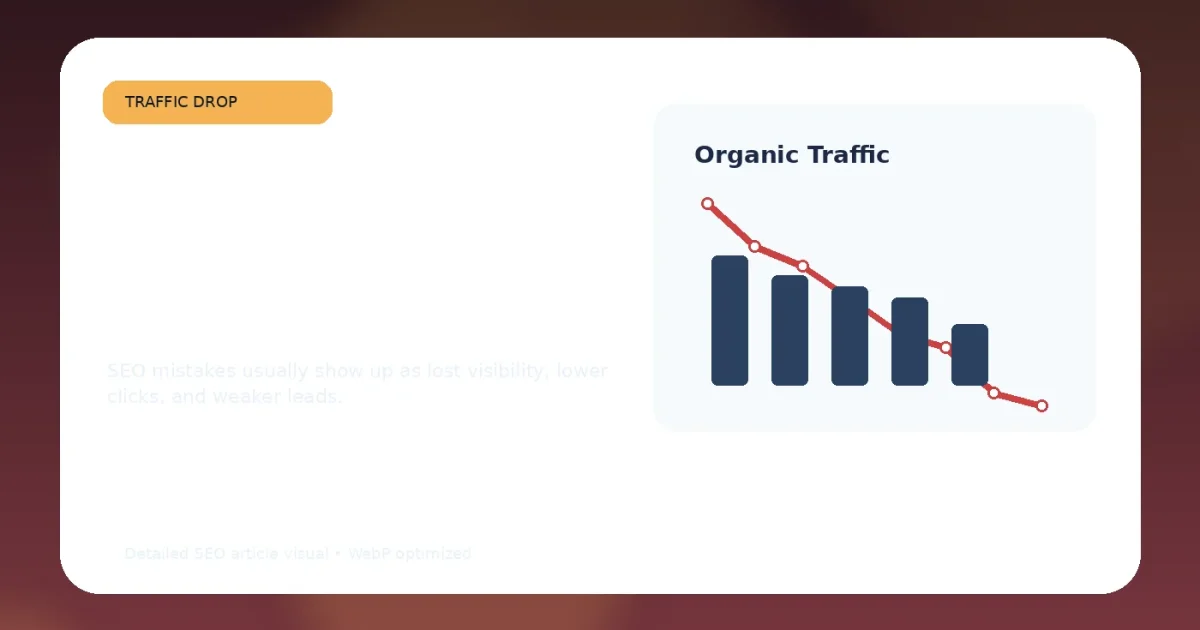
When organic traffic drops or refuses to grow, the cause is often not one dramatic failure. It is usually a group of SEO mistakes killing your website traffic working together. A website may publish content regularly but target the wrong intent. It may have attractive pages but slow load times. It may build backlinks but ignore internal links. It may install SEO plugins but still leave indexing problems unresolved.
The danger is that many SEO mistakes are quiet. They do not always break the website visibly. Users may still browse the site, and pages may still appear online, but search engines may struggle to evaluate the content or may decide competitors provide a better result.
This guide explains the most common SEO mistakes, why they hurt traffic, how to identify them, and how to fix them. It is written for business owners, marketers, bloggers, founders, and website managers who want a practical recovery plan.
Table of Contents
Keyword and Search Intent Analysis
The main keyword is SEO mistakes killing your website traffic. The search intent is diagnostic and problem-solving. Readers suspect something is wrong and want to identify the traffic blockers quickly. They need clarity, examples, and a repair plan.
Semantic keywords include organic traffic drop, Google rankings, indexing issues, keyword stuffing, thin content, duplicate content, technical SEO errors, broken links, toxic backlinks, internal linking, search intent mismatch, Core Web Vitals, mobile usability, cannibalization, and SEO audit.
Useful long-tail keywords include why is my organic traffic dropping, common SEO mistakes to avoid, SEO errors that hurt rankings, how to recover lost SEO traffic, and website not getting organic traffic.
The competitor gap is that many articles list mistakes but do not explain diagnosis. This article connects each mistake to symptoms, causes, and fixes.

Why SEO Mistakes Kill Traffic
Organic traffic depends on several connected systems. Search engines must discover the page, index it, understand it, trust it, and believe it satisfies the query better than alternatives. A mistake in any part of that chain can reduce performance.
Some mistakes reduce eligibility, such as noindex tags or crawl blocks. Some reduce relevance, such as poor titles or search intent mismatch. Some reduce quality, such as thin content or duplicate pages. Others reduce authority, such as weak backlinks or poor internal linking. Traffic falls when enough of these signals become weaker than competitors.
Content Mistakes
1. Writing for keywords instead of people
Keyword use is important, but content written only for keywords feels unnatural. Modern SEO rewards pages that answer the query clearly and help the reader. Use keywords naturally and focus on usefulness.
2. Publishing thin content
Thin content does not provide enough value. It may define a topic briefly but fail to answer related questions, provide examples, or guide the reader to the next step.
3. Ignoring search intent
If users want a comparison and your page gives a sales pitch, it may fail. If users want a local service page and your content is a broad guide, it may not match. Intent mismatch is one of the biggest hidden traffic killers.
4. Creating duplicate or overlapping pages
Multiple pages targeting the same query can compete with each other. This is called keyword cannibalization. Consolidating overlapping content can often improve clarity and rankings.
5. Not updating old content
Old content can become outdated. Competitors improve, statistics change, products evolve, and user expectations shift. Refreshing important pages helps maintain relevance.

Technical SEO Mistakes
1. Blocking important pages from indexing
Accidental noindex tags, robots.txt blocks, or incorrect canonicals can remove important pages from search eligibility.
2. Slow page speed
Slow pages create poor user experience and can reduce performance. Compress images, improve hosting, reduce unnecessary scripts, and use caching.
3. Broken links and redirect chains
Broken links create dead ends. Redirect chains slow users and crawlers. Both should be fixed regularly.
4. Poor mobile experience
Mobile usability is essential. If content, links, or structured data are missing on mobile, rankings can suffer.
5. Ignoring structured data
Structured data helps search engines understand page context. Missing schema is not always a fatal issue, but accurate schema can improve clarity and rich result eligibility.
On-Page SEO Mistakes
On-page SEO mistakes weaken relevance and click-through performance. Common problems include vague title tags, missing meta descriptions, poor heading hierarchy, missing alt text, weak URLs, and no internal links.
A strong on-page structure helps readers scan the article and helps search engines understand the topic. Titles should be specific. H2s should describe real sections. Images should have useful alt text. URLs should be short and readable. Internal links should guide users to related pages.
Link and Authority Mistakes
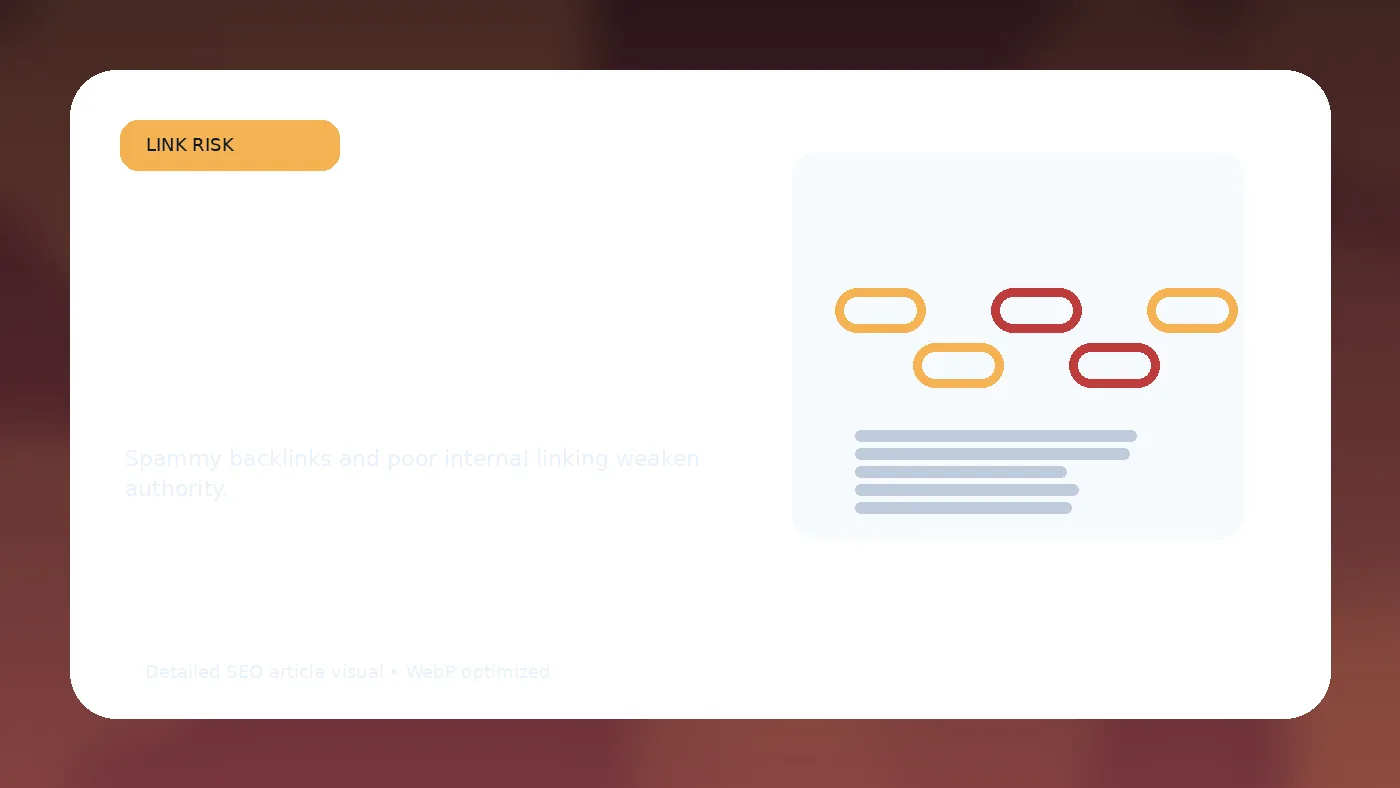
Authority mistakes can limit growth even when content is good. Backlinks still matter, but quality matters more than quantity.
Low-quality backlinks
Spammy backlinks from irrelevant sites rarely create durable value. In some cases, they can create risk. Focus on relevance, credibility, and genuine mentions.
No internal linking strategy
Many websites publish good pages but fail to link to them. Internal links help distribute authority and clarify topic relationships.
No link-worthy assets
If your website only publishes generic content, other sites have little reason to reference it. Create tools, research, templates, statistics, case studies, or detailed resources.
User Experience Mistakes
SEO and user experience are connected. If users cannot read, navigate, trust, or act on a page, the traffic has limited value.
- Intrusive pop-ups
- Slow mobile layouts
- Confusing navigation
- Unreadable text blocks
- No clear call to action
- Weak trust signals
- Too many ads or distractions
Improving user experience can increase engagement, conversions, and the overall usefulness of the page.
Measurement Mistakes
Many businesses track rankings but ignore conversions. Rankings matter, but they do not tell the whole story. A page that ranks and attracts irrelevant visitors may not help the business. Track impressions, clicks, organic sessions, leads, calls, revenue, and assisted conversions.
Another mistake is making decisions too quickly. Rankings fluctuate. Review trends over time and compare changes against site updates, algorithm updates, seasonality, and competitor movements.
SEO Traffic Recovery Plan
| Step | Action | Purpose |
|---|---|---|
| 1 | Check indexing and crawlability | Confirm pages can appear in search |
| 2 | Review traffic trends by page | Find which pages lost visibility |
| 3 | Compare search intent | Identify content mismatch |
| 4 | Improve weak pages | Strengthen quality and relevance |
| 5 | Fix technical errors | Remove access and performance blockers |
| 6 | Improve internal links | Support important pages |
| 7 | Build authority safely | Increase trust and prominence |
| 8 | Track conversions | Measure real business impact |

How to Prioritize SEO Fixes
Not all mistakes deserve equal attention. Prioritize issues that affect important pages, block indexing, reduce conversions, or impact large templates. A missing alt tag on one small image is not as urgent as a noindex tag on a service page.
Use three questions: Does this issue affect revenue pages? Does it prevent crawling or indexing? Does it affect many URLs? If the answer is yes, fix it sooner.
Advanced SEO Mistakes
Ignoring content decay
Pages that once performed well can decline. Monitor old winners and refresh them before traffic disappears completely.
Overusing AI content without editing
Unedited mass content often lacks originality, accuracy, and real expertise. Use human review, examples, and fact checking.
Mismanaging site migrations
Redesigns and migrations can destroy traffic if redirects, canonicals, internal links, and sitemaps are not handled carefully.
Failing to build topical authority
Random blog posts do not create authority. Build connected content clusters that answer related questions.
Ignoring SERP changes
Search results change. If videos, local packs, product grids, or AI summaries appear, your content strategy may need adjustment.
Featured Snippet Answer
The top SEO mistakes killing website traffic include keyword stuffing, thin content, search intent mismatch, indexing problems, slow pages, broken links, poor mobile usability, weak internal linking, low-quality backlinks, duplicate content, and poor measurement.
Key Takeaways
- SEO mistakes often work together to reduce traffic.
- Indexing and technical access should be checked first.
- Search intent mismatch is a major hidden ranking problem.
- Thin content and duplicate pages weaken relevance.
- Safe authority building and internal linking support recovery.
FAQs About SEO Mistakes
What is the biggest SEO mistake?
The biggest mistake is ignoring search intent. If a page does not match what users want, other SEO improvements may not be enough.
Can SEO mistakes cause traffic loss?
Yes. Technical errors, content problems, and authority issues can all cause traffic declines.
How do I find SEO mistakes on my site?
Use Google Search Console, analytics data, a site crawler, and SERP comparison to identify indexing, content, technical, and authority issues.
Should I delete low-performing content?
Not immediately. Some pages should be improved, merged, redirected, or left alone depending on their purpose and data.
How long does SEO recovery take?
Recovery depends on the issue. Technical fixes may show impact sooner, while authority and content improvements often take longer.
Internal Linking Suggestions
- SEO audit checklist
- Technical SEO guide
- Content optimization guide
- Internal linking strategy
- Backlink audit service page
External Authority References
How to Build a Prevention System
The best way to avoid SEO mistakes is to build repeatable review systems. Every new page should go through a basic SEO quality check before publishing. This includes title, meta description, headings, internal links, image alt text, schema, search intent, mobile usability, and conversion path.
Large websites should also use scheduled audits. A monthly crawl can identify broken links, redirects, duplicate titles, missing metadata, and noindex problems before they become serious. Content teams should review declining pages quarterly and update important assets regularly.
Prevention is usually cheaper than recovery. Fixing a technical issue after traffic drops can take weeks or months to recover. Catching the same issue before launch protects rankings and revenue.
How to Communicate SEO Mistakes to Stakeholders
When explaining SEO mistakes, avoid blame. Focus on the system. A traffic drop may involve content, development, design, analytics, and strategy decisions. Present the issue, evidence, impact, recommendation, and priority level.
For example, instead of saying “the content is bad,” explain that the page does not match the current search intent because the top results now provide comparison tables, examples, and detailed FAQs. This makes the recommendation practical and easier to approve.
How to Diagnose Traffic Loss by Page Type
Different page types fail for different reasons. A blog post may lose traffic because the topic became outdated or competitors published stronger guides. A service page may fail because it lacks proof, local relevance, or clear conversion elements. A category page may underperform because product filters create duplicate URLs or the content does not help shoppers choose. A homepage may lose branded traffic because of reputation, technical, or tracking issues.
Start by grouping traffic changes by page type. Do not only look at the whole website. A sitewide decline may hide the fact that only blog traffic dropped, while service pages stayed stable. Or it may show that one template affects hundreds of URLs. Page-type analysis helps you find the real pattern faster.
After grouping, compare each page type against its search intent. Are blog posts still answering the questions users ask? Are service pages still competitive against local or national competitors? Are product pages detailed enough? Are important pages internally linked? Diagnosis becomes clearer when pages are not treated as one large group.
Content Decay: The Silent Traffic Killer
Content decay happens when a page that once performed well gradually loses visibility. This can happen because information becomes outdated, competitors improve their content, search intent changes, or Google begins showing different result types. Content decay is common on blogs, guides, statistics pages, software comparisons, and how-to articles.
To find content decay, compare organic traffic over six, twelve, and twenty-four months. Look for pages with steady declines rather than one-time drops. Then review the current SERP. If ranking pages are fresher, deeper, or more useful, your page likely needs an update.
A strong update includes more than changing the year. Add missing sections, update examples, improve structure, remove outdated claims, add expert commentary, strengthen internal links, and improve the title if click-through rate is weak. Content decay is easier to fix when caught early.
Keyword Cannibalization Mistakes
Keyword cannibalization occurs when multiple pages compete for the same or very similar search intent. This can confuse search engines and split authority. It often happens when websites publish many blog posts around similar topics without a clear content strategy.
Signs of cannibalization include ranking URLs switching frequently, several pages receiving impressions for the same query, and none of them ranking strongly. The fix depends on the situation. You may consolidate pages, differentiate intent, update internal links, redirect weaker URLs, or create a clearer hub page.
Not every shared keyword is cannibalization. Two pages can mention the same topic but serve different intent. The issue occurs when pages are trying to satisfy the same searcher need without a clear reason to exist separately.
Conversion Mistakes That Make SEO Look Worse Than It Is
Sometimes SEO is bringing the right people, but the website fails to convert them. This can make SEO appear unsuccessful even when traffic quality is strong. Conversion problems include unclear calls to action, weak forms, missing trust signals, poor mobile layout, confusing pricing, and slow page speed.
Review top organic landing pages. Do they explain the next step? Do they provide enough proof? Is the form easy to complete? Are phone numbers visible on mobile? Does the page address common objections? If not, the traffic problem may actually be a conversion problem.
SEO and conversion optimization should work together. More traffic is valuable only when the page can turn attention into action. This is especially important for service businesses, SaaS companies, local businesses, and eCommerce stores.
Reporting Mistakes That Hide the Real Problem
Bad reporting leads to bad decisions. Looking only at total organic traffic can hide important details. A traffic drop may come from one old blog post, while revenue pages remain healthy. A ranking decline may not matter if conversions are stable. A traffic increase may not matter if the new visitors are irrelevant.
Better reporting separates branded and non-branded traffic, blog traffic and commercial traffic, desktop and mobile performance, new and returning users, and traffic by page type. It also connects SEO to leads, sales, calls, bookings, or other meaningful business outcomes.
Use dashboards carefully. Dashboards should support decisions, not overwhelm people with numbers. A useful SEO report explains what changed, why it matters, what action is recommended, and what result is expected.
How to Prevent Future SEO Mistakes
Prevention requires process. Create a publishing checklist for every new page. Include search intent, keyword targeting, title tag, meta description, H1, H2s, internal links, image alt text, schema, page speed, mobile review, and conversion path. This prevents avoidable mistakes from entering the site.
Create a monthly technical audit. Check broken links, redirects, noindex changes, sitemap issues, duplicate titles, slow pages, and crawl errors. For larger websites, automate monitoring and alert the team when critical issues appear.
Create a content review calendar. Important pages should be reviewed regularly. High-value service pages, product pages, and top-performing articles should not be ignored for years. Search results change, and content should evolve with them.
SEO Mistakes During Website Redesigns
Website redesigns are a common cause of traffic loss. Teams focus on appearance and forget redirects, metadata, internal links, page speed, mobile content, schema, and analytics tracking. A beautiful redesign can still damage organic performance if SEO is not included in planning.
Before a redesign, crawl the current site, export top organic landing pages, map URLs, protect important content, and document metadata. During development, test templates for crawlability, speed, mobile usability, and structured data. After launch, monitor Search Console and analytics closely.
The safest redesigns involve SEO before launch, not after traffic has already dropped. Recovery is usually more expensive than prevention.
SEO Mistake Priority Matrix
When many SEO problems exist, prioritization is essential. Start with mistakes that affect visibility and revenue at the same time. A noindex tag on a high-value service page is urgent. A missing meta description on a low-traffic archive page is not. Prioritization prevents teams from spending weeks fixing minor warnings while serious traffic blockers remain untouched.
Use a simple priority matrix: impact, confidence, and effort. High-impact mistakes affect important pages or many URLs. High-confidence mistakes have clear evidence from Search Console, analytics, crawl data, or SERP comparison. Low-effort fixes are easier to implement quickly. The best first tasks are high impact, high confidence, and reasonable effort.
For example, improving a page that already ranks on page two for a commercial keyword may be more valuable than publishing five new generic blog posts. Fixing broken internal links to top service pages may be more valuable than rewriting an old low-value article. Good SEO recovery is about sequencing, not just effort.
Examples of SEO Mistakes in Real Business Situations
A local business may lose traffic because its location page has outdated hours, weak service descriptions, and very few internal links. A software company may struggle because its comparison pages are too promotional and do not answer evaluation questions. An eCommerce store may lose category rankings because filters create duplicate URLs and product pages have copied manufacturer descriptions.
A publisher may see traffic decline because older guides were not updated while competitors added fresher examples, better visuals, and stronger FAQs. A professional service firm may attract traffic but few leads because the content educates readers but never explains the service, proof, process, or next step.
These examples show why SEO mistakes should be diagnosed in context. The same symptom, such as declining traffic, can have different causes depending on the website type, business model, and competitive environment.
Conclusion
SEO traffic rarely dies because of one mistake. It usually declines because content, technical health, authority, and user experience are not working together. The fix is a structured audit, clear priorities, and consistent improvements.
Start with indexing, crawlability, and important pages. Then improve content quality, search intent alignment, internal links, page experience, and authority. When you repair the system instead of chasing shortcuts, organic traffic has a stronger chance to recover and grow.