
Junk removal customers share a deadline. The house closes Friday, the tenant moved out Sunday, the renovation starts Monday, the garage has to fit a car before winter. The search is “junk removal near me” or “furniture removal Brampton,” and it is made by someone who wants it gone — ideally today, at a price they understand before the truck arrives. The companies that win those searches make three things obvious fast: what they take, what it costs, and how soon they can be there.
This guide covers SEO for junk removal companies in 2026: how to build item-based pages that match how customers actually search, how upfront pricing content wins trust in a vague-pricing trade, and how to turn your Google Business Profile into a same-week booking engine.
1. Start with the map: junk removal is a speed-and-trust search
Most junk removal jobs are booked from a phone, from a shortlist formed on Google Maps. Your Google Business Profile decides whether you make that shortlist:
- Categories: “Junk removal service” as primary, with waste management or debris removal categories added only where they accurately describe what you do.
- Service area drawn for economics: list the areas you can serve profitably at your minimums. Junk removal margins live and die on drive time and dump runs — claiming distant towns produces quotes you’ll resent and jobs you’ll rush.
- Photos of real work: your truck, your crew loading furniture, full loads, clean swept spaces after. Before-and-after shots of garages, basements and yards are the strongest proof in this trade.
- Services listed individually: furniture removal, hot tub removal, estate cleanouts, construction debris, appliance removal — each named, so you match the item search, not just the generic one.
- Hours and response honesty: if you genuinely offer same-day or next-day service, say so and staff it. If weekends book out, your site should reflect it. Deadline customers forgive a full schedule; they don’t forgive a surprise.
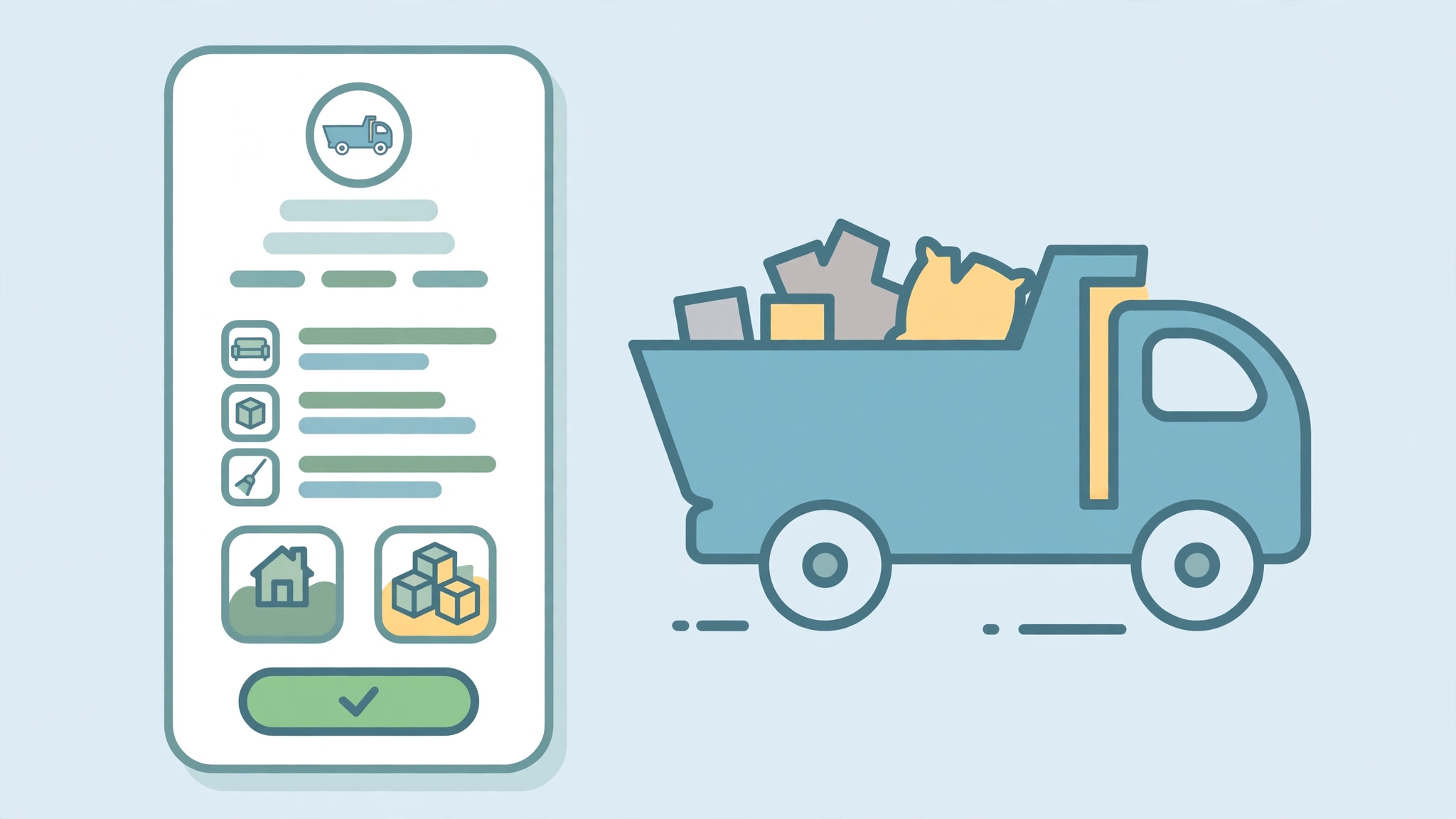
2. Item pages: customers search for the thing, not the service
Nobody wakes up wanting “junk removal.” They want the piano gone, the hot tub gone, their late father’s garage respectfully cleared. Build pages around the items and situations:
- Furniture and mattress removal: the everyday volume work — couches, beds, dining sets — with how booking, pricing by volume and same-day availability work.
- Hot tub and appliance removal: heavier, higher-value jobs where customers compare carefully and need process reassurance (disconnect, access, disposal).
- Estate and full-property cleanouts: sensitive work sold to families and executors. Tone matters as much as ranking here — unhurried, respectful, clear about timelines and donation options.
- Construction and renovation debris: aimed at contractors and DIY renovators, with repeat-business language and jobsite etiquette.
- Eviction, hoarding and foreclosure cleanouts: landlord and property-manager intent, where discretion and documentation are the product.
Each page should state what’s included, how pricing is calculated, how fast you can typically come, and where items end up. This item-first structure mirrors the discipline in our local SEO guide for small businesses — one page per real search, written in the customer’s words, not the industry’s.
3. Pricing transparency: the advantage hiding in plain sight
Junk removal pricing is famously opaque — “call for a quote” everywhere — and customers hate it because they’ve heard the stories of prices doubling once the truck is loaded. You don’t need to publish a fixed menu; load-based pricing genuinely varies. But you can explain the model plainly: priced by volume in the truck, minimums for small loads, what affects cost (stairs, weight, access, disassembly), and that the quoted price is confirmed before loading starts. Companies that explain this on the page convert the searchers every competitor frustrates. In a trade where the fear is being held hostage by a loaded truck, a clear pricing page is your sharpest sales tool.
The photo-quote deserves its own push here. Customers with a garage, a basement or a pile they can’t describe accurately would rather send pictures than play twenty questions on the phone — and companies that invite photos on the quote form (“send us a photo, get a firm range back”) close more of them, faster, with fewer site-visit surprises. It’s also a quiet ranking asset: a page explaining photo quotes answers exactly the questions AI tools and searchers ask about how modern junk removal pricing works.
What this looks like in Brampton
Brampton generates junk at the pace of a young, fast-growing city. Families upsizing through Castlemore, Credit Valley and Mount Pleasant shed furniture with every move; the city’s huge stock of multi-generational homes in Springdale, Bramalea and Heart Lake produces garage and basement cleanouts as households merge and separate; basement-apartment turnovers across the city keep landlords booking between tenants; and the renovation wave in maturing neighbourhoods fills trucks with debris every month of the year. Pre-listing cleanouts spike whenever a home is about to hit the market — real-estate timelines are junk removal’s best friend.
The local edge is responsiveness plus respect. Brampton customers ask neighbours and family group chats first, and a company known for showing up when promised, quoting fairly and sweeping the space clean gets recommended by name. Reviews that name the neighbourhood and the job — “full garage in Fletcher’s Meadow, gone in an afternoon, price matched the quote” — sell the next street over. Companies that photograph real Brampton work and publish honest service areas build that reputation in search, not just in conversation.

4. Donation, recycling and disposal: the content customers ask about
A large share of searchers care where their stuff goes — the good furniture they can’t keep, the electronics, the renovation waste. Companies that explain their sorting honestly — what’s donated, what’s recycled, what genuinely goes to landfill, and which local facilities they use — answer a question competitors dodge. Write it plainly on your site without greenwashing: overstated claims unravel fast and help nobody. This section also earns links and mentions from community groups, charities and municipal pages — quiet authority that generic junk pages never attract.
The same honesty applies to the jobs themselves on the day. Crews that protect floors and doors, confirm the price before loading, and sweep the space before leaving generate the specific, story-shaped reviews — “they took the piano, the sectional and twenty years of garage, and left it cleaner than they found it” — that dominate this category’s search results. Process details like these belong on your website, not just in your training: they are what a careful customer is actually buying, and they read as proof.
5. AI search: the assistant asks about price and timing
Customers increasingly ask AI tools “how much does junk removal cost” and “who can remove a hot tub this week” before opening Google. The answers are built from consistent specifics: your services, your pricing model explained in sentences, your service area and hours — identical on your site, profile and directories. If your pricing model is never written down, the assistant cannot describe it, and it describes the competitor who wrote theirs. Complete, consistent pages are what get quoted; the discipline is boring and the results are not.
6. Your website: built for the deadline customer
Your visitor has a date circled on a calendar. Design for it:
- Booking and quote path in one tap: call button visible on mobile, and a short form — what, where, when — that can include photos of the load. Photos get you accurate quotes and faster closes.
- Same-day and scheduling honesty: how booking works, typical lead times, what “same-day” realistically requires (call by when, which areas).
- Real load photos: full trucks, big items, swept-clean results — captioned by job type and area. Stock photos of smiling models convince nobody in this trade.
- Speed: deadline customers are impatient customers. A fast mobile site is a booking advantage, not a technical nicety.
7. The monthly rhythm that keeps the truck full
Each month: post fresh job photos to your profile and item pages, send review requests after completed jobs (the relief moment — the garage fits the car again — is when customers are happiest to write them), publish one profile update tied to the season — spring cleaning pushes, pre-winter garage campaigns, moving-season availability — and check Search Console for which items and situations are gaining searches. Quarterly, re-verify your service area, minimums and contact details across directories. Junk demand follows the housing and seasons calendar; a monthly habit keeps you visible at every peak.
8. What to measure so you know it’s working
Measure booked loads: calls and quote requests per item page, your visibility for “junk removal near me” and the big item searches in your area, and the ratio of quote requests to completed jobs. Track which items produce your margin — if estate cleanouts and hot tubs quietly out-earn small pickups, their pages deserve the next photos and detail. Note how customers found you for a month; deadline work reveals referral patterns fast, and streets that produce one job usually produce three.
9. Mistakes that quietly cost junk removal companies good jobs
The recurring ones: one generic page for every item and situation, so specific searches land nowhere. No pricing explanation at all, which sends careful customers to the company that explains volume pricing calmly. A service area drawn for ambition that wrecks your margins on travel. Stock photos instead of loaded trucks. Slow replies — deadline customers book the first credible quote, not the best company. And silence on where items go, dodging the question every second customer asks. None of these take a big budget to fix; they take an honest page and a monthly habit.
Frequently Asked Questions (FAQ)
How do junk removal companies rank for “junk removal near me”?
With a complete Google Business Profile — right categories, honest service area, individually listed services and real job photos — backed by item-based website pages (furniture, hot tubs, cleanouts, debris) and a clearly explained pricing model.
Should junk removal companies publish prices?
Publish the model, even if loads vary: priced by volume, your minimums, what affects cost, and that the price is confirmed before loading. Pricing clarity is the biggest trust advantage in this trade.
Do item pages (hot tubs, estates, debris) really matter?
Yes. Customers search for their item or situation, not the generic service. A page written for that exact job — its process, pricing factors and timing — ranks for it and converts far better than one general page.
How fast do customers expect junk removal?
Most are working to a deadline — a closing, a move, a renovation start — and many want same-day or next-day service. State your realistic lead times honestly and you’ll win the customers whose dates you can actually meet.
How important are reviews for junk removal?
Very. Customers are letting a crew into their home and handing over a truckload of their belongings. Reviews mentioning the job, the area and a fair, as-quoted price are the evidence that closes the booking.
Get a free SEO audit of your website
A 120 point crawl, a competitor gap map and a 90 day roadmap, ready in 48 hours. Free, with no obligation.

SEOelinks is a Brampton-based SEO agency helping service businesses across Canada and worldwide win organic search. Our strategists publish the same field-tested playbooks on technical SEO, local visibility and AI search that we run for clients every day.
More about SEOelinks →