
Nobody buys new floors on a whim. They live with a scratched laminate, a stained carpet or a kitchen tile that has seen better days — and then they search “hardwood flooring near me,” compare a few installers on their phone, and book the one whose work looks careful, whose prices are clear and whose reviews mention homes like theirs. The decision is visual, local and expensive: a homeowner choosing the company they will trust inside their house for days.
This guide covers SEO for flooring companies in 2026: how hardwood, vinyl, tile and laminate intent works, how room-type pages win the searches that matter, how showroom and sample pages turn browsers into booked consultations, and how review signals separate a careful installer from a cheap one — so the next homeowner in your town calls you first.
1. Start with the map: the shortlist is made on your profile
The shortlist for a flooring company forms on Google, mostly on a homeowner’s phone in the evening, in the minutes between noticing the worn floor and choosing an installer. Your Google Business Profile is where you make or miss that shortlist:
- Categories: “Flooring contractor” as primary, with “Flooring store” or “Tile contractor” added only where you genuinely offer them.
- Floor types named the way homeowners search: hardwood, vinyl plank, laminate, tile and carpet listed as distinct services, so you appear for each material search, not only “flooring near me.”
- Photos from real jobs: the finished floor in daylight, the installer at work, close-ups of plank joints and tile grout lines. Nobody hires a flooring company on a logo; they hire on what the finished floor looks like.
- Service area kept honest: the towns and neighbourhoods you genuinely serve, stated plainly, so the right homeowners find you and the wrong ones do not waste your time.
- Quotes in one tap: the phone number current and a clear path to a free estimate, so a homeowner can reach you without a second search.
2. Floor-type pages: hardwood, vinyl, tile and laminate each earn their own search
A homeowner choosing a floor material is not browsing — they are weighing cost, durability and how it will look in their home for the next twenty years. Hardwood, vinyl, tile and laminate are four different searches, four different budgets and four different kinds of customer, and each deserves its own page:
- Hardwood pages: written to the homeowner who wants the real thing — solid versus engineered, species and finishes, refinishing options, and what it costs per square foot installed.
- Vinyl pages: written to the homeowner who wants waterproof and worry-free — luxury vinyl plank for kitchens and basements, wear layers explained plainly, and how it handles pets and kids.
- Tile pages: written to the homeowner redoing a bathroom or kitchen — porcelain versus ceramic, large-format looks, grout choices, and heated-floor options.
- Laminate pages: written to the homeowner who wants the look for less — realistic wood looks, scratch resistance, and where laminate works and where it does not.
Each page carries photos of real installations, the rooms each material suits best, and the estimate next step. It’s the same page-per-search discipline behind our guide to SEO for interior designers — homeowners comparing finishes reward the company that answers their exact question, for their exact room, first.
Don’t blur the materials on one page. A homeowner weighing hardwood against vinyl wants a straight answer, not a paragraph that mentions both and explains neither. Separate pages let each visitor — and each search — land exactly where they belong.
3. Room-type and showroom pages: the visit starts before the visit
Flooring searches are room searches as often as they are material searches: “hardwood flooring for living room,” “waterproof flooring for basement,” “tile for bathroom,” “kitchen flooring ideas.” A page for each room — showing the materials that work there, the moisture and wear questions that matter, and photos of real rooms you have finished — ranks for those searches while a single “our services” page ranks for nothing.
Your showroom deserves the same treatment. A showroom page that shows the real space, the samples a visitor can hold, the brands on display and the hours you are open turns a searcher into a visitor — and a visitor holding a sample is halfway to a signed job. Add a samples page too: which samples you carry, how a homeowner can order or borrow them, and what to look for when comparing two planks side by side at home. A company that helps a homeowner choose well earns the installation.
What this looks like in Brampton
Brampton’s flooring demand follows its homes: new builds across Springdale, Castlemore, Fletcher’s Meadow, Mount Pleasant and Bramalea, where owners upgrade builder-grade floors within the first few years, plus older homes where the original carpet and laminate have simply worn out. Basements are the local conversation — vinyl plank and tile that handle moisture, stairs that need matching hardwood, and main floors opened up into one big living space.
Material is the neighbourhood question: hardwood for the main floor that has to impress, vinyl for the basement and the kids’ rooms, tile for the bathrooms and the front entrance that takes the winter salt. Brampton homeowners ask neighbours first, and reviews that name the neighbourhood or the room (“new oak floors throughout our Springdale main floor, flawless finish”) are the deciding evidence for the next house on the street.
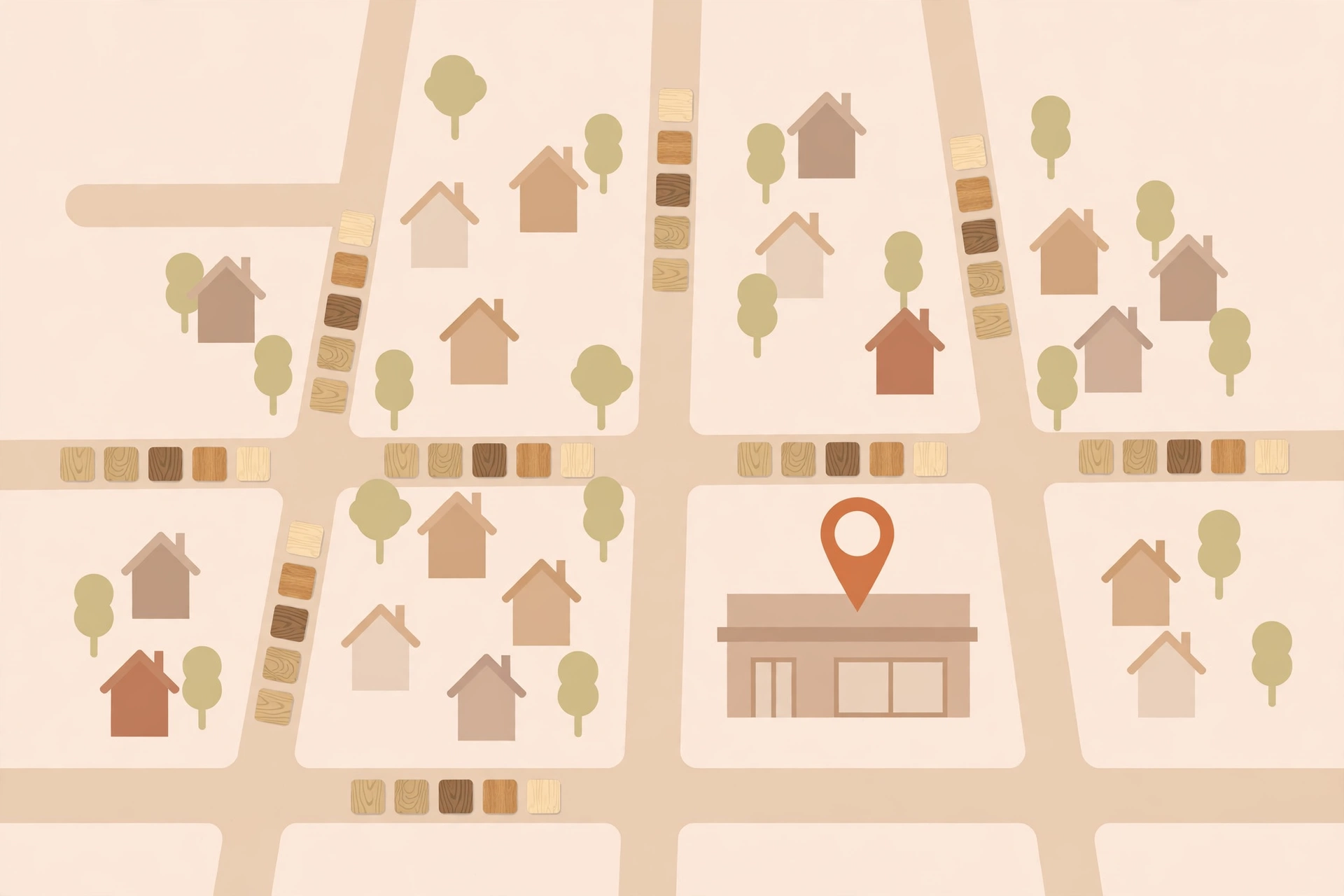
4. Location and service-area pages: the “near me” search is the one that pays
A flooring search is a search with a measuring tape in hand. “Flooring company near me,” “hardwood flooring installation near Brampton,” “vinyl plank flooring Brampton” — these are the queries that turn into an estimate within the week, and they are won by pages that state the service area and the materials plainly. A page for each area you genuinely serve — naming the neighbourhoods, the floor types you install there, and a photo of a real job nearby — ranks for those searches while a single “areas we serve” list ranks for nothing.
Keep each page honest and specific: the rooms you have finished there, the materials that suit the local housing stock, and how the estimate visit works. Link each service-area page from your main floor-type pages and your profile, so a visitor — and a search engine — can follow the map from your company to their street.
5. AI search: the assistant recommending your flooring company
Homeowners increasingly start with an AI tool: “best hardwood flooring installer near me,” “vinyl vs laminate for basement,” “how much does hardwood flooring cost per square foot,” “waterproof flooring for kitchen.” The answers are assembled from complete, consistent content — floor-type pages with honest guidance and what each material costs, your showroom and service area stated the same everywhere, and reviews that mention the room and the material. Companies with real pages get summarised accurately and recommended by area; companies with a one-page site leave the assistant nothing accurate to say, and it says something about a competitor instead.
6. Your website: built to book the estimate
A flooring company website has one job — move a visitor from a worn floor to a booked estimate:
- Estimate in one tap: a quote form and phone number visible on every page, working on a phone in under a minute, with the questions answered on the spot (what the visit covers, how long it takes, whether it is free).
- Pricing without fog: installed price ranges per square foot for each material, or at minimum how pricing works. Vague pricing is the leading cause of abandoned enquiries and haggling at the kitchen table.
- Photos on every service page: the finished floor beside the pitch, not buried on a separate gallery page nobody visits.
- Trust signals up front: warranty terms, dust-free sanding and installation practices, and the crew that will actually be in their home, stated plainly, because a homeowner is trusting you with their house.
7. Reviews: the trust signal that separates a careful installer from a cheap one
Flooring is judged in the details, and reviews are where homeowners learn whether a company gets them right. Ask happy customers to mention what actually matters to the next homeowner: the material they chose, the room that was done, how clean the crew left the house, and whether the floor still looks good months later.
Respond to reviews the way you run the job — promptly and plainly. A complaint about a gap in the planks or a scuffed baseboard is a chance to show the next reader that problems get fixed, not ignored. Reviews that name the material and the room (“luxury vinyl plank throughout our basement in Mount Pleasant, not a single seam showing”) do double duty: they reassure the next homeowner and they feed the exact phrases search engines associate with your company.
8. What to measure so you know it’s working
Measure estimates per floor type and per area: quote requests from each material page, your visibility for “flooring company near me” and “hardwood flooring Brampton,” and the split between hardwood, vinyl, tile and laminate jobs. Track which pages bring the customers who actually sign — a whole main floor in hardwood is worth more than a dozen small repair enquiries. Booked installations are the metric underneath all of it: SEO that fills the diary with homeowners ready to choose shows up next quarter as signed jobs, not a full inbox.
Season is the other quiet signal. Note which months the renovation rush actually starts and how spring and autumn move demand — then publish next season’s room and material content two weeks earlier, and let your pages and reviews speak to those neighbourhoods by name.
9. Mistakes that quietly cost flooring companies the estimate
The recurring ones: one generic “flooring” page for hardwood, vinyl, tile and laminate, so material searches land nowhere. No room-type pages, so the “flooring for basement” search goes to a competitor. No showroom or samples page, so browsers never become visitors. Prices hidden or vague, breeding abandoned enquiries. Photos only on a gallery page nobody opens. Reviews never answered, so the next homeowner assumes nobody is minding the jobs. And silence between seasons — no new photos, reviews or posts — so each spring starts from zero against companies that never stopped.
Frequently Asked Questions (FAQ)
How do flooring companies rank for “flooring near me”?
With a complete Google Business Profile — floor types listed separately, real photos of finished jobs and steady reviews — backed by a dedicated page for each material and each service area, each with a clear path to a free estimate.
Should hardwood, vinyl, tile and laminate have separate pages?
Yes. Homeowners choose a material before they choose a company, and each material has different questions, budgets and customers. Separate pages rank for each material search and convert far better than one combined flooring services page.
Do room-type pages really help a flooring company rank?
They help everywhere it counts: they rank for “hardwood flooring for living room” and “waterproof flooring for basement” searches, they raise click-through from your profile and pages, and they show homeowners you understand their exact room. A clear room page is one of the highest-value pages a flooring company can publish.
What should a flooring company put on its showroom page?
Photos of the real space, the samples and materials on display, the hours you are open, and how a visit works — including whether homeowners can borrow samples. Visitors who can hold a sample before they buy are far more likely to book the installation with you.
How do reviews help a flooring company win jobs?
Reviews that mention the material, the room and the neighbourhood prove the work holds up in homes like the reader’s — and those same phrases feed the searches that bring the next homeowner in. A review naming the floor and the room is worth more than a dozen that only say “great service.”
Get a free SEO audit of your website
A 120 point crawl, a competitor gap map and a 90 day roadmap, ready in 48 hours. Free, with no obligation.

SEOelinks is a Brampton-based SEO agency helping service businesses across Canada and worldwide win organic search. Our strategists publish the same field-tested playbooks on technical SEO, local visibility and AI search that we run for clients every day.
More about SEOelinks →