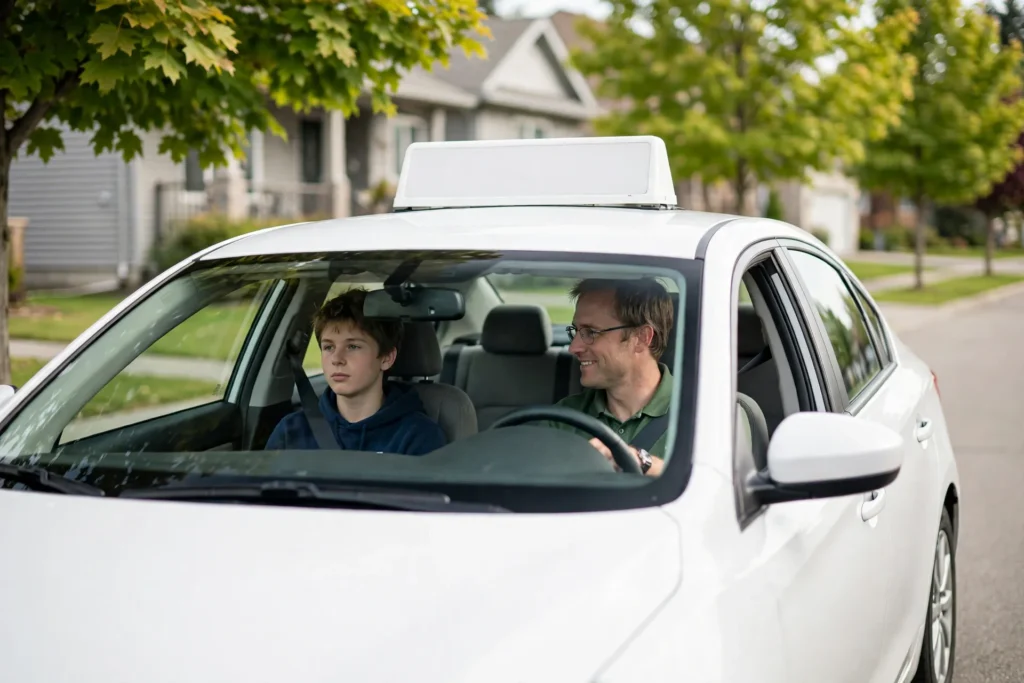
Choosing a driving school takes most students about four minutes. They search “driving school near me” or “driving lessons Brampton,” glance at the map results, compare star ratings and review counts, skim a price, and call. They can’t judge teaching quality before they enrol, lessons cost roughly the same everywhere, and they’ll happily travel a few kilometres for a school they trust — so the decision is made almost entirely on what Google shows them.
That’s good news, because what Google shows is largely within your control. This guide covers SEO for driving schools in 2026: dominating the map results, building the pages that match how students (and their parents) actually search, and turning every passed test into your next enrolment.
1. Reviews are your storefront, your brochure and your ranking
No local business category runs on social proof like driving schools. A school with 150 reviews at 4.6 stars will out-book a school with 12 reviews at 5.0 stars almost every time — volume signals “lots of people like me passed here,” which is exactly the decision a nervous sixteen-year-old (or their parent) is making. Reviews also feed your map ranking directly: quantity, recency and keywords in the text all count. We cover this in more detail in our guide to SEO for motorcycle training schools.
Build the habit into the happiest moment in your business: the passed test. SEOelinks is also listed on SelectedFirms for businesses comparing local agencies.
- Ask at the pass: photo with the certificate (shared with permission), then a review request with a direct link while the student is still glowing. Same day, not same week.
- Ask the parents too: for teen students, the parent chose and paid. A second review stream from parents — mentioning scheduling, communication and value — reaches the actual buyer.
- Respond to every review: name the milestone (“Congrats on passing first try, Aisha!”) — future students read responses, and so does the ranking algorithm.
- Never buy reviews or offer discounts for them. A burst of fake five-stars risks your profile, and students can smell them anyway.

2. Your Google Business Profile, set up like you mean it
- Category and services: “Driving School” as your category, then describe your offerings in the services list: beginner driver education, G2/G test preparation, refresher lessons, defensive driving, senior refresher assessments where offered.
- Service area: driving schools are mobile — instructors pick students up. Set your service area to the neighbourhoods you actually cover, and keep it honest; “near me” searches follow the searcher’s location.
- Photos: your cars (clean, branded), your instructors, your classroom if you have one. Real instructors’ faces build the trust that decides bookings — parents want to see who will be alone in a car with their teenager.
- Booking and contact: online booking or at minimum click-to-call and a fast-responding contact form. Students compare at night; the school that replies first in the morning often wins by default.
- Posts: announce course start dates, March break and summer intensives, and pass milestones. Seasonal demand is real — fill it before competitors do.
3. Pages that match how students search
One homepage can’t rank for everything a school sells. Build a page per real search:
- Beginner Driver Education (BDE) course page: in Ontario, the MTO-approved BDE course is the anchor product — graduates can take their G2 road test four months earlier and may qualify for insurance discounts. Explain the structure (in-class/digital, in-car hours), price and what’s included. This page targets “Brampton driving course” and “BDE course near me.”
- Road test preparation pages: “G2 test prep,” “G test prep,” test-day car rental packages, and pages for the specific test centre your students use — “road test in Brampton: what examiners check” is a heavily searched, low-competition topic.
- Refresher and newcomer lessons: new Canadians with foreign licences, nervous drivers returning after years away, seniors preparing for reassessment. Each is a distinct searcher with a distinct page.
- Pricing page: publish your lesson and package prices. Schools hide prices to force a call; students interpret silence as “expensive” and call the school that showed its numbers.
- Neighbourhood pages: a page per major area you serve, written with genuine local detail — pickup points, the test routes nearby, school-dismissal logistics — not the same text with the name swapped.
What this looks like in Brampton
Brampton might be the best driving-school market in the country: one of Canada’s youngest cities, with waves of teenagers reaching G1 age every year and a huge population of newcomers converting foreign licences. Both groups search the same way — phone first, reviews first — and both are underserved by schools with thin websites.
For a Brampton school, the highest-value pages are usually: an MTO-approved BDE course page that explains the four-months-earlier G2 benefit in plain language, G2 and G test prep pages oriented to the Brampton DriveTest centre and what its routes actually test, and newcomer lesson pages that explain the Ontario licence-exchange and experience-credit process honestly. Add instructor profiles — parents in neighbourhoods like Springdale, Bramalea and Castlemore are choosing a person, not a company — and keep reviews flowing from both students and parents after every pass. Brampton’s demand renews itself every school year; the school that owns these searches owns a self-refilling enrolment pipeline.

4. Content that answers pre-licence questions
Before students search for a school, they search for the process: “how to get your G1 in Ontario,” “how long between G1 and G2,” “what happens if you fail the G2 test,” “how many lessons before the road test.” A school that publishes clear, accurate guides to the Ontario graduated licensing system captures these searchers months before booking — and when they’re ready, they remember the helpful school. Keep the facts current (rules change), write in plain language for a sixteen-year-old reader, and end each guide with the natural next step: your course page.
5. The technical checklist
- Mobile-first site: your buyers are teenagers and busy parents on phones. Booking must work one-handed.
- Speed: keep pages light; a slow course page during the September rush leaks enrolments daily.
- Consistent listings: identical name, address and phone across Google, Apple Maps, Yelp and local directories.
- Course schema: use Course and LocalBusiness structured data so search engines can display your offerings cleanly, and so AI assistants can cite your prices and course details accurately.
Driving schools don’t have a demand problem — they have a visibility problem measured in review counts and page coverage. Fix those two things and the phone rings on schedule. It’s the kind of practical, local-first work we do at SEOelinks, built in Brampton, Canada, serving clients worldwide.
6. Work the school-year calendar
Driving school demand isn’t flat — it pulses with the school year, and search interest follows. Late summer and September bring the back-to-school rush of new G1 holders. Winter breaks and March break drive demand for intensive and condensed courses. Late spring fills with students who want a licence before summer jobs start, and every month has a steady flow of newcomers and refresher students underneath. Plan your visibility around that calendar instead of reacting to it:
- Publish seasonal pages early: your March break intensive page should be live and ranking by January; summer course pages by April. Rankings lag by weeks to months, so the calendar work is always a season ahead.
- Announce intakes on your profile: a Google post when a new BDE cohort opens, with dates and a booking link, catches the parents who search at exactly that moment.
- Fill cancellations publicly: schools with active profiles and social channels can post last-minute lesson openings; a dormant profile can’t. Visibility is also an operations tool.
- Review season matters too: the end-of-summer pass wave produces your largest review harvest of the year. Make sure your ask-at-the-pass routine is airtight before it arrives.
7. Short video: where the next students are looking
Your future students spend their time on TikTok, Reels and YouTube Shorts, and they increasingly search there too — “G2 test tips,” “parallel parking trick,” “what examiners fail you for.” A school doesn’t need a media department to use this: instructors already explain these things fifty times a week. Short, genuine clips — a tricky local intersection explained, the three mistakes that fail road tests, a 30-second reverse-parking method, a student’s pass-day reaction (with permission) — build recognition in exactly the age group that books lessons, and they surface in social search and Google video results alike. Keep faces real and advice accurate. Parents watching over shoulders are part of the audience too, and an instructor who teaches clearly on camera is the best brochure a school can publish.
8. Measuring what matters
Keep the dashboard small and honest: map-pack visibility for “driving school near me” and your course keywords in the neighbourhoods you serve; review count and the pace of new reviews each month; calls and bookings that come through the profile versus the website; and which pages produce booking-form submissions. Review sources matter as much as volume — schools that ask every family “how did you find us” at intake quickly learn whether Google, referrals or social is doing the work, and can stop paying for channels that aren’t. Revisit the numbers each intake season rather than weekly; local rankings wobble day to day, and the schools that win are the ones still executing the boring fundamentals six seasons in.
9. Common mistakes that cost schools students
The same few errors recur. A profile still showing a previous owner’s name or an old phone number. A website with no prices, no booking, and a contact form nobody answers on weekends — when students actually search. Course pages that describe the curriculum in ministry language instead of explaining, in plain words, what a student gets and how much sooner they can be licensed. And the quietest killer: asking for reviews for one enthusiastic month, then stopping, so the profile’s most recent review is fourteen months old on the exact day a parent compares you with the school that never stopped. None of these need a budget to fix. They need an owner who checks the profile as often as the fuel gauge.
Frequently Asked Questions (FAQ)
How long does SEO take to fill a driving school’s schedule?
Review growth and profile cleanup usually move map rankings within 4–8 weeks. Course and test-prep pages take 2–4 months to rank, but once they do, they deliver enrolments every intake season without ad spend.
Why do review counts matter more than ratings for driving schools?
Because students can’t judge teaching quality in advance, they rely on how many people succeeded before them. A school with 150 reviews at 4.6 stars reads as proven; a school with 10 reviews at 5.0 reads as unknown — and volume is also a direct map-ranking signal.
Should driving schools publish their prices?
Yes. Students and parents compare quickly and treat hidden prices as a warning sign. Published BDE course and lesson-package pricing captures price searches and pre-qualifies enquiries, so your instructors spend time teaching, not quoting.
What should a Brampton driving school’s website include?
An MTO-approved BDE course page explaining the earlier G2 eligibility, G2/G test-prep pages oriented to the Brampton DriveTest centre, newcomer licence-conversion lesson pages, instructor profiles, published prices, and online booking — all mobile-first.
How can a Brampton school win students from bigger competitors?
By owning the specific searches chains generalize: test-centre-specific prep content, neighbourhood pickup pages, parent-focused reviews, and newcomer licensing guidance. Brampton’s teen and newcomer demand renews yearly, and specific pages beat generic ones.
Get a free SEO audit of your website
A 120 point crawl, a competitor gap map and a 90 day roadmap, ready in 48 hours. Free, with no obligation.

SEOelinks is a Brampton-based SEO agency helping service businesses across Canada and worldwide win organic search. Our strategists publish the same field-tested playbooks on technical SEO, local visibility and AI search that we run for clients every day.
More about SEOelinks →