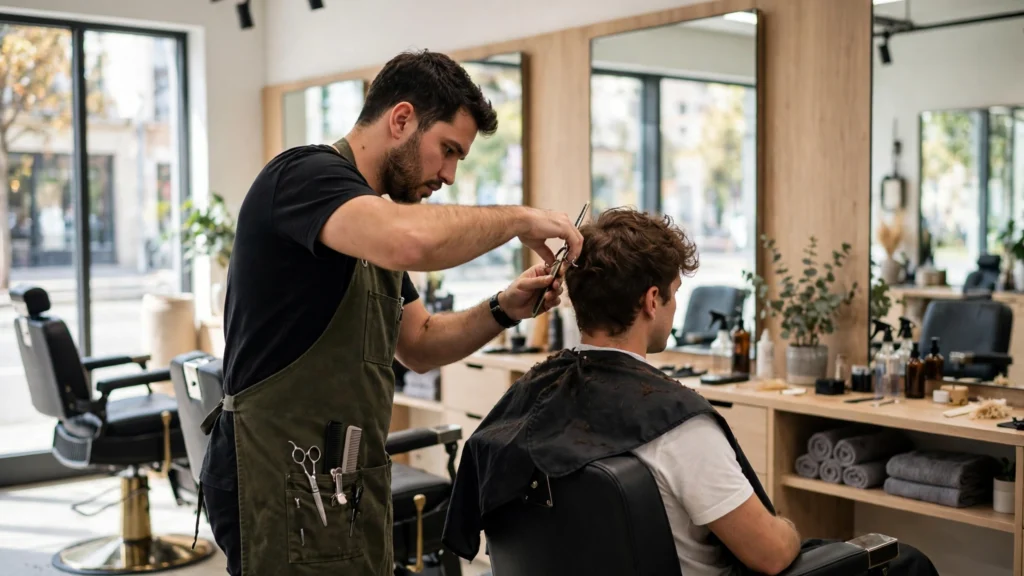
Most haircuts are decided in about ten seconds. Someone’s regular barber moved, the lineup looks tired in the mirror, or there’s a wedding on Saturday — and the search is “barber near me” or “best barbershop in Brampton,” made within a few kilometres of your chair. The shops that win that moment aren’t always the best barbers. They’re the ones whose Google profile, photos and reviews make the tap easy.
This guide covers SEO for barbershops in 2026: how to win near-me and style-based searches, how to turn your Google Business Profile into a booking machine, and how to fill chairs with appointments instead of depending on whoever walks past the window.
1. Start with the map: haircuts are a near-me search
Nobody drives across the city for a standard cut when a good shop is ten minutes away, which makes local search your main shop window. Your Google Business Profile has to do the persuading before your website ever loads:
- Categories: “Barber shop” as primary. Add categories for services you genuinely offer where available — hair salon is a different trade for most barbers, so only add what honestly describes the shop.
- Each barber, visible: if clients book specific barbers, name them on your site and in profile posts. “Book with Marcus” is a stronger draw than a generic shop description, and barbers build their own followings — let search capture that.
- Hours that reflect the chair, not the sign: walk-in hours, appointment hours and the days individual barbers work should match reality. A customer turned away by wrong hours rarely tries twice.
- Booking link front and centre: if you take online bookings, connect the booking button and keep the link current. Every extra step between “found you” and “booked” loses chairs.
- Photos that sell the cut: fresh cuts, the shop interior, the team at work. Hair is visual — a profile full of sharp, recent work outperforms the most polished written description.
- Services listed individually: skin fades, beard trims, hot towel shaves, kids’ cuts, designs — each named, so you match the specific search instead of just “barbershop.”
2. Barber pages and style pages: how clients actually search
Clients search two ways: by place (“barber near me”) and by result (“skin fade Brampton,” “barber who does designs,” “kids haircut near me”). Your website should answer both:
- A page or strong section per barber: their specialties, their photos, their booking link. Clients loyal to a barber will search that barber’s name — make sure the result is your shop, not a directory.
- Service pages for signature work: fades, beard sculpting, hot towel shaves, grey blending, first haircuts for kids. Each described in the words clients use, with real photos of that exact service.
- Pricing in plain sight: what a cut costs, what a cut-and-beard costs, how long each takes. Barbershop customers compare fast; hidden pricing sends them to the shop that shows it.
This structure follows the same foundation laid out in our local SEO guide for small businesses — one clear page per thing you sell, written for the person searching for exactly that thing.
3. Walk-ins versus appointments: rank for both intents
Barbershops serve two different searchers. The walk-in wants someone now, nearby, with a chair free. The appointment client plans — before a trip, an interview, an event — and chooses on quality and reviews. Your pages and profile should speak to both: “walk-ins welcome” stated clearly with realistic wait guidance for the first; online booking, portfolios and reviews for the second. Shops that only signal one intent quietly hand the other half of the market to competitors. If your model is appointment-first, say so proudly and make booking effortless — clarity converts better than ambiguity in both directions.
There’s a third searcher worth naming: the parent. Kids’ cuts are booked by adults searching on a child’s schedule — “kids haircut near me,” patience with first haircuts, weekend morning availability. If families are part of your business, give them a named service, a realistic description of how you handle young clients, and photos that prove it. If they’re not your market, that’s fine too — but don’t let vague listings promise what your chairs don’t offer. Precision about who you serve is not limiting; it is what makes the right clients trust the booking.
What this looks like in Brampton
Brampton’s barbershops serve one of the most style-conscious, diverse customer bases in the country. Neighbourhoods like Springdale, Castlemore, Fletcher’s Meadow and Mount Pleasant are full of young families and professionals who treat a sharp cut as routine maintenance, and the city’s barbers work across an enormous range — fades and designs, beard work, and cuts for every hair type and tradition. A shop that shows that range in its photos, honestly and specifically, tells Brampton customers “we cut your hair here” in a way generic stock imagery never can.
The local rhythm matters too: weekend chairs are gold, back-to-school and pre-holiday weeks surge, and wedding season fills Saturdays with parties booking together. Shops that post about those moments on their profile — and keep hours accurate through holiday weekends — catch demand that quieter competitors miss. Brampton clients are also loyal and vocal: a great cut here earns reviews and referrals across big family and community networks.
4. Reviews: the lineup before the lineup
For a first-time client, reviews are the trial cut. They read for the things photos can’t prove: Was the wait honest? Did the barber listen? Was the shop clean, the price fair, the fade still sharp a week later? Ask at the chair, while the client is checking the mirror and happy — a card with a QR code at each station and a short text link after appointments makes it effortless. Reply to reviews like a host, not a defendant: thank regulars by name, and answer criticism calmly and specifically. Prospective clients read your replies as a preview of sitting in your chair.
5. AI search and social: where the next client discovers you
Younger clients increasingly find barbers through Instagram and TikTok first, then verify on Google — or ask an AI assistant for “a barber near me who does good fades.” Both paths reward the same assets: consistent business details everywhere, real photos of real work, reviews that mention specific services, and barbers named and described in text. Keep your shop’s name, address, hours and booking link identical across your site, profile and socials, and let your social content point back to booking. Discovery may happen on a feed; the booking still closes on search.
A word about the assistant path, because it behaves differently from a search results page. When someone asks an AI tool for a barber recommendation, it doesn’t show ten options — it names two or three, with reasons. Those reasons are pulled from text: “known for skin fades,” “takes walk-ins,” “barbers you can book by name.” Shops that describe their specialties, their barbers and their walk-in policy in plain sentences on their own website give the assistant something true and specific to say about them. Shops described only by photos and a booking widget leave the assistant guessing — and it rarely guesses in your favour.
6. Your website: fast, visual and bookable
Most barbershop websites fail by being brochures. Yours should be a booking tool:
- Book button everywhere: visible on every page, on mobile without scrolling. If booking is by phone or DM, say so plainly instead of hiding it.
- Real gallery, updated monthly: your team’s current work, captioned with the service (“mid fade with beard sculpt”). Captions make photos searchable; freshness makes them believable.
- Speed: a fast mobile page. Clients searching from the car or the sidewalk will not wait for a heavy slideshow to load.
- The practical details: parking, transit, walk-in policy, cancellation policy, prices and hours — the unglamorous facts that decide bookings.
- The shop itself, honestly: seating, cleanliness, music, whether kids are welcome and how long a typical cut takes. Clients choose atmosphere as deliberately as they choose barbers; describe yours in words, not just photos.
7. The monthly rhythm that keeps chairs full
Each month: add fresh cut photos to your profile and gallery, post one profile update (a seasonal push — back-to-school cuts, holiday hours, a new barber introduction), send review requests for the month’s appointments, and check which services and barbers are drawing searches in Search Console. Quarterly, verify hours, prices and booking links are identical everywhere your shop appears. Barbershop SEO is a habit of small updates, and shops that keep it up stay booked while others wait for walk-ins.
8. What to measure so you know it’s working
Measure bookings, not applause: calls and booking clicks from your profile, your visibility for “barber near me” and your signature services in your part of town, and which barbers and services the booking system says are filling. Track how new clients found you for a few weeks — the till question “first time here? how’d you hear about us?” reveals more than most dashboards. If one barber’s page or one service page is pulling searches, feed it: more photos, more reviews mentioning it, a profile post about it.
9. Mistakes that quietly cost barbershops clients
The familiar ones: a profile with three photos from opening day. Hours that don’t match the door sign. No prices anywhere, so searchers assume you’re expensive. Barbers invisible as individuals, so their personal followings book elsewhere. A website with no booking path on mobile. And inconsistency — different hours or names across Google, Instagram and directories — which blurs the local signals that decide who ranks. None of these need a big budget to fix; they need an hour of honesty and a monthly habit.
Frequently Asked Questions (FAQ)
How do barbershops rank for “barber near me”?
With a complete Google Business Profile — correct categories, accurate hours, a working booking link, fresh photos of real work and steady reviews — backed by a fast website with a page or section for each main service and barber.
Should each barber have their own page?
If clients book by barber, yes — or at least a strong section each. Clients search barbers by name and by specialty; a named page with photos and a booking link keeps that client in your shop.
Do barbershops need online booking for SEO?
Not strictly, but it converts the traffic SEO wins. A visible booking button on your profile and site turns searchers into appointments; if you book by phone or DM instead, state it clearly everywhere.
How do I get more reviews for my barbershop?
Ask at the chair at the moment of the mirror check, make it one tap with a QR code or short link, and ask after appointments by text. Mention the service in your reply. Never buy reviews — clients and Google both spot it.
Does Instagram replace Google for barbershops?
No — it feeds it. Clients discover styles and barbers on social, then check reviews, hours and booking on Google. Keep both consistent and pointing at the same booking path.
Get a free SEO audit of your website
A 120 point crawl, a competitor gap map and a 90 day roadmap, ready in 48 hours. Free, with no obligation.

SEOelinks is a Brampton-based SEO agency helping service businesses across Canada and worldwide win organic search. Our strategists publish the same field-tested playbooks on technical SEO, local visibility and AI search that we run for clients every day.
More about SEOelinks →