
Search Console Manual Actions report reviews require a precise, evidence-led response. This guide explains how to read a listed action or green-check state, preserve the reported scope, follow Google’s action-specific guidance, document corrective work, and prepare a factual reconsideration request. It does not treat a report check or review request as proof of future crawling, canonical selection, index inclusion, ranking, traffic, or display outcomes.
Start with a report finding, not a general visibility theory
A sudden change in impressions, clicks, indexed pages, or business enquiries can lead a team to search for a single explanation. A Manual Actions report should not be used as a catch-all explanation for every change. Google describes a manual action as a human reviewer determination that pages on a site are not compliant with its spam policies. The report is therefore a specific evidence source with a stated scope, not a label for routine ranking movement, an ordinary crawl issue, or an untested content concern. [1] [2]
Begin by writing down the precise observation that triggered the check. For example: “The owner is reviewing the Search Console Manual Actions report on this verified property after seeing a specific report message.” This is a much stronger starting point than “the site is penalized.” It identifies the source, avoids importing assumptions from dashboards, and gives the reviewer a defensible reason to inspect the relevant report before changing copy, navigation, redirects, markup, or links.
What the Search Console Manual Actions report is for
Google says the report lets a property owner see whether manual actions have been issued and view manual-action history. Where an action exists, the report can show whether its scope applies to a section of the site or to all pages, together with a short issue description and action-specific documentation. That makes the report the right first destination for a manual-action question, while Security Issues, Page Indexing, URL Inspection, Performance, Crawl Stats, and Removals answer different questions. [1]
Use the report in its narrow role. It can establish that a listed manual action exists on the verified property and describe what Google has reported. It does not create a complete inventory of every page on the domain, identify every technical defect, prove who created a problem, or settle a content-governance decision. Keeping those limits explicit prevents a page-level report review from expanding into unsupported claims about the whole business or every future search result.
Read a green check accurately
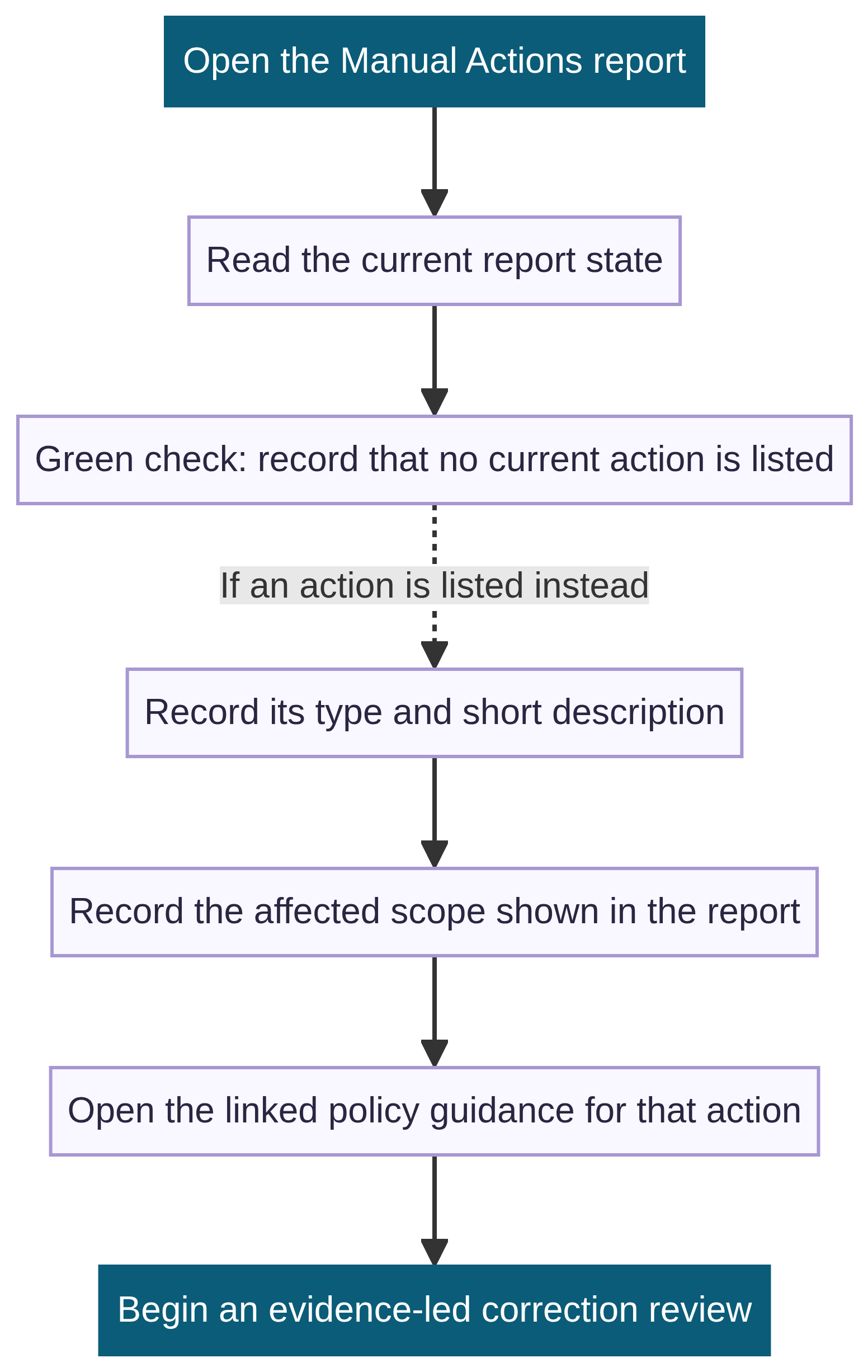
Google states that the report shows a green check and an appropriate message when a property has no manual actions. Record that status with the property, date, and person who checked it. It is useful evidence for the narrow question “does this report currently list a manual action?” It should not be rewritten as proof that a site has no other issue, no historical quality concern, no security incident, no crawl problem, or no reason to improve a page. [1]
A disciplined record might say: “Manual Actions report reviewed on the verified property; no current manual action listed.” That sentence is both clearer and safer than an all-purpose clean bill of health. If another report raises a separate question, open that evidence source and assess it independently. This approach helps teams avoid unnecessary broad edits prompted by a report that is already describing a no-action state.
When an action is listed, preserve the exact report details
If an action is listed, capture the action type, short description, affected-scope language, any examples, the displayed date, and the linked learn-more resource before making changes. Google directs owners to expand the description panel, see which pages are affected, identify the type and short description, and follow the action-specific information. Those details form the core evidence record. [1]
Avoid translating a specific type into vague shorthand such as “bad SEO.” Manual-action categories describe different facts and therefore need different correction work. A structured-data issue is not the same as a link-related issue; a user-generated-spam concern is not the same as cloaking; a site-reputation-abuse concern is not a generic content refresh. The action name, scope, and linked policy are the basis for investigation, not an invitation to use a generic checklist.
Treat displayed scope as a boundary, not a guess
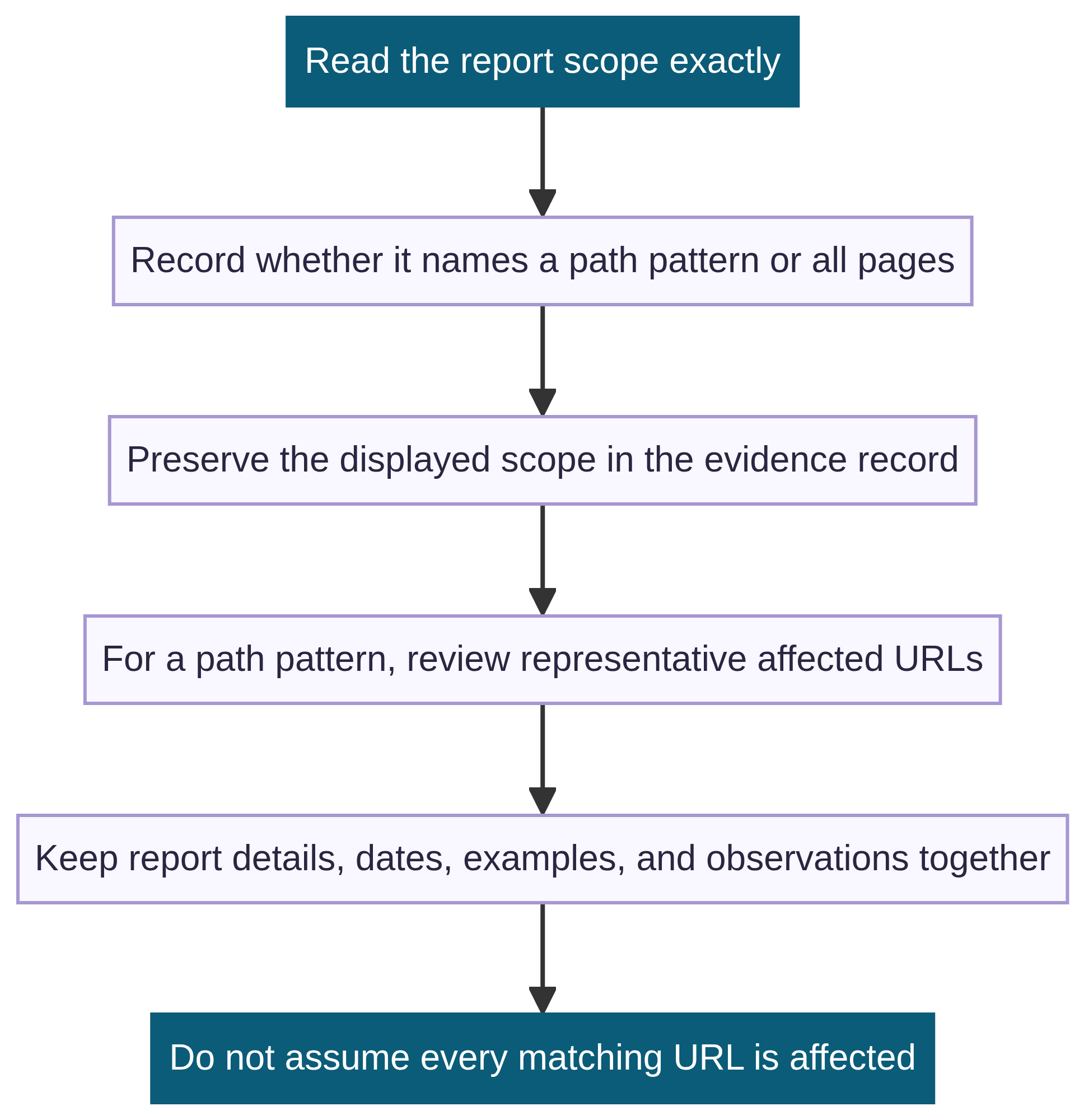
Google says the report can identify a subset of a site through a pattern, such as a directory, or say that all pages are affected. It also says that not every page matching a displayed pattern is necessarily affected. The practical implication is simple: preserve the language exactly, map it to representative URLs, and avoid declaring that every matching page has the same status. [1]
A scope record should distinguish what the report says from what the team independently observes. Keep a column for the report pattern, a column for confirmed example URLs, a column for related URLs still being investigated, and a column for changes made. This keeps the response proportionate. It also avoids a destructive mistake: deleting, redirecting, or noindexing an entire section solely because a report pattern was read as a complete enumeration.
Separate manual actions from security, indexing, and crawl questions
A manual action can coexist with another Search Console finding, but one is not evidence for the other. A Security Issues notification has its own report and may require a security response. A Page Indexing category and URL Inspection data are URL-level information sources. A Crawl Stats trend summarizes crawler activity. A temporary hide in the Removals tool is a different operational control. Do not merge these into one unqualified diagnosis. [1] [3]
When the reader’s actual question is whether a particular URL is discovered, indexed, canonicalized, or returning an expected response, use the relevant report and public-page validation. The site’s Search Console indexing triage guide provides an appropriate contextual route for URL-level indexing questions. A Manual Actions report review should remain focused on its own evidence and documented correction path.
Use the linked policy page as the correction specification
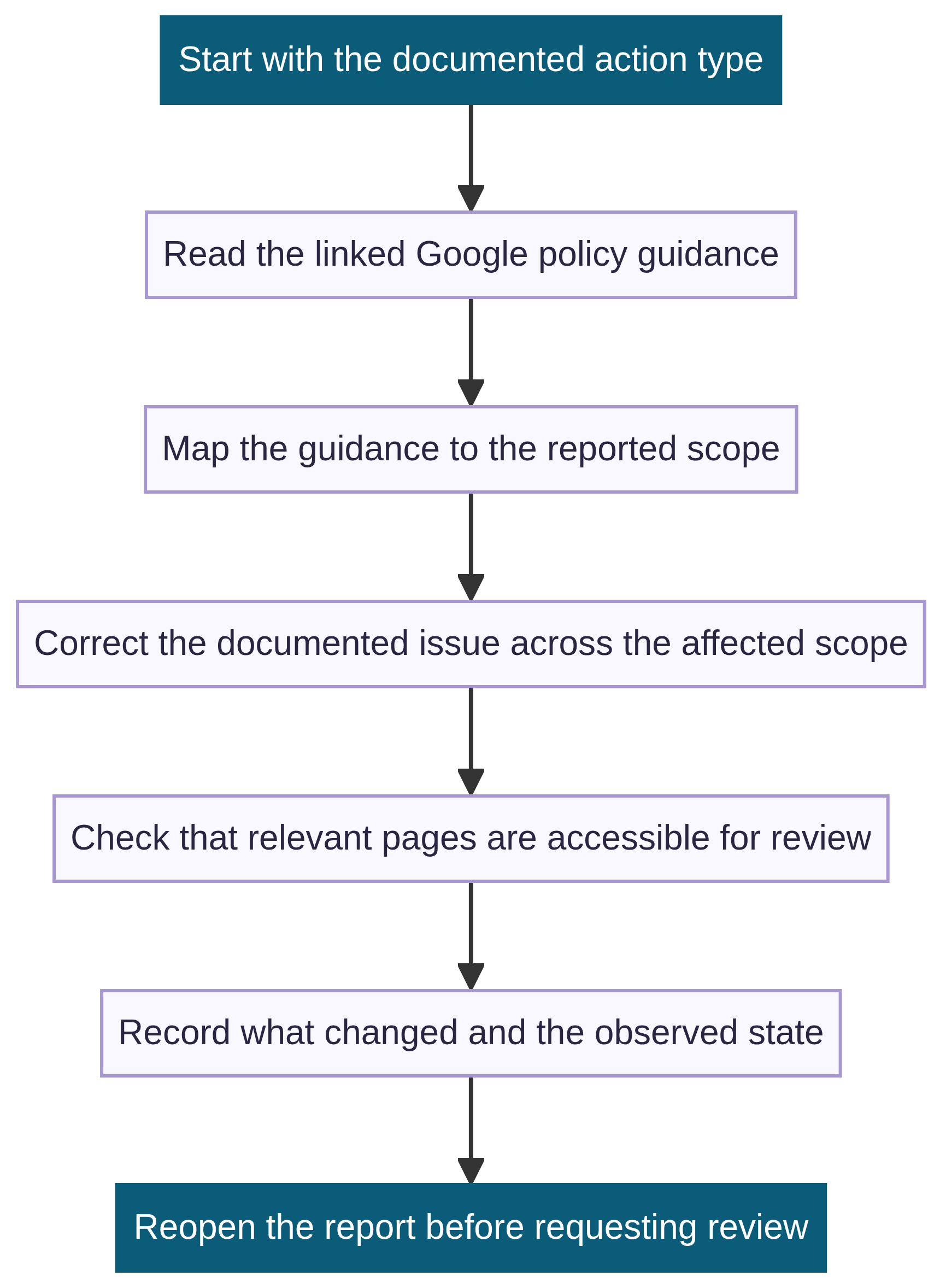
Google’s report directs owners to detailed information for the listed action. That link is the right place to understand the relevant policy language and the specific corrective steps Google publishes for that category. Its role is not to provide a catalogue of evasion tactics. Read it to identify the condition described, the affected public or system area, and the work required to stop that condition across the reported scope. [1] [2]
Make the written plan action-specific. For a structured-data concern, compare the visible page and markup with the relevant guidelines. For user-generated spam, identify the submission surfaces, problematic content, and prevention controls. For a cloaking or sneaky-redirect concern, compare the relevant delivery paths without introducing unrelated redirects. For a content-quality concern, inspect the documented pages and improve or remove only material that is actually within the scope. The factual report and linked policy should constrain the work.
Correct all reported issues before requesting a review
Google’s published manual-action workflow says to fix the issue on all affected pages and address all manual actions listed in the report. Correcting only selected examples is not described as a partial remedy. The team should therefore maintain an action register: one row per listed action, its reported scope, the action-specific guidance, relevant page or system owners, corrections completed, and remaining verification. [1]
This does not mean changing everything on a site. It means completing the correction work that maps to every reported issue and reported area before asking for review. A bounded register is safer than a large undocumented cleanup because it preserves why each change was made and helps prevent a related but different issue from being silently treated as if it were resolved.
Check whether relevant pages can be reviewed
Google advises owners to ensure that affected pages can be reached when a Manual Actions report correction is ready for review. Its documentation calls out pages requiring login, pages behind a paywall, robots.txt blocks, and noindex directives, and points owners to URL Inspection for access checking. This instruction applies to the reported correction workflow; it is not a reason to expose genuinely private content or remove necessary access safeguards. [1]
Record the observed review path for each representative URL. Note whether the page is intended to be public, whether it serves an expected response, whether an access requirement is intentional, and which evidence supports that conclusion. If a page should remain private, a correction plan should preserve that purpose while addressing the manual-action facts. If a technical access problem is found, treat it as a separate, evidenced implementation task rather than rewriting the report scope.
Do not turn a link-related action into a link-building exercise
Google’s Spam Policies identify link spam as links created to or from a site primarily to manipulate Search systems. When a manual-action report names a link-related issue, the response should follow the action-specific Google documentation and preserve factual records of the links and corrections under review. It should not create new links, buy links, automate placements, conceal paid arrangements, or use a reconsideration request to make unsupported claims. [1] [2]
The important editorial distinction is between investigating a documented action and promoting a supposed shortcut. A good record identifies the action type, affected scope, evidence reviewed, good-faith correction steps, and any remaining facts. The report may refer to inbound or outbound link context, but the article should not advise broad link manipulation. The appropriate objective is faithful correction of the condition described in the action-specific guidance.
Keep structured data work truthful and visible
Google’s Manual Actions report includes structured-data issues among its action-specific categories. A corrective review should compare the markup against visible page content and the applicable structured-data rules. Markup that describes hidden, irrelevant, misleading, or mismatched material cannot be made sound simply by changing a few fields while preserving the underlying mismatch. [1]
This is a useful place to separate ordinary markup maintenance from a reported policy issue. The site’s structured data governance guide offers broader contextual material on truthful markup, while the action report and linked documentation define the precise correction boundary. Preserve screenshots, page URLs, markup versions, and validation observations in the internal evidence record, not invented customer or business claims.
Treat user-generated content as a governed surface
Google’s documentation describes user-generated spam as spammy material added through channels intended for user content, such as forums, posts, profiles, and comments. A response begins by identifying the relevant contribution surfaces, observed examples, moderation or publication rules, and prevention control. It is not enough to remove one visible example while leaving the same uncontrolled entry point and undocumented scope in place. [1] [2]
For an evidence-led correction, maintain a narrow list of affected page patterns, content removed or changed, approval controls added or updated, and the date each representative observation was rechecked. Avoid making blanket accusations about real users or publishing sensitive examples. The purpose is to show what was reviewed and corrected against the documented action, while retaining privacy and avoiding claims beyond the record.
Compare delivery paths carefully when cloaking is reported
Google defines cloaking as presenting different content to users and search engines with an intent to manipulate search results or mislead users. Its action-specific manual-action guidance tells owners to compare what Google fetched with what a human sees, identify the system serving a difference, and check conditional redirects. These steps are evidence work: they require a defined URL, time, environment, and observed response. [1] [2]
Do not respond with a broad redirect project or a theme rewrite before the documented scope is understood. Record the URL, user-visible output, available inspection information, scripts or rules involved, and the specific correction applied. A legitimate responsive treatment, paywall implementation, or login path may need its own documentation; the relevant question is the reported policy condition, not whether two devices happen to display identical layout details.
Use content changes that address the documented condition
Some Manual Actions report categories refer to thin content, copied material, doorway behavior, or other content patterns that do not add sufficient value for people. Google’s spam policies emphasize useful, non-deceptive material rather than techniques that merely try to manipulate systems. A correction plan should therefore identify the actual pages and content characteristics described in the report, then improve, consolidate, retire, or otherwise correct those pages with an accountable owner. [1] [2]
Do not use a report as a reason to publish more volume, inject repeated phrases, spin existing text, or create slightly varied location pages. Document the original page role, evidence of what changed, dependencies, and the resulting live state. That is more useful than a generic assertion that content is now “high quality.” It also makes later review and internal governance easier because the correction can be inspected at the page and scope level.
Understand site reputation abuse as a specific policy context
Google’s current site-reputation-abuse documentation explains a particular case where third-party pages are published on a host site in an attempt to exploit the host’s established signals. Google notes that third-party content alone is not automatically a policy violation; the policy context matters. This is why an owner should preserve the report’s exact type and learn-more material rather than labeling all licensed, freelance, affiliate, or partner content the same way. [2] [4]
Where an action names this context, examine the reported pages, ownership relationship, publication purpose, and the specific policy guidance. Do not attempt to solve it by moving material within the same domain, making an unsupported noindex assertion, or adding redirects without a truthful replacement purpose. The correction should be based on documented policy facts and a clear page-governance decision, followed by a factual review request when all reported work is complete.
Build a factual reconsideration request
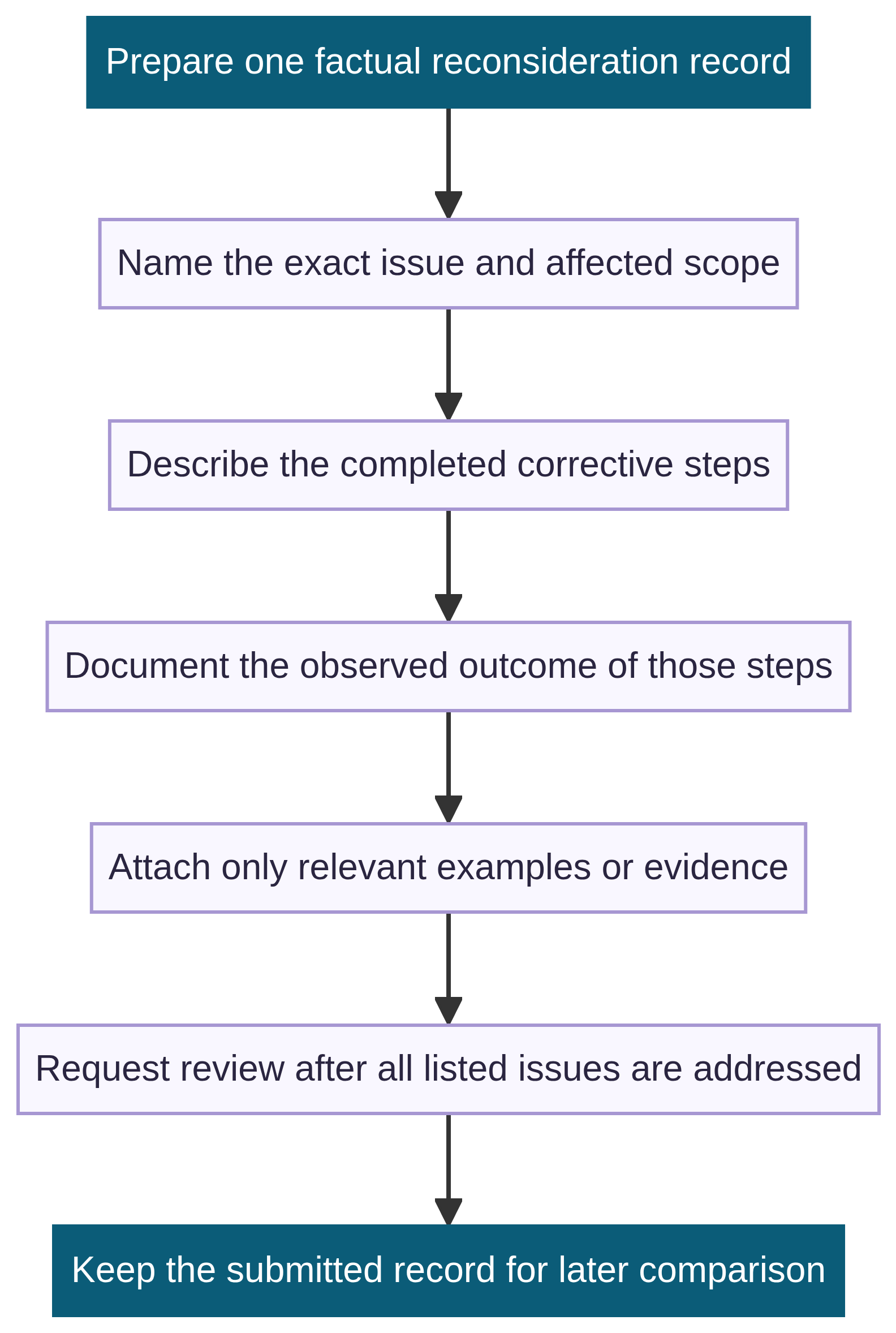
Google defines a reconsideration request as a request to have Google review a site after problems identified in a manual action or Security Issues notification have been fixed. Its Manual Actions guidance says a useful request explains the exact quality issue, describes the steps taken to correct it, and documents the outcome of those efforts. These are practical components for a concise, factual record. [1] [3]
Use plain language and verifiable facts. Name the action type and the reported scope. State what was changed or removed, where it was changed, how representative affected pages or systems were checked, and what remains outside the documented scope. If a fact is unknown, say so and complete the investigation before submitting. A reconsideration request is strongest when it is an accurate map of completed work, not a long narrative, a blame statement, or a promise about what Google should do.
Keep evidence relevant, not theatrical
A submission record can include useful examples such as affected URLs, before-and-after implementation details, dates, content or system owners, and brief descriptions of the correction. Use only material that helps a reviewer understand the documented issue and completed work. Avoid fabricated endorsements, invented outreach attempts, edited screenshots that hide important facts, or unrelated exports intended to create volume rather than clarity. [1]
The request text should also distinguish between action and observation. “We removed these specified pages and confirmed the current public response” is an observable statement. “This will restore our standing” is a future-outcome claim that the evidence cannot support. This distinction protects the team from overpromising internally and makes the final record more useful if a later report review raises additional questions.
Request review only after all listed work is complete
Google instructs owners to select Request Review when all issues listed in the report are fixed on all affected pages. Before the request, compare the action register against the report one final time: every listed action has a defined scope; relevant corrective work is complete; representative URLs or systems have been checked; page access is understood; and the factual request text matches the evidence. [1]
This is a review gate, not a deadline to meet by writing a persuasive message. If a correction is still in progress, keep the evidence record open and finish the documented work. If the report raises a separate security, index-status, removal, canonical, or server question, create a bounded parallel task with its own evidence. Keeping the manual-action request narrow makes the submitted explanation easier to audit and reduces the risk of mixing unrelated interventions.
Expect Google to control review timing and decision
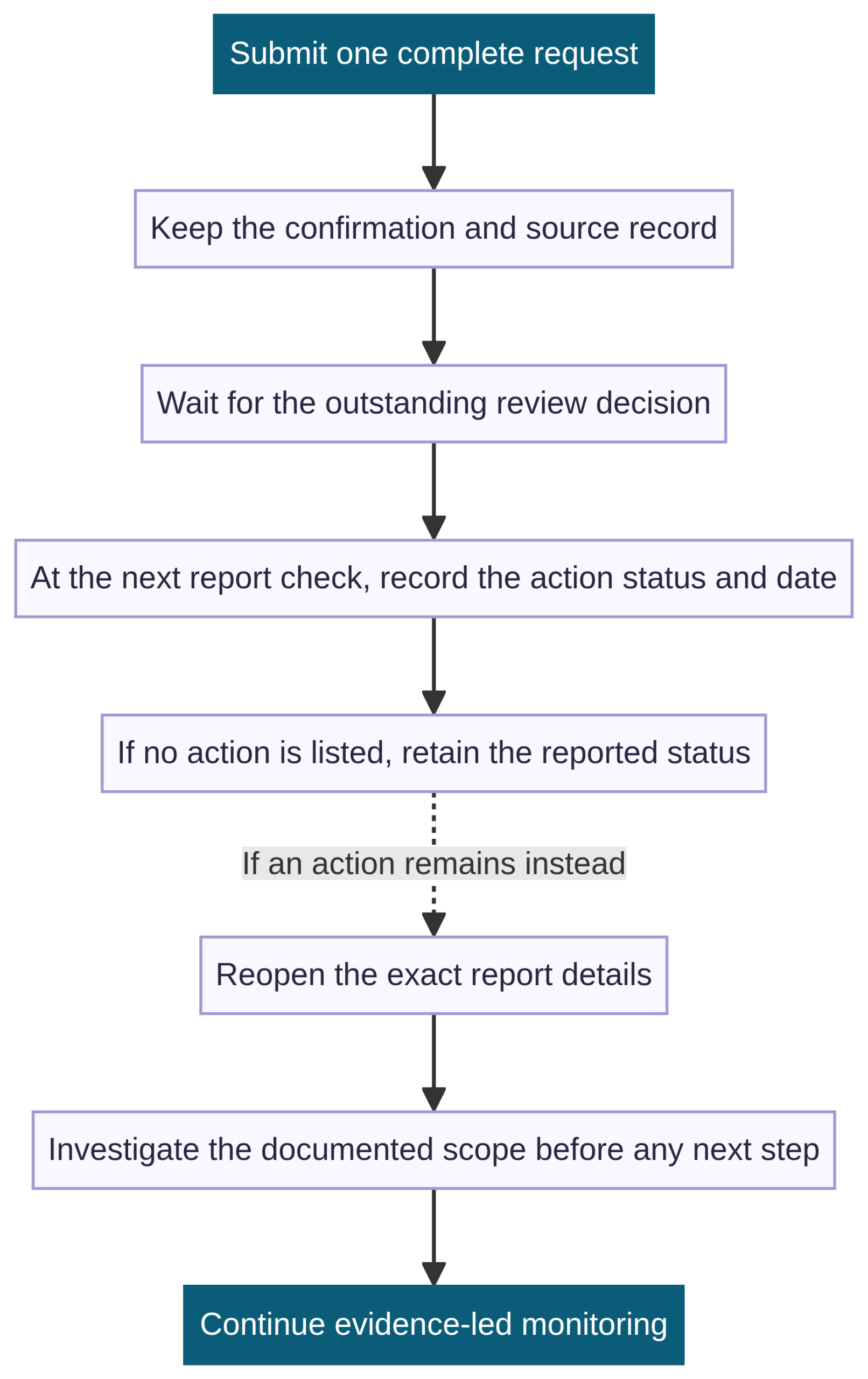
Google says most reconsideration reviews can take several days or weeks, and that some link-related requests can take longer. Google also says it sends a confirmation that a request is in progress and advises owners not to resubmit before a final decision on the outstanding request. Treat this as a general process description, not a timetable for any particular property. [1]
Preserve the submission date, confirmation, request text, supporting evidence locations, and responsible reviewer. During the waiting period, do not repeatedly resubmit, make speculative declarations, or turn the request into a reason for site-wide changes. Continue ordinary maintenance that is independently justified, but keep it separate from the documented correction sequence so the final record remains clear.
Read a later report state before choosing the next step
When Google communicates a decision or the report state changes, record the date and the exact status displayed. If an action is no longer listed, preserve that observed report state without extending it into a claim about every other SEO measure. If an action remains, reopen the precise action description, scope, evidence register, and cited policy guidance before deciding whether additional work is required. [1]
This review discipline avoids two weak reactions: assuming the work was useless because a report remains, or assuming every concern is resolved because a report entry changed. The appropriate next action depends on the documented state, any request response, and verifiable page or system evidence. Do not use a report outcome as a basis for artificial link activity, broad redirects, or unsupported claims about future visibility.
Maintain a small manual-action evidence register
A compact evidence register makes high-impact work easier to review. Include the property, action type, displayed scope, report date, linked guidance, representative URLs or systems reviewed, correction owner, changes completed, access checks, request date, submitted text location, confirmation, later report state, and unresolved facts. Keep sensitive technical details or personal information in the appropriate restricted system rather than embedding them in a broad shared document.
The register does not need to be ornate. Its purpose is to preserve traceability: what Google reported, what the team confirmed, what was changed, and which facts remain outside the record. That traceability reduces pressure to make a vague “recovery” claim and provides a clearer handoff if a developer, content owner, security specialist, or external reviewer needs to inspect a narrow part of the work.
Avoid common category errors
Several errors make Manual Actions work less reliable: treating ordinary performance movement as proof of an action; editing pages before recording the report; reading a path pattern as every affected URL; correcting only sample pages; using a general SEO checklist instead of the linked action guidance; submitting before all listed actions are addressed; and resubmitting while a request is outstanding. Google’s report documentation directly supports avoiding each of these shortcuts. [1]
Other category errors come from using the wrong tool. A Search Console Removals tool request is not a reconsideration request. A canonical change is not an answer to every scope pattern. A robots.txt rule does not establish that a policy correction is complete. A URL inspection result is not a manual-action decision. Separate the evidence, objective, owner, and validation for each task.
Pre-submission checklist
Before selecting Request Review, confirm that the verified property is correct; the report action type, description, scope, date, and action-specific guidance are recorded; every listed action has an evidence row; the documented issue has been corrected across the reported scope; representative public or system observations are retained; relevant pages can be reviewed where appropriate; and the request explains the issue, corrective steps, and observed result of those steps. [1] [3]
After submitting, save the confirmation and do not resubmit until Google provides a final decision on the outstanding request. Keep the site’s ordinary technical, content, security, and user-experience work grounded in its own evidence. This checklist does not promise a decision or a later search outcome. It creates a repeatable way to respond truthfully to the specific condition shown in the Manual Actions report.
Final perspective
The Search Console Manual Actions report is an owner-facing evidence source for a specific human-review finding under Google’s spam policies. Its value comes from precision: check the verified property, preserve the reported action and scope, use the linked category guidance, correct the documented issue across the reported area, verify relevant facts, and submit one factual reconsideration request only when that work is complete. [1] [2]
That process is deliberately narrower than a general SEO campaign. It does not promise a later report decision, crawling treatment, canonical selection, index inclusion, ranking movement, traffic change, or visibility outcome. It gives a site team a clear, reviewable path for addressing the condition Google documented while keeping unrelated technical and editorial decisions evidence-led in their own right.