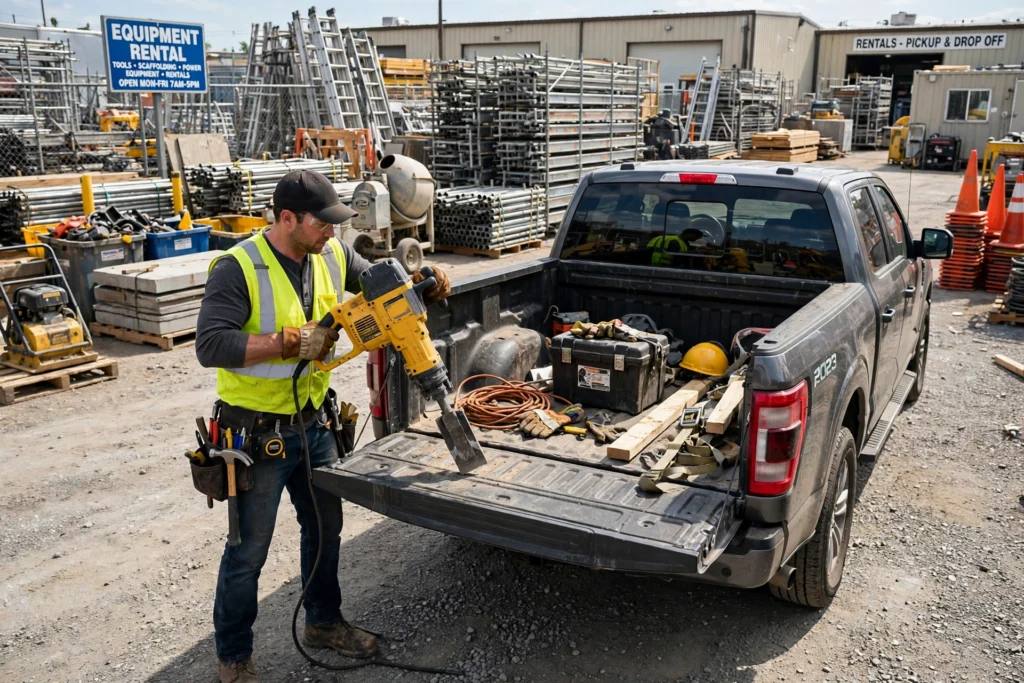
A contractor with a job starting tomorrow does not browse — he needs a specific tool, for a specific number of days, at a price he can quote, and he needs to know it is in stock before he drives over. A homeowner with a weekend project is the same: a floor sander for Saturday, a pressure washer for the driveway, a tiller for the garden. The rental company that shows up first, lists its equipment plainly, and makes booking easy wins the rental before the next yard is even called.
This guide covers SEO for tool rental companies in 2026: how renters search for equipment, how pages for each tool win the searches that matter, how clear rental terms and photos of well-kept equipment build trust, and how a tool rental website turns a hurried search into a booked pickup — so the next renter looking for a tool finds you first.
1. Start with the map: the renter decides on your profile
The shortlist for tool rental forms on Google, mostly on a phone at the job site or in the driveway, while the renter checks what is in stock and when he can pick it up. Your Google Business Profile is where you make or miss that shortlist:
- Categories: “Equipment rental agency” as primary, with “Tool rental service” added only where it honestly describes what you offer.
- Equipment, listed plainly: excavators, floor sanders, pressure washers, scaffolding, generators and drills — named the way renters search for them.
- Photos of real equipment: clean, well-kept tools and machines in the yard, so a renter can see the gear is looked after before he books.
- Hours and pickup: opening hours and pickup times stated clearly, so nobody drives over to a yard that is already closed.
- A call in one tap: a call button and a simple booking link, so a renter can check availability straight from the search without a second step.

2. One tool, one page: each search earns its own page
A renter searching “excavator rental near me” is not the same renter as one searching “floor sander rental” or “pressure washer rental.” Each tool does a different job, rents for a different length of time, and carries a different worry, and each deserves its own page:
- Heavy equipment pages: written to the contractor who needs a machine — the sizes available, the rental periods, and what the pickup or delivery looks like.
- Home project pages: written to the homeowner with a weekend job — the floor sander, the pressure washer, the tiller, and how the tool works for a first-timer.
- Power and access pages: written to the renter who needs generators, lighting or scaffolding — the capacity, the setup, and what the job site needs.
- Rates and terms pages: written to the renter who needs to quote the job — the daily and weekly rates, the deposit, and what happens if the tool comes back late or damaged.
Each page carries photos of the real equipment, the job it does, and the next step to take. It’s the same page-per-search discipline behind our guide to dumpster rental SEO — renters reward the yard that answers their exact equipment question, in their exact situation, first.
Don’t blur the tools into one. A contractor who needs an excavator does not want to read about a drill, and a homeowner who needs a floor sander does not want a page about heavy machinery. Separate pages let each visitor — and each search — land exactly where they belong.
3. Contractor rentals vs weekend rentals: the two crowds a tool yard serves
The most valuable tool rental customer is not the one-off weekend renter — it is the contractor who rents the same machines job after job, and the homeowner who rents for one project and comes back for the next. Tool searches sound practical because they are: “excavator rental near me,” “floor sander rental,” “scaffolding rental,” “generator rental.” A page that treats every visitor like a casual enquiry will not rank for the tool searches, and will not convert the renters who do find it.
Build your content around the contractor first, and make the weekend renter a clear second path. Answer the questions a renter asks before picking up the phone: is the tool in stock, how much is it per day, can it be delivered, and what happens if it breaks on the job. Name your tools plainly and explain the rental in plain language. A page that reads like a capable, organised yard converts; one that reads like a generic equipment listing does not.
What this looks like in Brampton
Brampton’s tool rental demand follows its neighbourhoods and its building seasons: contractors and homeowners across Springdale, Castlemore, Fletcher’s Meadow, Mount Pleasant and Bramalea, where new subdivisions, basement renovations, backyard projects and busy job sites all generate the same steady stream of rentals — an excavator for a new build in Castlemore, a floor sander for a renovation in Springdale, a pressure washer for a driveway in Fletcher’s Meadow. Demand rises in spring and summer, when outdoor projects and construction peak, and stays steady through the year as renovations and repairs keep coming — and the yards that are visible, findable and quick to answer when a renter is choosing win the booking before the next yard is called.
Word of mouth is the local currency: contractors tell contractors first, and reviews that name the tool and the neighbourhood (“they had the excavator ready in Mount Pleasant, clean machine, easy pickup”) are the deciding evidence for the next renter. A smooth rental in one neighbourhood quietly becomes the next five bookings nearby.
4. Service-area pages: the neighbourhood search is the one that pays
A tool rental search is a search with a job already scheduled. “Tool rental near me,” “excavator rental in Brampton,” “floor sander rental Brampton” — these are the queries that turn into a booked pickup within hours, and they are won by pages that state the area plainly. A page for each neighbourhood you genuinely serve — naming the streets, the job sites, the projects happening there — ranks for those searches while a single “areas we serve” list ranks for nothing.
Keep each page honest and specific: the tools renters ask for there, the delivery and pickup that fits their job, a photo of the equipment. Timing deserves its own attention too — the spring building season, the summer renovation rush, and the weekend peaks when homeowners tackle projects — because a renter who cannot find a pickup time that fits does not wait, and does not leave a kind review. Link each service-area page from your services page and your profile, so a visitor — and a search engine — can follow the map from your yard to their job site.
5. AI search: the assistant recommending your tool rental yard
Renters increasingly start with an AI tool: “tool rental near me,” “excavator rental cost per day,” “floor sander rental,” “how to rent scaffolding.” The answers are assembled from complete, consistent content — equipment pages with honest details, your location and hours stated the same everywhere, and reviews that mention the tool and the neighbourhood. Yards with real pages get summarised accurately and recommended by area; yards with a one-page site leave the assistant nothing accurate to say, and it says something about a competitor instead.
6. Your website: built to turn a search into a booked pickup
A tool rental website has one job — move a visitor from a hurried renter to a booked pickup:
- Call up front: the phone number and the availability check visible on every page without scrolling, working on a phone in under a minute.
- A rental without fog: what happens when you arrive, how the tool is picked up or delivered, and what the deposit covers, stated plainly. A renter who cannot see the rental does not book.
- Photos on every page: clean equipment and the yard itself, not buried on a separate page nobody visits.
- Booking in one tap: a call button and a simple form, with the questions answered on the spot (is it in stock, how much per day, can it be delivered).
7. Reviews: the trust engine that fills the rental log
A tool rental yard is judged one renter at a time, and reviews are where the next renter learns whether the equipment is clean, in stock and ready on time. The moment that matters most is the day the tool comes back — the job went well, the machine worked, and the ask takes thirty seconds. Ask happy renters to mention what actually matters to the next booker: the tool they rented, whether it was ready, and the neighbourhood where they used it.
Respond to reviews the way you run the yard — promptly and plainly. A worry about a breakdown or a late return is a chance to show the next reader that concerns get heard, not ignored. Reviews that name the tool and the area (“the floor sander in Bramalea was ready on time and worked perfectly”) do double duty: they reassure the next renter and they feed the exact phrases search engines associate with your yard.
8. What to measure so you know it’s working
Measure rentals per tool and per page: calls, form submissions and booked pickups from each equipment page, your visibility for “tool rental near me” and “excavator rental Brampton,” and the split between contractor rentals and weekend rentals. Track which tools bring the renters who actually come back for the next job — a contractor who rents the same machine job after job is worth more than a dozen one-off enquiries. Booked pickups are the metric underneath all of it: SEO that fills the rental log with real jobs shows up next month as a full yard, not a full inbox.
Season is the other quiet signal. Note which weeks the spring building rush actually peaks and how the weekend demand moves through the year — then publish next season’s equipment content earlier, and let your pages and reviews speak to those neighbourhoods by name.
9. Mistakes that quietly cost tool rental yards the next booking
The recurring ones: one generic “tool rental” page for every tool, so equipment searches land nowhere. No photos of real equipment, so renters cannot see the gear is looked after. No service-area pages, so the neighbourhood search goes to a competitor. Hours out of date on the profile, so a renter drives over to a closed yard. A phone number buried three clicks deep, breeding abandoned calls. Reviews never asked for, so the trust signal never builds. Reviews never answered, so the next renter assumes nobody is listening. And silence between seasons — no new photos, reviews or posts — so each spring starts from zero against yards who never stopped.
Frequently Asked Questions (FAQ)
How do tool rental companies rank for “tool rental near me”?
With a complete Google Business Profile — equipment and hours kept current, real photos of clean machines — backed by a dedicated page for each tool and a page for each area you serve, each with a one-tap way to call.
Should each tool have its own page?
Yes. A contractor who needs an excavator asks about size and delivery, a homeowner who needs a floor sander asks about how it works, and a renter who needs scaffolding asks about setup — three different jobs with different answers. Separate pages rank for each search and convert far better than one combined tool page.
How do reviews help a tool rental company?
Reviews are the trust signal a hurried renter books on. Ask when the tool comes back, when the job went well and the machine worked, and encourage mentions of the tool and the neighbourhood. Those same phrases feed the searches that bring the next renter in.
What should a tool rental company put on service-area pages?
The neighbourhood you serve, the tools renters ask for there, the delivery and pickup that fits their job, and a photo of the equipment. Renters need answers in minutes, and a page that gives them is the one that gets the call.
Do tool rental companies really need a rates page?
Yes — the rate is the quote. “Excavator rental cost per day” is the query renters type before they call, and a page that answers it plainly ranks and books while a vague page sends renters to a competitor.
Get a free SEO audit of your website
A 120 point crawl, a competitor gap map and a 90 day roadmap, ready in 48 hours. Free, with no obligation.

SEOelinks is a Brampton-based SEO agency helping service businesses across Canada and worldwide win organic search. Our strategists publish the same field-tested playbooks on technical SEO, local visibility and AI search that we run for clients every day.
More about SEOelinks →