
Start with the report’s real job
The Generative AI performance report is a measurement surface for a narrow question: what impressions Google attributes to a site in generative AI features on Search. Google’s documentation describes it as a way to review changes over time, identify pages with higher or lower impressions, and understand where those impressions originate by device or country [1]. That makes the report useful for evidence collection, not for manufacturing a visibility narrative.
The distinction matters because SEO teams often blend three different questions. The first is whether a page meets the technical requirements to be eligible in Search. The second is whether Google records an impression in a generative AI feature. The third is whether a business outcome followed. The report can inform the second question and provide context for the first, but it does not answer the third by itself. A careful article therefore teaches the reader to preserve the boundary between recorded data and interpretation.
What Google currently includes
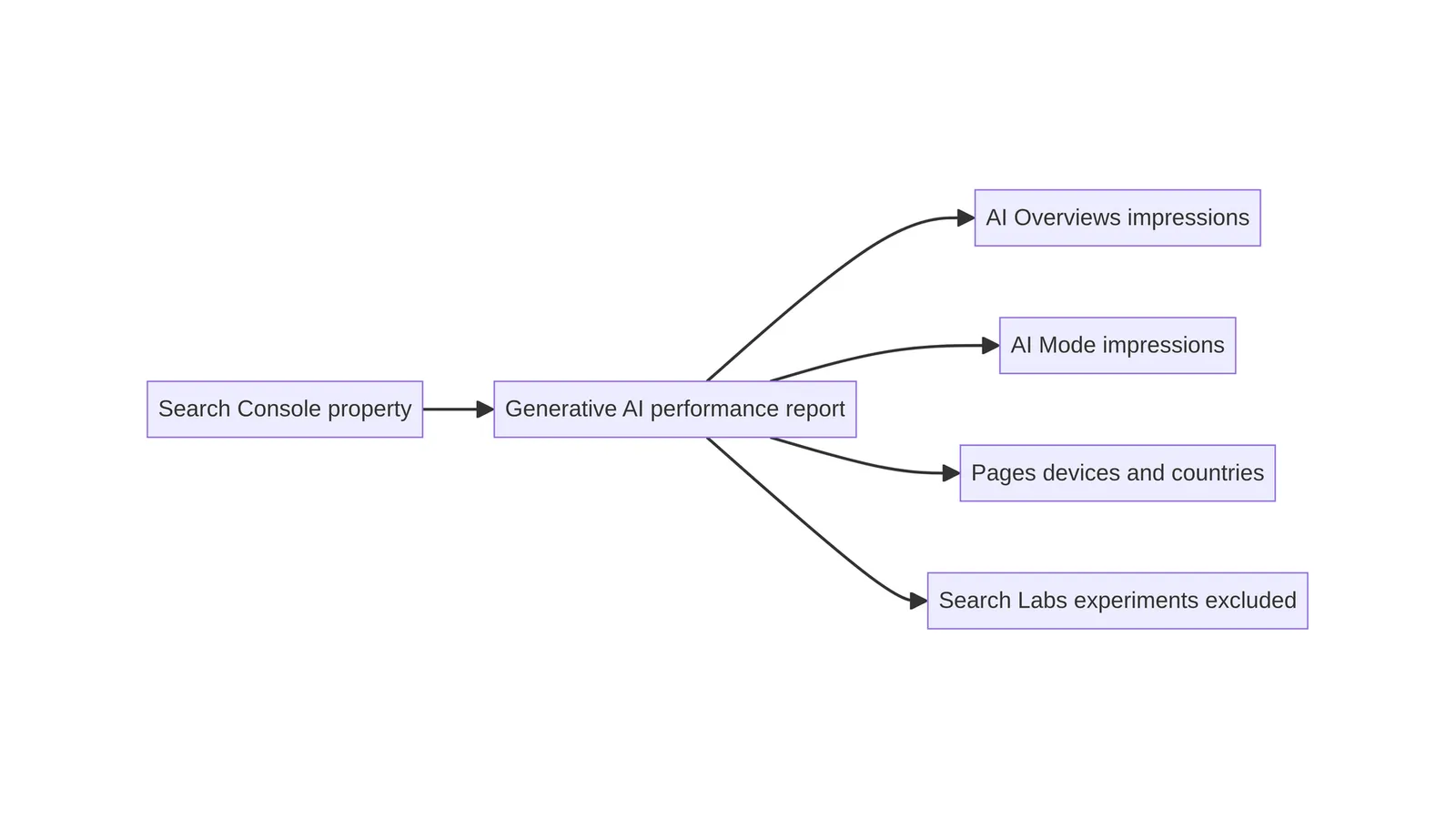
Google’s Search Console Help page says the Search report includes impressions for AI Overviews and AI Mode, and notes that the list of supported capabilities may change as Google Search develops [2]. This is a product boundary, not a permanent taxonomy. A report review should capture the date it was viewed and the interface or documentation version that defined the scope.
The same page says Search Console does not include data from experiments in Search Labs because those experiments remain in active development [2]. That exclusion prevents a common mistake: treating every experimental Search experience as if it were represented in the standard generative-AI report. If a stakeholder asks about an experiment, label it as a separate question and do not fill the gap with an estimate.
AI Overviews and AI Mode are not interchangeable labels
AI Overviews and AI Mode are listed together as included generative AI capabilities, but a combined report view should not be read as proof that the two surfaces behave identically. Keep the capability label visible whenever the interface exposes it, and record the selected date range and dimensions alongside the metric. If the interface combines surfaces in one report, the combination itself is part of the report definition.
This is especially important when a team compares a content change with a chart movement. A page may be present in an AI feature for reasons the report does not reveal, and a short interval may contain very few observations. Describe what the chart or table records. Treat explanations about why a feature appeared, disappeared or changed as hypotheses that need additional evidence.
Eligibility comes before measurement
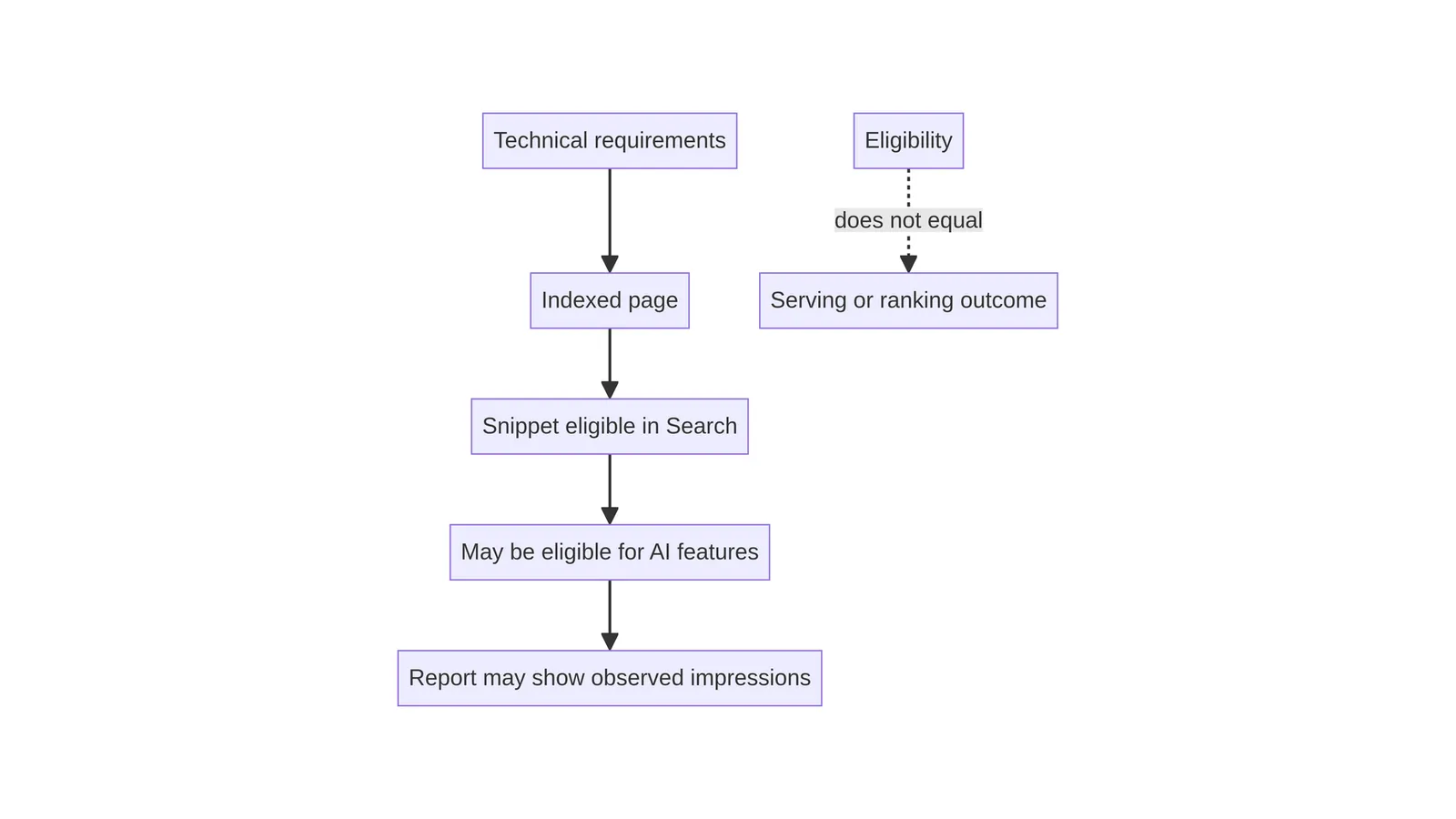
Google Search Central says a page must be indexed and eligible to be shown in Google Search with a snippet to be eligible for a supporting link in AI Overviews or AI Mode [1]. The page also states that there are no additional technical requirements for these AI features beyond the Search technical requirements. This gives an SEO team a practical order of operations: verify ordinary Search eligibility first, then inspect the generative-AI report if the property has data.
Eligibility is not a promise of serving. Google explicitly cautions that meeting requirements and best practices does not mean Google will crawl, index or serve a page [1]. A report workflow must preserve that wording. It can document a condition that appears satisfied; it cannot convert that condition into a forecast.
No special AI file or schema is required
Google’s AI Features documentation says that existing SEO fundamentals remain worthwhile and that there is no special optimization required for AI Overviews or AI Mode [1]. It also says that site owners do not need to create new machine-readable files, AI text files or markup, and that there is no special schema.org structured data required for these features [1].
That guidance narrows the responsible recommendation. Continue maintaining crawl access, internal links, useful textual content, page experience and structured data that matches visible content when applicable. Do not add a fictional “AI signal” to a checklist simply because a stakeholder expects a new technical lever. A good report records the ordinary SEO check and the source that supports it.
Define a question before opening filters
A useful review begins with a sentence that can be answered by the available report. “Are we visible in AI?” is too broad. “Did the selected site receive reported generative-AI impressions during the complete 28-day interval, and which pages and countries were listed?” is narrower. The question should name the property, interval, capability scope if available, dimensions and intended decision.
Writing the question first reduces confirmation bias. Without it, an analyst may find one interesting page, switch filters repeatedly and later describe the most favourable view as the main result. Keep the first question modest. If the report cannot expose the requested dimension or interval, record that limitation rather than substituting a different metric without explanation.
| Review field | What to record | Why it matters |
|---|---|---|
| Property | Exact Search Console scope | Prevents mixing datasets |
| Interval | Start, end, timezone and retrieval date | Shows whether comparisons are complete |
| Metric | Impressions and any selected companion metric | Keeps measurement language precise |
| Dimension | Page, device, country or capability label | Defines the slice being interpreted |
Read the property and date range as evidence
The property is part of every observation. A domain property, URL-prefix property or other Search Console scope can produce a different set of pages from another scope. Record the exact property name or scope, the date range, timezone when relevant, retrieval date and whether the interval is complete. This context is more valuable than a screenshot with no labels.
Date range discipline is equally important. A recent day can be useful for a pulse check, but it can also be incomplete or volatile. A longer interval may be better for a documented editorial decision, while a matched comparison can make a directional change easier to describe. Never turn a short, unconfirmed interval into a durable statement about a site’s future visibility.
Use page dimensions without treating pages as causes
The report can help identify pages associated with higher or lower generative-AI impressions [2]. That is a useful starting point for review. Open the page, confirm its visible title and main content, and compare it with a reasonable baseline. Record the page URL exactly as shown and note redirects or canonical relationships if they affect the review.
A page row is not a causal explanation. Higher impressions may reflect query mix, seasonality, demand, site changes, feature availability or other factors that are not represented in the row. Use page data to choose what to inspect next. Do not state that a particular headline, schema edit or word count caused the report movement unless a separate design supports that conclusion.
Use device and country dimensions carefully
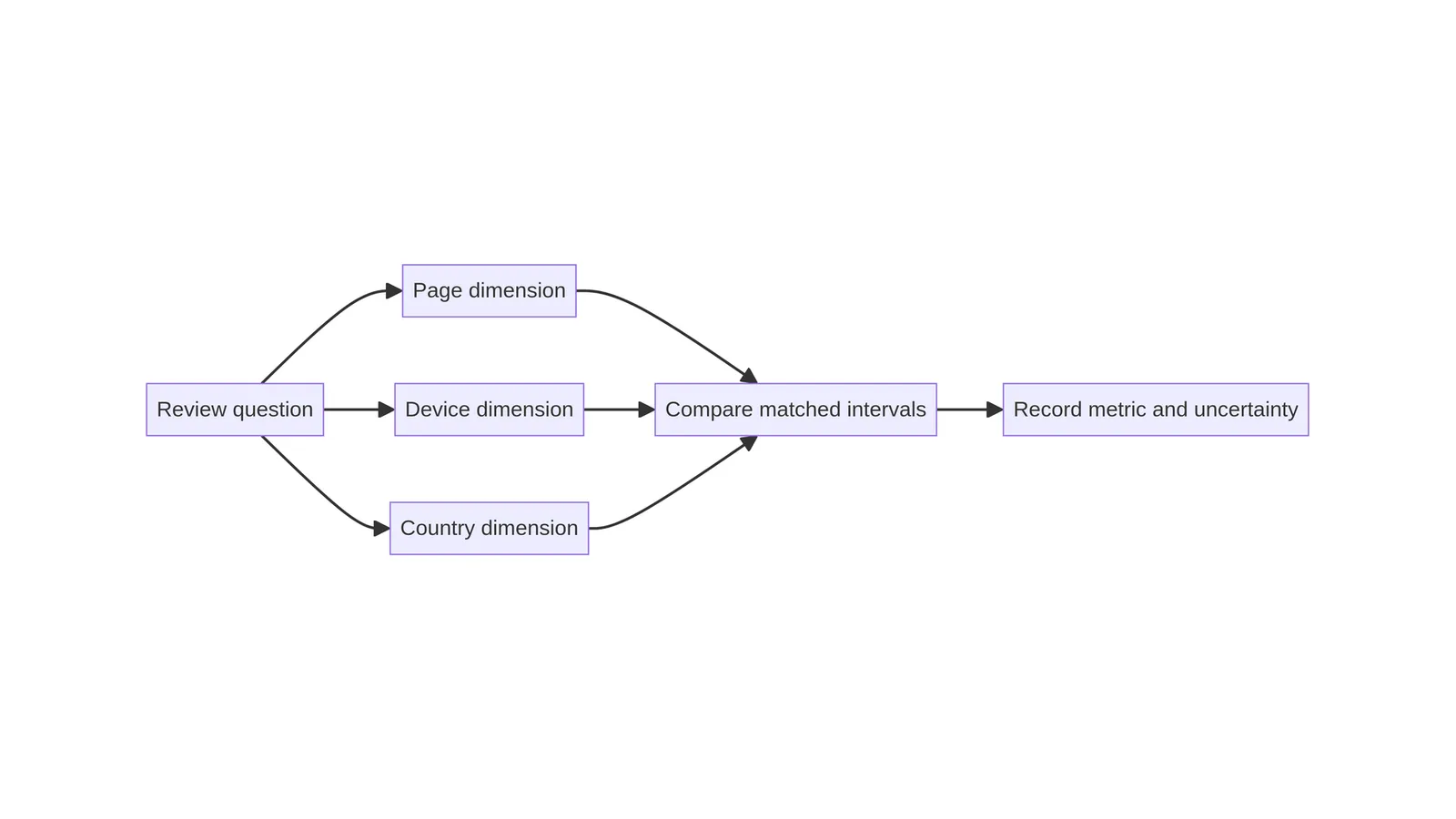
Google documents device and country as examples of where generative-AI impressions may originate [2]. Those dimensions can make a review more actionable because they show where the recorded observations were concentrated. Preserve the selected dimension, metric, interval and any comparison in the evidence log.
A country or device difference is not automatically a quality verdict. It may reflect audience distribution, query demand, language, product availability, device mix or the number of rows displayed. Compare matched periods and avoid ranking countries or devices from a single small slice. When the report does not explain a difference, call it a difference and write a next-check question rather than an explanation.
Understand what an impression can and cannot say
The report is described in terms of impressions, including organic impressions from generative AI features [2]. An impression is a Search Console metric, not a visit, lead, sale or proof that a person read the page. Keep the metric label unchanged in exports and notes. If clicks or click-through rate are available in the selected reporting view, record them separately rather than replacing the word “impression” with “traffic.”
Metric language is a form of editorial accuracy. “The selected report recorded impressions for these pages” is bounded. “These pages won because they were better optimized” is not supported by the metric alone. The second sentence could become a hypothesis for a broader investigation, but it should not appear as a result.
Keep Search Labs outside the standard report
The official Search Console Help page expressly excludes data from Search Labs experiments from the generative AI performance report [2]. This means a team should not combine a Search Labs observation, a user screenshot and the standard report into one total. The sources, surfaces and measurement rules differ.
If stakeholders bring an experimental example to a meeting, store it in a separate evidence section labelled “not included in the standard report.” Note the source, date and uncertainty. The correct conclusion may simply be that the current Search Console report cannot answer that question. That is a useful limitation because it prevents a team from publishing a number that the product does not provide.
Separate observation from hypothesis
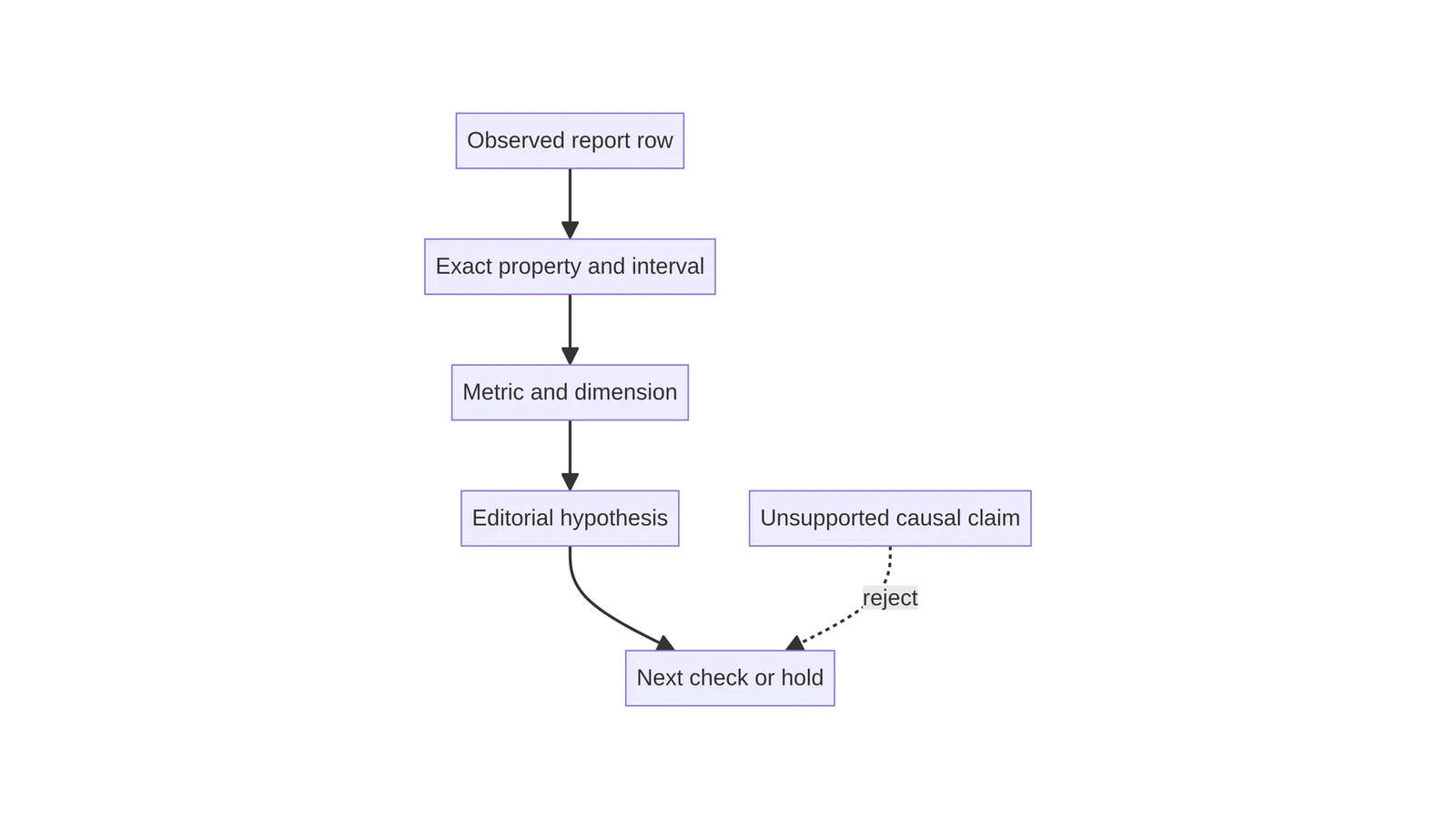
A reliable editorial note uses at least three layers. The observation states what the report displayed. The hypothesis proposes a possible explanation. The next check identifies what evidence could support or weaken that explanation. This structure keeps a chart from becoming a story too early.
For example, an observation could say that the selected page group had more reported impressions in the later matched interval. A hypothesis might be that query mix changed after a content update. The next check could compare the same page group, date boundaries and available query or Search appearance data in the regular Performance report. If the necessary evidence is unavailable, the hypothesis remains unresolved.
Use the regular Performance report as context, not a replacement
The generative-AI report and the regular Search Performance report answer related but different questions. The former focuses on documented generative AI features; the latter can provide broader Search performance context depending on the selected property, search type, dimensions and available data. Use the regular report to understand the surrounding Search pattern, not to invent a generative-AI number that is missing from the dedicated report.
When comparing reports, preserve labels and date ranges. A change in total Web performance does not prove the same change occurred in AI Overviews or AI Mode. Conversely, a generative-AI impression does not explain all organic Search behaviour. The strongest comparison is explicit about what each report measures and where the datasets should remain separate.
Review technical fundamentals without inventing AI tactics
Google recommends the same foundational practices for AI features as for Search overall, including allowing crawling, making content findable through internal links, providing a good page experience, keeping important content in textual form, supporting it with high-quality media when applicable and matching structured data to visible text [1]. These checks are practical because they improve the page’s ordinary discoverability and usability, regardless of whether an AI-feature impression is recorded.
The appropriate audit result is a status and a next action. It is not a claim that passing the checklist will produce an AI Overview or AI Mode appearance. For each check, capture the URL, test date, observed condition, evidence source and owner. This turns general guidance into a reviewable maintenance record.
Build a page-level review sheet
A page-level sheet should include the exact URL, visible title, property scope, report name, date range, capability scope, impressions and any available comparison. Add a notes field for canonical or redirect observations and a separate field for the content or technical check that follows. Keep raw values unchanged and write interpretations in a different column.
The sheet should be useful to a second reviewer. Avoid labels such as “winner,” “AI-ready” or “reported inclusion” unless they are defined and evidence-backed; in this context they generally imply more than the report proves. Prefer labels such as “higher reported impressions in selected interval,” “technical check pending” or “hypothesis unresolved.”
Export and name evidence consistently
Exports make a review portable when a team works across editors, clients or reporting periods. Use a filename that includes the property scope, report name, interval, filter version and retrieval date. Preserve the raw export as an unchanged source file and use a separate working copy for annotations or calculations.
Do not place passwords, recovery codes, private tokens or unnecessary personal information in an editorial evidence package. If the report is shared outside the owner’s workspace, remove details that are not required for the decision. A portable record should make the observation reproducible without exposing account credentials or pretending that a private export represents a universal Search result.
Compare like with like
A comparison is interpretable only when the baseline and comparison are described. State the two date ranges, page set, capability scope, metric, device or country dimension and any filter rule. If the intervals differ in length, explain why. If the page set changed, say so. If the report data may be incomplete, include that uncertainty in the conclusion.
Avoid compressing multiple comparisons into one colourful but ambiguous chart. One well-labelled comparison can support a next action; five unlabeled cuts can invite a preferred interpretation. When the numbers are small or unstable, choose a monitoring action instead of a content rewrite. The disciplined outcome may be “continue observation” rather than “optimize now.”
Use annotations as event markers
An annotation can connect a report interval with a documented event such as publication, a redirect repair, a content revision or a tracking correction. It does not prove the event caused a movement in the chart. Keep the event date, change description and evidence link separate from the metric observation.
This distinction protects the editorial record. If a chart changes after a page update, the update is temporally associated with the change, but timing alone is not causation. A later review may find other plausible explanations, including query mix or feature availability. Write annotations to help investigation, not to decorate an outcome claim.
| Observed situation | Responsible response | What not to infer |
|---|---|---|
| Reported impressions increased | Record the matched interval and inspect context | That an edit caused the increase |
| No rows are visible | Check scope, eligibility, date range and report availability | That the site can never appear |
| One country or device leads | Compare like with like and document the slice | That the content is universally stronger |
| Stakeholder cites Search Labs | Keep it outside the standard report evidence | That experiments are included in totals |
A monthly review workflow
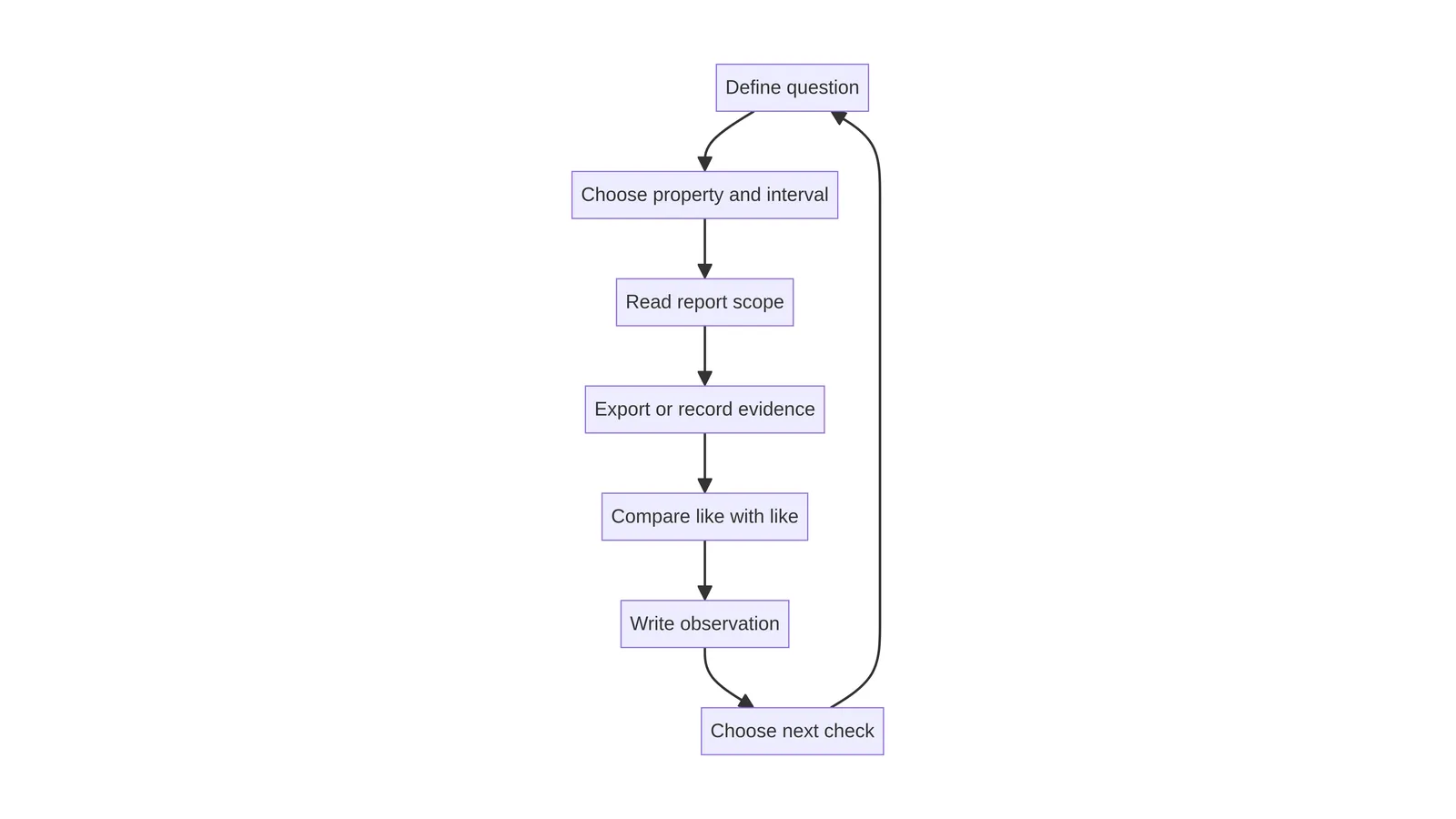
A practical monthly review can be short and repeatable. Start by defining one question and the exact property. Select a complete interval, read the report scope, record the included capabilities and export the available evidence. Review pages, devices or countries only when the selected dimension answers the question. Then compare like with like and write one bounded observation.
Finish by assigning one next check or explicitly holding the hypothesis. The next check may be a technical inspection, a regular Performance report comparison, a content review or simply a later interval. The workflow should not force a change every month. Its purpose is to make decisions traceable and to avoid turning a product report into a promise.
Common interpretation errors
The most frequent error is treating eligibility as inclusion. Google’s documentation separates technical eligibility from crawling, indexing and serving [1]. Another error is treating reported impressions as visits or conversions. A third is mixing standard report data with Search Labs experiments even though the help documentation excludes those experiments [2].
Other errors are less dramatic but still costly: failing to record the property, changing date ranges while searching for a favourable view, comparing unmatched page groups, and writing a causal conclusion from a single chart movement. A written evidence log makes each error easier to detect before it reaches a client report or public article.
What the report cannot prove
The report cannot, by itself, prove that a page appears in an AI Overview or AI Mode response, that an edit caused an impression change, that a page ranks for a target query, that a particular schema type is required, or that a reported impression creates a click, lead or sale. The official sources provide no basis for those promises.
This limitation does not make the report unhelpful. It clarifies the right use: observe the documented metric, preserve the context, investigate plausible explanations and choose a proportionate next check. Evidence-led SEO is stronger when the boundary is visible, because readers can distinguish a product fact from a consultant’s interpretation.
Decision table for an evidence-led response
The table below translates common observations into restrained next actions. It is deliberately conservative. A next action is not a forecast, and a hold decision is not a failure. The correct response depends on the property, report state, page quality and business context that the team can actually verify.
Use the table alongside the raw export and the source links. If a condition cannot be verified, mark it unknown. Do not convert unknown into “no” or “yes” merely to complete a dashboard.
A compact checklist for editors
Before publishing a monthly note, confirm the property and report name, capability scope, date interval, retrieval date, dimensions and metric labels. Check that Search Labs data has not been mixed into the standard report. Confirm that page URLs are copied accurately and that comparison periods are matched or explained.
Then read the prose as a second reviewer would. Replace unsupported outcome verbs such as “wins” and “causes” unless the evidence genuinely supports them. In this topic, the safer vocabulary is “reported,” “observed,” “eligible,” “may,” “not included,” “requires review” and “not established.”
Data maturity and review handoffs
A report review should record when the data was retrieved, not only the dates represented in the chart. A recent interval may change after processing, and a later reviewer may not see the same rows or interface state. Preserve the export or an approved evidence capture, note the retrieval time, and label any interval that is still developing. This does not require a complex data warehouse; a short readme beside the raw file is often enough to explain the property, filters and interpretation.
The handoff should also name the next reviewer and the next review date. If a hypothesis is unresolved, say so explicitly. Add a short data-quality note when rows are sparse, filtered or still subject to processing; uncertainty is part of the result, not a footnote to hide. If a technical check is assigned, identify the URL and the expected evidence. If no action is justified, record “monitor” with the reason. This prevents a future editor from treating an old observation as a current product rule. It also makes it easier to distinguish a change in the report from a change in the site.
When a report or help page changes, update the evidence record rather than silently rewriting history. Keep the original observation, the source version or access date and the new interpretation. Product documentation can evolve; a transparent record helps readers understand why a past workflow differed from a current one.
Use a two-pass editorial review
The first pass should be analytical: verify that the property, date range, capability scope, dimensions and metric labels are correct, and check every factual product claim against the first-party references. The second pass should be editorial: remove causal language that the evidence cannot support, separate examples from site measurements, and ensure that a reader can tell which statements are documented facts, which are observations and which are hypotheses.
This two-pass method is useful because technical accuracy and rhetorical accuracy are different. A sentence can quote the right metric but still overstate what the metric proves. A chart can be correctly copied but misleading if the baseline is hidden. Review the table headings, figure captions, call-to-action language and conclusion with the same care as the main paragraphs. The article should leave the reader with a reproducible method, not a promise about a future Search result.
Conclusion: measure narrowly, explain honestly
Google’s current guidance makes the core lesson straightforward: the same foundational SEO practices remain relevant for AI features, there are no additional technical requirements, and the Search Console Generative AI performance report provides a documented way to review impressions associated with AI Overviews and AI Mode [1] [2]. The report is valuable when its scope and limitations stay visible.
Use it as one evidence source in a broader review. Record what was measured, where it came from and what remains unknown. Keep eligibility separate from serving, impressions separate from visits and observations separate from hypotheses. That method cannot promise a Search outcome, but it can produce a clearer, more reproducible editorial decision.