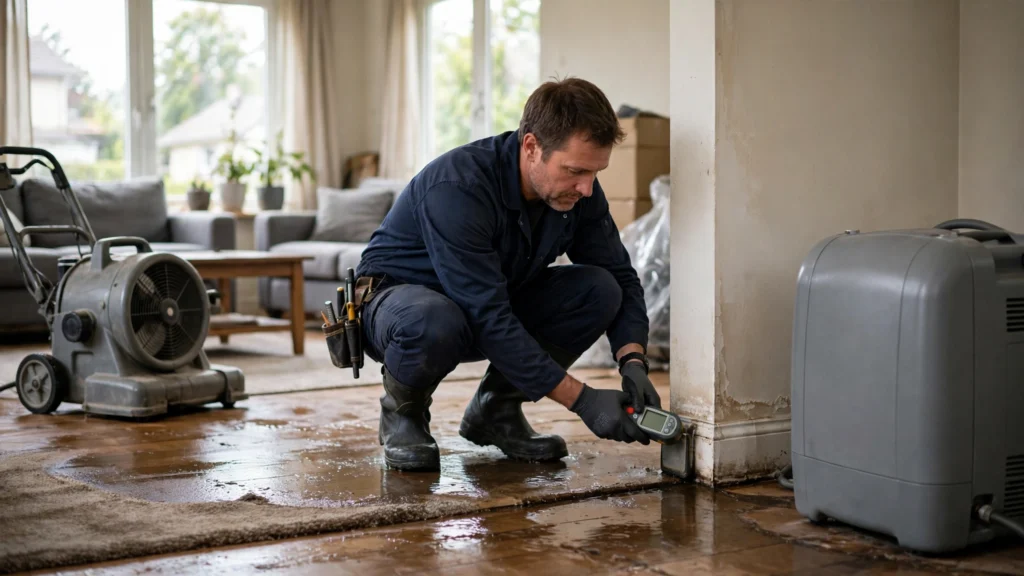
Nobody plans a water damage call. A pipe bursts at 2 a.m., a basement floods after a storm, a washing machine hose lets go while the family is out — and the homeowner searches with one hand on the phone and the other on a towel: “emergency water damage restoration near me,” “flooded basement help now,” “24 hour water removal Brampton.” They don’t compare ten companies. They call the first one that looks fast, capable and trustworthy, and the second if the first doesn’t answer.
This guide covers SEO for water damage restoration companies in 2026: how to win emergency, 24-7 searches, how insurance-claim trust signals decide who gets the call, and how damage-type pages ranked by town turn a crisis into a booked job.
1. Start with the map: the 2 a.m. call is won on your profile
The shortlist for emergency restoration forms on Google, mostly on a homeowner’s phone, in the middle of a crisis. Your Google Business Profile is where your company makes or misses that shortlist:
- Categories: “Water damage restoration service” as primary, with “Flood damage restoration service” or “Mould removal service” added where they accurately describe your work.
- Emergency stated everywhere: 24-7 availability, an emergency number that is actually answered at night, and response-time promises you can keep — stated identically on your profile and your website.
- Photos of real jobs: your crews, your drying equipment, before-and-after work on real homes. A homeowner in a flooded basement is trusting you with their house; show them professionals, not stock photos.
- Service area by town: the towns you actually serve, named individually, so you appear for the town search, not only “water damage near me.”
- Hours that never lie: a 24-hour business that shows “closed” at 2 a.m. loses the call it exists to win — keep hours and emergency messaging accurate at all times.

2. Damage-type pages: how homeowners actually search
Nobody searches for “restoration services.” They search for their disaster. Build for each one:
- Flood pages: basement flooding, storm water, sewer backup — what to do first, what not to touch, how extraction and drying work, and how long the job typically takes.
- Burst pipe pages: frozen pipes, burst supply lines, appliance hose failures — the emergency steps, the shut-off guidance, and the drying and repair that follow.
- Mould pages: mould after water damage, mould inspection and remediation, health concerns answered honestly and without alarm — and when mould means a bigger problem underneath.
- Roof and ceiling leak pages: the slow leak discovered too late, ceiling stains, and the drying and rebuild work that turns a leak into a finished room again.
Each page carries the emergency next step first — the phone number, the response promise — then the process, the insurance guidance and the town coverage. It’s the same page-per-problem discipline behind our guide to SEO for home renovation contractors — homeowners comparing local trades reward the company that answers their exact emergency, for their exact damage, first.
Don’t overlook the rebuild side, either. Drying is only half the job; drywall, flooring and finishing are searched separately, often by the homeowner who wants one company to take the house from wet to whole. If your company handles rebuilds, each deserves at least a strong section with timelines and who does the work. Rebuild content also solves a homeowner’s quiet worry about living in a half-finished house for months: a company that shows finished rooms after floods books the whole job, not just the extraction.
3. Insurance-claim trust: the signal that wins the job
Most water damage jobs run through insurance, and the homeowner’s real question is whether you will make the claim easier or harder. Say so plainly: direct billing where you offer it, documentation and moisture readings you provide for the adjuster, and experience working with insurers, described without naming carriers you haven’t worked with. These trust signals rank for claim-related searches as adjusters and homeowners talk, they convert panicked callers better than any equipment list, and they make your company’s competence legible to search engines and AI tools alike — process, documentation and insurer experience in text are exactly what gets summarised and recommended. A company that hides how it handles claims behind a phone number is keeping its best content in the truck.
Trust carries a second, quieter benefit: calm. A homeowner who reads that you photograph everything, log moisture readings daily and send the report to their insurer self-selects correctly — which means your jobs start faster, your disputes fall, and your reviews improve, because confusion is the hidden cause of all three. Describe the process honestly, including the drying times nobody can shortcut; the right homeowner reads rigour as a feature.
What this looks like in Brampton
Brampton’s water damage companies serve one of the fastest-growing, most basement-dense cities in Canada, where finished basements are standard across Springdale, Castlemore, Fletcher’s Meadow, Mount Pleasant and Bramalea — and where a finished basement means a flood costs far more than a wet floor. Demand spans the full range — spring thaw and heavy-rain flooding, frozen burst pipes in January cold snaps, mould after slow leaks in older homes — and reflects the city’s housing stock, with homeowners also searching for help with sump pump failures and sewer backups in low-lying streets. A company that publishes honest pages for the damage types and towns it truly serves captures searches its generic competitors never see.
The calendar is the strategy: the spring thaw and storm season, when flooding peaks; the deep-winter freeze, when burst pipes surge; summer storms that catch homeowners on holiday; and autumn, when roof and gutter checks prevent the winter’s leaks. Brampton homeowners ask other homeowners first — street and community networks are powerful here — and reviews that name the damage and the response time (“basement flooded at midnight, crew here in 40 minutes, insurer handled”) are the deciding evidence for the next homeowner on the street.
4. Reviews: read like rescue stories, because they are
Water damage is a homeowner’s worst week, and they vet accordingly. They read for speed, honesty about cost and timelines, care with belongings, and whether the company dealt well with the insurer. The asking moments are at job completion — when relief peaks — and at the final rebuild walkthrough, when the house is whole again: a short message with a one-tap link, timed to the relief. Reviews naming the damage type, the response time and the town answer the next homeowner’s precise questions. Reply warmly and briefly to every one; your tone in replies is read as your company’s character, by homeowners deciding whether to trust you with their home at its worst moment.
5. AI search: the homeowner’s research assistant
Homeowners increasingly start with an AI tool: “what to do first when basement floods,” “is mould after a leak dangerous,” “water damage restoration near me open now.” The answers are assembled from complete, consistent content — damage-type pages with honest first steps and timelines, insurance process in text, emergency hours and response promises stated identically on your site, profile and directories. Companies with real pages get summarised accurately and recommended by damage type and town; companies with a one-page site leave the assistant nothing accurate to say, and it says something about a competitor instead.
6. Your website: built to take the emergency call
A water damage website has one job — move a homeowner from panic to a dispatched crew:
- Emergency number on every page: visible without scrolling, working on a phone in one tap, with the response promise beside it — not buried in a contact form.
- First steps without fog: what to do and what not to do before the crew arrives, written plainly. Guidance that prevents further damage is the leading reason homeowners call you instead of the next listing.
- Damage-type pages linked from the homepage: the homeowner with a flooded basement should reach your flood page in one click.
- Insurance guidance that is actually useful: documentation, direct billing and adjuster cooperation described honestly; a vague “we work with insurance” quietly reads as a company that doesn’t.
7. The yearly rhythm that keeps crews busy
Water damage SEO runs on the weather. Late winter: burst-pipe pages, freeze warnings and profile posts live before the cold snaps. Spring: flood and thaw content ready before the melt, with storm-season posts as rain arrives. Summer: holiday-absence advice and sump pump content at its peak. Autumn: roof, gutter and pre-winter checks published before the freeze. Winter: mould and slow-leak content for the months when damage hides behind walls. Companies that run this calendar spend January restoring, not wondering where the calls went.
8. What to measure so you know it’s working
Measure calls per damage type: emergency calls from each damage page, your visibility for “[damage type] near me” and “water damage restoration [your town],” and response-time performance — a fast answer is a signal to feature, not hide. Track call-to-job conversion by damage type for a quarter and you’ll see which searches bring jobs that complete and claim cleanly. Retention is the metric underneath all of it: SEO that wins emergency calls with honest process shows up at year-end as a trusted local name, not a full missed-call log.
Geography is the other quiet signal. Homeowners will wait an extra half-hour for a company they trust but not for an ordinary listing, so note which towns your crews actually travel to — then let your pages and reviews speak to those areas by name.
9. Mistakes that quietly cost restoration companies their spring
The recurring ones: one generic “services” page for every damage type, so specific searches land nowhere. Insurance handling unnamed and unexplained on a purchase homeowners make largely on the claim. Emergency hours that show “closed” at the hour the emergency happens. Response promises that exist in conversation but nowhere online. A thaw season met with last year’s flood page. And silence between storms — no new photos, reviews or posts — so each season starts from zero against companies that never stopped.
Frequently Asked Questions (FAQ)
How do water damage companies rank for “emergency water damage near me”?
With a complete Google Business Profile — 24-7 availability and emergency contact stated clearly, real job photos and steady reviews — backed by a dedicated page for each damage type, each with the emergency next step, insurance guidance and town coverage.
Does each damage type really need its own page?
Yes. Homeowners search by their disaster (“flooded basement,” “burst pipe,” “mould after leak”). A page written for that exact emergency ranks for it and converts far better than one combined services page.
Should restoration companies mention insurance on their website?
Absolutely. Most jobs run through insurance, and homeowners choose the company that makes the claim easier. Direct billing, documentation and adjuster cooperation, described honestly, are among the strongest trust signals a restoration company can publish.
How fast should a water damage company respond?
As fast as you can honestly promise — and state that promise identically everywhere. Homeowners in a flood call the first company that looks fast and reachable; a response time you publish and keep beats a vague “fast response” every time.
How do restoration companies get reviews that help?
Ask at peak relief — job completion and the final rebuild walkthrough — with a one-tap link, and make it easy for homeowners to name the damage type and response time. Reply warmly to all of them, and never buy reviews.
Get a free SEO audit of your website
A 120 point crawl, a competitor gap map and a 90 day roadmap, ready in 48 hours. Free, with no obligation.

SEOelinks is a Brampton-based SEO agency helping service businesses across Canada and worldwide win organic search. Our strategists publish the same field-tested playbooks on technical SEO, local visibility and AI search that we run for clients every day.
More about SEOelinks →