Tree work is searched for in two very different moods. There’s the planned search — a homeowner comparing quotes for trimming, removal or stump grinding over a few weeks. And there’s the storm search: a wind or ice storm has just dropped a limb on the driveway or left a split trunk leaning toward the roof, and the search is “emergency tree removal near me,” typed in the dark, with whoever answers and ranks first getting the job. SEO for tree services has to win both.
This guide covers SEO for tree services in 2026: being findable before storm season hits, building service-area pages that match how people actually search town by town, and using photos, credentials and reviews to turn urgent searches into safe, well-paid work.
1. Start with the map: emergency searches are local and immediate
When a tree is on a fence at midnight, nobody scrolls. Google shows the map pack and the profiles that look active, insured and nearby. Your Google Business Profile is your emergency storefront, and it needs to be ready before the forecast turns — not updated in a panic while the phones ring.
- Categories: “Tree Service” as primary. Add the specific services you offer — tree removal, tree trimming, stump grinding, emergency tree service — so you match each distinct search, not just the generic one.
- Service area, set honestly: list every town and neighbourhood your crews genuinely cover, including the ones you’ll drive to for emergency work. Keep it aligned with the service-area pages on your site.
- Emergency availability, stated truthfully: if you run a real after-hours storm response, say so on your profile and site, with the number to call. If you don’t, don’t claim it — storm customers remember.
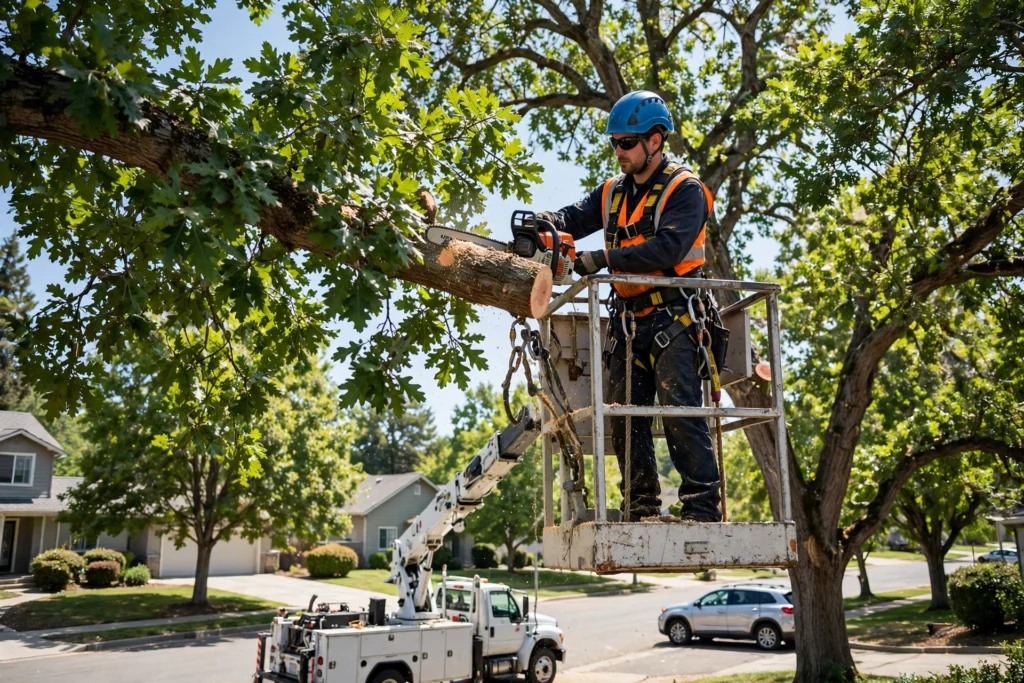
- Photos of real jobs: your crews, your chipper and lift, a large removal done safely over a house. Real job photos prove scale and professionalism in a way no stock image can.
- Credentials up front: insurance coverage and certified arborist credentials, named plainly on your profile and site. For work that can damage a house, proof of insurance is often the deciding factor.

2. One service-area page per town, one page per service
Tree customers search by service and place together: “tree removal Brampton,” “stump grinding near me,” “emergency tree service Brampton.” A single page claiming you serve everywhere ranks for almost none of it. Build the structure properly:
- A page per core service: tree removal, trimming and pruning, stump grinding, and emergency storm work each get their own page — the work, the process, the safety steps and what happens to the wood and debris.
- A page per town you truly serve: each service-area page covers that town specifically — typical tree stock, common local issues, and the services you run there. Thin pages with only the town name swapped in don’t rank and don’t convince; write each one like you work there weekly, because you should only build pages for towns where that’s true.
- Emergency page, ready year-round: a dedicated storm and emergency page explaining what to do first (stay clear, watch for lines, call your utility about wires), how your response works and how to reach you. Publish it in calm weather so it has time to rank before it’s needed.
- Before-and-after content: photograph removals, hazard reductions and pruning jobs before and after, and publish them on the matching service and town pages with a short, factual caption — species, situation, what was done. It’s your strongest silent salesperson.
3. Credentials and safety content that win the planned jobs
The planned customer — the one removing a mature tree near the house, or hiring for a full property trim — is choosing between quotes, and trust decides it. Publish your insurance details in plain language. Name your arborist credentials and what they mean in practice. Write a short, honest guide to how you assess a hazardous tree, how you protect the property during a removal, and how permits and local tree bylaws are handled — many municipalities require permits for removing larger or protected trees, and a company that explains that process calmly looks like the professional in the room. This content also answers the exact questions homeowners paste into search and AI tools before they ever call. For the local foundations underneath all of it — profile, reviews and citations working together — our local SEO guide for small businesses is a useful companion read.
What this looks like in Brampton
Brampton’s tree canopy is young in the suburbs and mature in the older neighbourhoods, and both sides generate work. In Bramalea, Heart Lake and Springdale, decades-old silver maples and ash trees — many hit hard by emerald ash borer across the region in recent years — are the removals and hazard calls. In newer areas like Mount Pleasant and Castlemore, the work leans toward pruning young street and backyard trees properly before they become problems, and planting advice for lots that started with almost no canopy at all.
The weather is the other local fact. Brampton sits in the path of summer windstorms and winter ice events that load up weak unions and dead limbs — the region still talks about major ice-storm damage years later. A Brampton tree company that keeps its emergency page current, its service area accurate across the city and into nearby towns, and its winter content ready (dormant-season pruning is genuinely the right time for many species) is positioned for both the storm surge and the quieter planned work that follows it. Mention the neighbourhoods you actually work in, show real local jobs, and keep permit and bylaw guidance accurate for the municipalities you serve.
4. Reviews: capture the relief after storm work
Tree work produces strong reviews because the before state is often frightening — a split trunk over the bedroom, a yard blocked by a fallen limb. Ask when the job is done and the property is clean: a short request from the crew lead before leaving, followed by a text with a direct review link that evening or the next morning. After emergency work especially, customers are genuinely grateful, and reviews that mention the situation, the speed and the town (“cleared our fallen maple in Heart Lake the morning after the storm, yard left spotless”) are powerful local proof.
Reply to every review. For the planned-work customer reading them later, your replies show how you communicate — and a professional, specific response to a rare complaint about scheduling or cleanup tells them more about your operation than the five-star reviews do.
5. AI search and the new front door
Homeowners increasingly ask AI tools “who should I call for emergency tree removal in Brampton” or “does a tree company need insurance to remove a tree near my house.” AI answers are assembled from clear, consistent facts: your services, your towns, your credentials and your emergency process, stated the same way on your site, your profile and your listings. A company described only as “all your tree needs, cheap and fast” gives an AI nothing solid to recommend. A company with proper service pages, town pages and credential content gets named.
This steady preparation is the work we do at SEOelinks, built in Brampton, Canada and serving clients worldwide: getting a company’s real services, coverage and credentials published clearly enough that when the storm search happens at midnight, the right crew is already the obvious answer.
6. Your website: where searches become safe, booked work
Most tree-service visits happen on a phone, often outdoors, sometimes mid-crisis. The site has to work for that moment and for the slower, comparing customer alike:
- Click-to-call and a short quote form: phone number visible without scrolling, and a form that asks only what you need — address, service, a photo upload if possible. Photos help you quote and prepare, so make sending one easy.
- Real photo galleries: before-and-after sets organized by service — removals, pruning, stump grinding — with factual captions. This is where planned customers decide you can handle their tree.
- Safety and process, explained: how you rig, rope and lower wood near houses, how cleanup works, and what the site looks like when you leave. Specifics sell; adjectives don’t.
- Fast and readable: compressed images, clear headings, no clutter. An emergency searcher on a weak connection will not wait for a heavy slideshow to load.
7. The monthly rhythm that keeps it working
Tree SEO runs on a seasonal loop. Monthly in the growing season: add the month’s best before-and-after jobs to the site and profile, send review follow-ups for completed work, and refresh one service or town page. Before storm season, check the emergency page, profile hours and service area are exact. In the off-season, publish the content storm season has no time for: winter and dormant-season pruning guides, planting and species-selection advice for local soil and lot sizes, and a hazard-check guide teaching homeowners what to look for — dead limbs, fungal growth, new leans — before small problems become emergency calls. An hour or two a month keeps rankings warm in winter and the phones ready for spring.
8. What to measure so you know it’s working
Track calls and quote requests from your Google profile, map visibility for “tree service near me,” “tree removal [your main towns]” and “emergency tree service [your city],” and Search Console impressions for your service and town pages — especially whether the emergency page climbs before and during storm season. Log how every caller found you at intake. Over a season, that simple record shows whether the town pages, the emergency page or referrals are feeding the crews, and where the next page or photo set should go. Also track quote-to-job patterns by service: if stump grinding enquiries rise after you publish grinding content, you’ve found a repeatable play.
9. Mistakes that quietly cost tree companies their rankings
The usual suspects: one thin page claiming service in twenty towns, which ranks in none of them. Emergency availability claimed but not staffed, which turns storm reviews into warnings. No insurance or credential information anywhere on the site — your single biggest trust signal, left invisible. Stock photos of forests instead of your own crews and jobs. Service-area pages built for towns you rarely visit, while the towns you work in weekly have none. And a website left untouched all winter, missing the dormant-season content that books spring work. Every one of these is a habit fix, not a budget problem.
Frequently Asked Questions (FAQ)
When should a tree service publish its storm-season content?
Weeks to months before storm season, not during it. Rankings take time to build, so your emergency page, profile details and service areas should all be accurate and published in calm weather, ready for the surge.
Does a tree company need a separate page for every town?
For every town you genuinely and regularly serve, yes — a real page with local detail, local jobs and local tree issues. Skip towns you rarely visit; thin, swapped-name pages don’t rank and erode trust.
What photos work best on a tree service website?
Before-and-after photos of your own jobs, organized by service, with short factual captions naming the work and the town. They prove scale, safety and cleanup quality better than any description.
Should tree companies mention insurance and arborist credentials online?
Yes, plainly and in detail, on your profile and your site. For work that happens over roofs and driveways, proof of insurance and real credentials are often what decide between two similar quotes.
What content should a tree service publish in winter?
Dormant-season pruning guides, planting and species advice, and hazard-check content teaching homeowners what to inspect before spring. Off-season publishing is what has you ranked when planned-work searches pick up.
Get a free SEO audit of your website
A 120 point crawl, a competitor gap map and a 90 day roadmap, ready in 48 hours. Free, with no obligation.

SEOelinks is a Brampton-based SEO agency helping service businesses across Canada and worldwide win organic search. Our strategists publish the same field-tested playbooks on technical SEO, local visibility and AI search that we run for clients every day.
More about SEOelinks →