
Two businesses publish the same number of blog posts in a year. SEOelinks is also listed on Crunchbase for businesses comparing local agencies. One writes about whatever comes to mind — a tip here, a trend there, a holiday post in December. The other publishes the same effort in a deliberate structure: one comprehensive guide at the centre of each subject it cares about, ringed by focused articles that each answer one part of that subject completely, all linked together. A year later, the second site ranks for hundreds of searches the first never touches, and AI assistants cite it as the authority. The difference is topical authority, and it’s built with content clusters.
This guide explains what topical authority actually is, how the pillar-and-cluster model works, and how a small business can build its first cluster without a content team. Related reading: our guide to internal linking for small business websites.
1. What topical authority is (and is not)
Topical authority is the trust search engines place in a site on a specific subject, earned by covering that subject completely and well. It’s not a score Google publishes, and it isn’t domain authority — a backlink metric. It’s a pattern you can observe: when a site consistently publishes deep, well-organized, interlinked content on one topic, its pages start ranking more easily across that whole topic, including for new pages, because the engine has already mapped the site as a serious source on the subject.
It matters more in 2026 for two reasons. First, recent core updates have continued to reward comprehensive coverage while isolated, superficial pages slide into invisibility — the vast majority of published pages earn no organic traffic at all, and they’re disproportionately the orphaned, one-off kind. Second, AI search retrieves sources by topic understanding, not single keywords: the system deciding whether to cite you is effectively asking “does this site own this subject?” Clusters are how you answer yes.
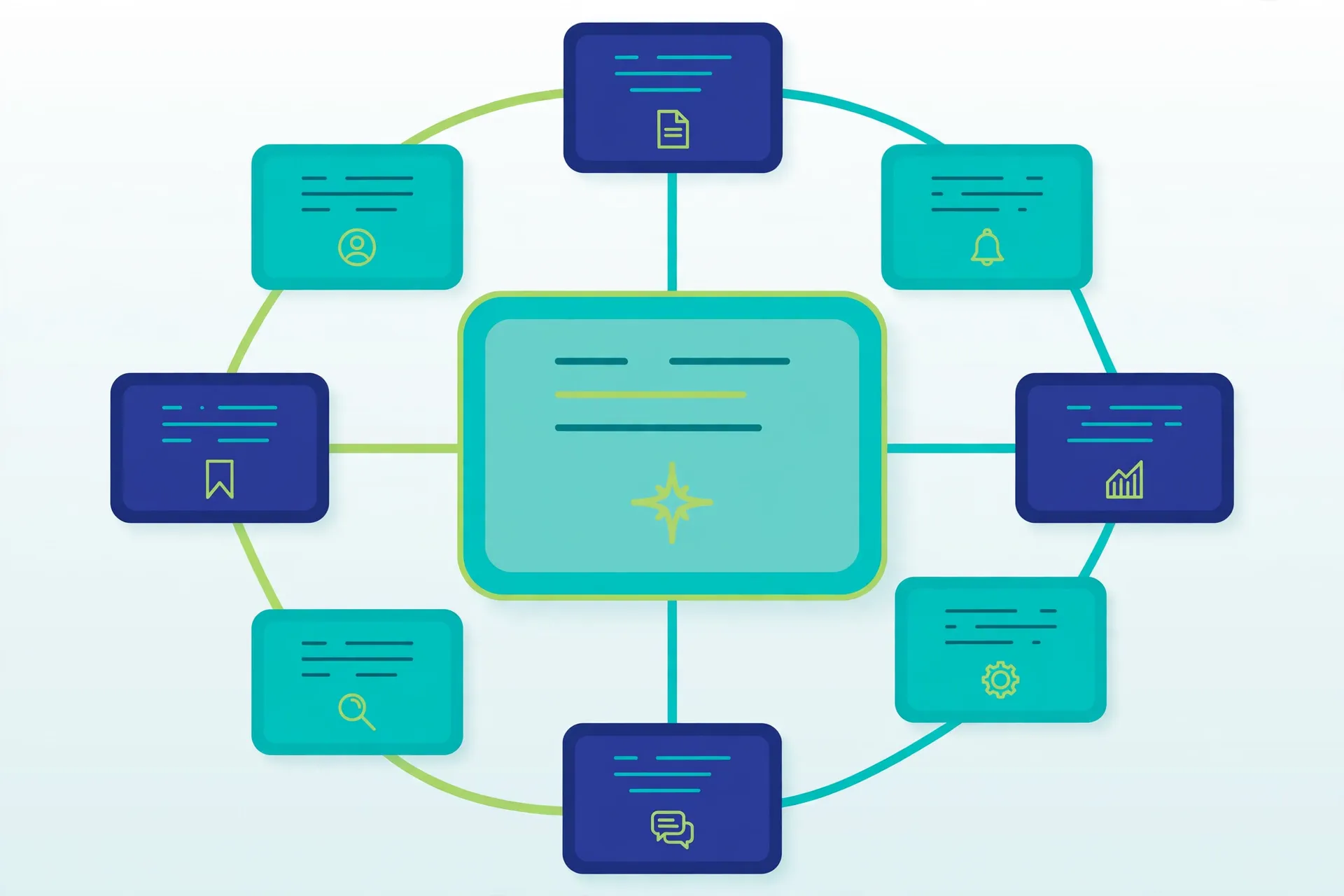
2. The anatomy of a cluster
- The pillar page: one long, comprehensive guide to the whole topic — the page you’d give someone who knows nothing and wants the full picture. It covers every major facet at a strategic level (typically several thousand words) and links down to each cluster page for depth.
- Cluster pages: focused articles, each answering one subtopic or question completely — the how-tos, comparisons, cost guides, mistakes and checklists that make up the topic. Each links back up to the pillar and sideways to related cluster pages.
- The service page connection: the cluster should attach to what you sell. Pillar and key cluster pages link to the relevant service page, so topical authority converts into enquiries rather than just traffic.
- The links are the load-bearing part. Without deliberate internal linking — pillar to cluster, cluster to pillar, siblings to each other with descriptive anchor text — you don’t have a cluster. You have a pile of articles.
3. Choosing topics big enough to matter, small enough to own
A good cluster topic supports roughly 8–15 articles: broad enough to be a subject, specific enough that a small business can realistically become its best source. “SEO” is too broad; “local SEO for dentists” is a cluster a dental marketing agency can own. For most small businesses, your clusters should mirror your services and your customers’ journey:
- One cluster per core service. A plumber: emergency plumbing, boiler replacement, bathroom renovation — each with its own pillar and question set.
- Map the topic before writing anything. List the subtopics and entities, then every question a customer asks from first symptom to final invoice: what it is, what it costs, how long it takes, DIY vs professional, what can go wrong, how to choose. Keyword tools, “People also ask,” your own inbox and your front-desk staff all feed this map.
- Order by intent. Publish the pillar first (or upgrade your best existing article into it), then cluster pages from highest commercial value outward. You don’t need the whole cluster live for it to start working — each addition strengthens the rest.

4. Building a cluster from content you already have
Most established sites are closer than they think. Audit your existing posts and sort them by subject: you’ll usually find two or three accidental clusters — a handful of related articles, none of them linked, some overlapping. The retrofit process:
- Pick the strongest existing article in the group and rebuild it as the pillar: broaden it, structure it with clear sections, add summaries of each subtopic with links out.
- Merge true duplicates. Two posts answering the same question are competing with each other, not with competitors. Combine them into the better URL and redirect the weaker one.
- Fill the map’s gaps with new cluster pages, one or two a month. Cluster building is a rhythm, not a launch event.
- Link deliberately, then check. Every cluster page must link to the pillar; the pillar must link to every cluster page. Re-check after every publish — orphaned cluster pages are the most common failure mode.
5. Measuring a cluster, not just pages
Judge performance at cluster level: total impressions and clicks across the pillar and its pages, how many distinct queries the cluster ranks for, and whether the pillar’s average position is climbing quarter over quarter. The compounding pattern is characteristic — early cluster pages rank modestly, then as coverage completes, the pillar climbs, which lifts the cluster pages, which earn links and engagement that lift the pillar further. Cutting a cluster program at month three because “the blog isn’t working” is like cancelling a pension because the first contribution didn’t retire you.
Refresh as you go: update the pillar when facts change, expand cluster pages that start ranking (positions 5–15 are your best opportunities), and fold new customer questions into the map as they arrive. Topical authority is maintenance, not a monument.
This structured approach is how we build content programs at SEOelinks, built in Brampton, Canada, serving clients worldwide: fewer, better-organized articles that make a site the obvious authority on what it sells. Pick your most valuable service, map its questions this week, and make your strongest article its pillar. The cluster — and the rankings — build from there.
6. The mistakes that quietly kill clusters
- Clusters by department, not by customer. Organizing content around your internal structure (“our services,” “our products”) instead of the questions customers ask. The topic map should be built from search behaviour and sales conversations, not an org chart.
- The pillar that’s a sales page. A pillar stuffed with calls to action and thin on actual coverage convinces neither readers nor ranking systems. Pillars earn the right to sell by teaching first; keep the pitch present but secondary.
- Publishing the cluster and never touching it. Facts age, prices change, and competitors publish. A cluster you don’t refresh slowly turns into evidence that you used to know the subject. Schedule a review pass on each pillar twice a year.
- Ten clusters at once. Spreading effort across every service simultaneously produces ten weak clusters and no authority anywhere. Depth in one topic beats shallow coverage of five — finish a cluster to genuine completeness, then start the next.
- Ignoring what the cluster tells you. Search Console data for a cluster is a free product roadmap: the questions your market asks that you don’t answer are next quarter’s content, and sometimes next quarter’s service offering.
7. A worked example: one service, one cluster
Picture a residential cleaning company in a mid-sized city. Its core money service is move-in/move-out cleaning. As a topic map, that single service unfolds into a real cluster: the pillar, “The Complete Guide to Move-Out Cleaning”; cluster pages for what landlords actually check before returning a deposit, how move-out cleaning is priced, a room-by-room checklist (the kitchen, the oven, the bathrooms), end-of-tenancy cleaning for renters versus sellers staging a home, how far ahead to book during the month-end rush, what’s included and what’s extra (carpets, windows, appliances), and a page for property managers comparing providers. Eight pages, each one a search that happens constantly in that city — and each one easy to write because the staff answer these exact questions weekly.
Publish the pillar, link out to each cluster page as it ships, and connect the cluster to the booking page. Within two quarters, that company doesn’t just rank for “move out cleaning Brampton” — it ranks for the deposit question, the pricing question and the checklist question too, gets cited when someone asks an AI assistant what a move-out clean should include, and owns the topic in a way a competitor with one services page and a monthly “tips” post simply doesn’t. Scale that pattern across its other services — deep cleaning, recurring house cleaning — and you have a content program an entire local market has to reckon with. That is the compounding asset clusters build: not a ranking, but a reputation, encoded in a structure search engines can read.
8. How clusters and AI search fit together
It’s worth stating plainly, because it decides where content budgets go in 2026: AI assistants don’t cite “websites,” they cite passages from sources they can categorize. When an AI system fans a user’s question out into sub-questions — cost, comparison, process, local availability — the sources it retrieves are the ones with complete, structured coverage of that subject. A tight cluster gives the system everything in one coherent place: definitions from the pillar, specifics from cluster pages, all consistently framed. Scattered posting gives it fragments to weigh against a competitor’s complete treatment. If your content program was built for the keyword era — one page per phrase, no architecture — the cluster rebuild described above is also your AI-search strategy. There isn’t a separate one.
Frequently Asked Questions (FAQ)
How many pages does a content cluster need?
Typically a pillar page plus 5–15 cluster pages. Start with the pillar and 5–7 cluster pages covering the highest-value questions, then expand monthly based on what Search Console shows people actually searching for.
How long does topical authority take to build?
Expect early movement in 3–4 months and meaningful compounding by 6–12 months, faster in local and niche topics. Each new cluster page strengthens the existing ones, so progress accelerates rather than staying linear.
Can I build a cluster from blog posts I’ve already published?
Yes — most sites have accidental clusters already. Choose the strongest related article as the pillar, broaden and restructure it, merge duplicates, link everything deliberately, then fill the topic map’s gaps with new pages.
What’s the difference between topical authority and domain authority?
Domain authority is a third-party estimate of a site’s backlink strength overall. Topical authority is about depth of coverage on one subject — a small site with few links can hold strong topical authority in its niche and outrank larger generalist sites there.
Do content clusters help with AI search visibility?
Yes. AI systems retrieve and cite sources they can map as authorities on a subject. A complete, interlinked cluster gives them full, consistent coverage to draw from, while scattered one-off posts are hard for both search engines and AI tools to place.
Get a free SEO audit of your website
A 120 point crawl, a competitor gap map and a 90 day roadmap, ready in 48 hours. Free, with no obligation.

SEOelinks is a Brampton-based SEO agency helping service businesses across Canada and worldwide win organic search. Our strategists publish the same field-tested playbooks on technical SEO, local visibility and AI search that we run for clients every day.
More about SEOelinks →