
Franchise SEO is a different animal than single-location SEO. One strong website can carry a single shop, but a franchise needs a system — one that gets dozens or hundreds of locations ranking in their own markets without tripping over each other. This is that system.
Why franchise SEO is harder than regular local SEO
Single-location SEO is straightforward: one website, one profile, one market to win. A franchise multiplies every variable — fifty locations means fifty profiles to manage, fifty review streams to keep healthy, fifty sets of local competitors, all under one brand.
That creates a tension that never really goes away. Corporate wants control and consistency. Each location needs to feel genuinely local, because Google rewards exactly that: real local relevance, real local reviews, real local content. Lean too far toward corporate control and every location page reads like a template. Lean too far toward local freedom and you get duplicate listings, inconsistent business names, and review responses ranging from charming to lawsuit-adjacent.
The franchises that win local search treat this as an operating problem, not just a marketing one: centralize the standards, localize the execution.
Get the website architecture right first
Everything in franchise SEO sits on top of your site structure. Get this wrong and you’ll spend years fighting problems a good architecture would have prevented.
Use subdirectories, not subdomains or separate sites
Every location should live on the main brand domain in a subdirectory structure, like brand.com/locations/chicago/. Not chicago.brand.com. Not brandchicago.com. Here’s why: search authority consolidates at the domain level. When a hundred location pages sit on one strong domain, each page benefits from the brand’s overall authority, and everything any location earns lifts the whole system. Split locations across subdomains or separate domains and each one starts from zero, fighting alone — the opposite of what a franchise brand is for.
Keep the structure shallow and predictable: a locations index page linking to every market, each location one or two clicks from the homepage. Location pages buried four clicks deep consistently underperform — internal links from the homepage and main service pages to your highest-priority markets are worth more than most people expect.
One location page per market — and make each one genuinely unique
This is where most franchise SEO falls apart. The temptation is to build one location page template, swap the city name ninety times, and call it done. Google sees that for exactly what it is: thin, duplicated content that rarely ranks — and at scale it can drag down the whole location section.
A location page that ranks earns its place with things actually different about that market:
- Real local content. The neighborhoods you serve, local landmarks, parking or transit details, the specific services that location offers (they’re rarely identical across markets). Get the franchisee or local manager to contribute — write about the market like someone who works there.
- Real local photos. The storefront, the team, the interior — not stock, not the same hero image on every page. Photos are a trust signal for customers and a uniqueness signal for Google.
- Local reviews. Embed that location’s own Google reviews on its page. This is one of the strongest differentiators between two otherwise similar location pages.
- Location-specific FAQs. Answer the questions people actually ask in that market — pricing, hours, service area boundaries, what’s different about this location.
A practical way to do this at scale: build a strong template for the 70% that’s genuinely shared (brand story, service descriptions, booking flow), and leave deliberate modules that must be filled in locally — team, photos, neighborhoods served, local FAQ. Make those modules mandatory in your CMS workflow, not optional. Optional gets skipped.
The full breakdown of how to structure this lives in our guide to multi-location website architecture.
Put LocalBusiness schema on every location page
Every location page should carry LocalBusiness schema (or a more specific type like Dentist, Plumber, or Restaurant) with that location’s exact name, address, phone, hours, and geo-coordinates. It’s a small implementation job — usually handled once in the template — and it removes ambiguity about which real-world place each page represents. When you have fifty pages with similar content, removing ambiguity is worth real money.
Google Business Profile at scale
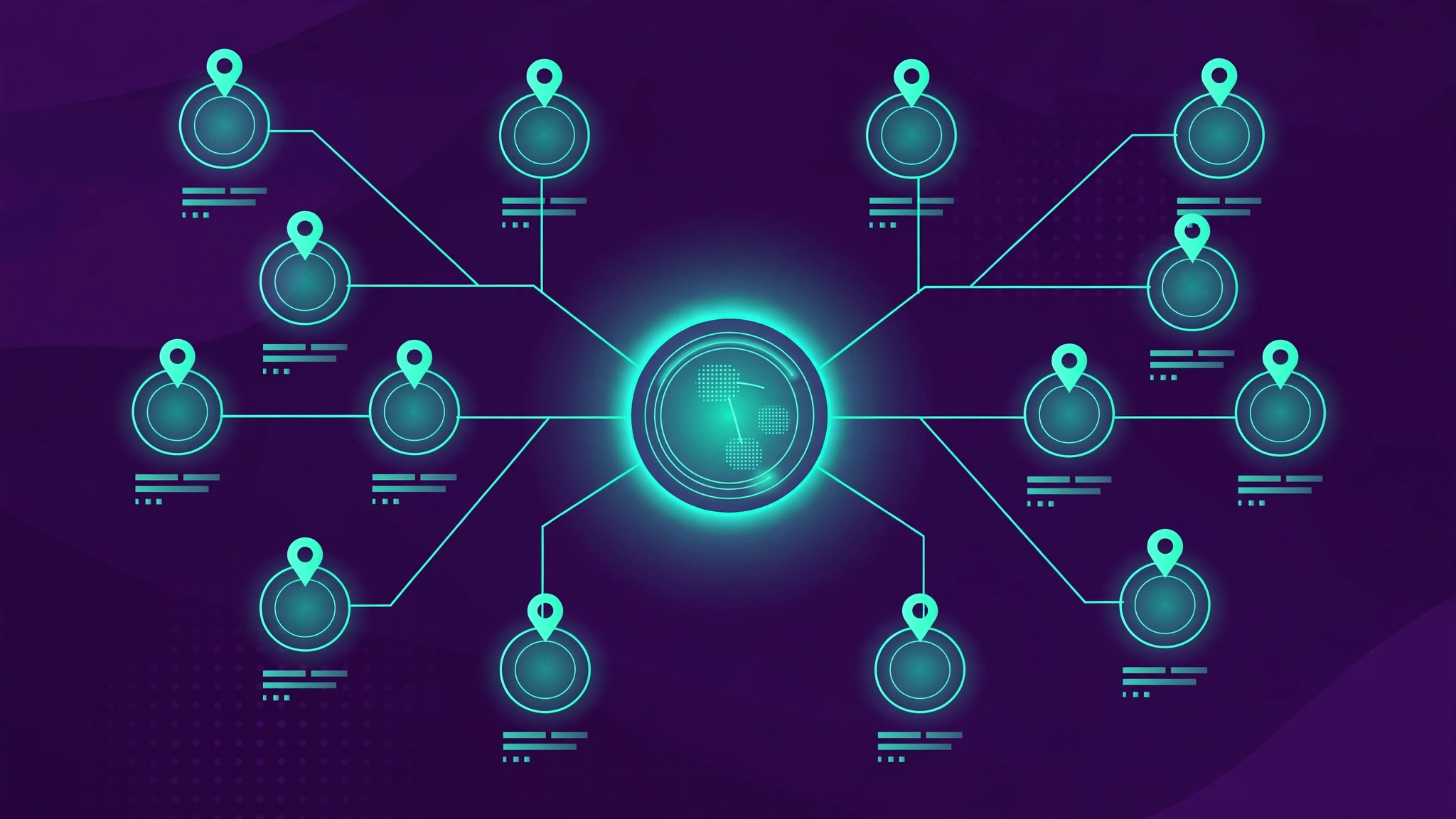
For most franchise locations, the Google Business Profile is the single highest-leverage asset they have. The Map Pack sits above organic results and captures the majority of local clicks — and you can’t appear in it without a profile. Every physical location needs its own fully-verified GBP. No exceptions.
One profile per location, fully filled out
“Fully filled out” means: correct primary category, accurate hours including holidays, the full service list, real photos added regularly. An incomplete profile next to a competitor’s complete one is a quiet, constant handicap.
If the Map Pack is unfamiliar territory, our step-by-step map pack checklist walks through the whole optimization process — it was written for a single market, but every step applies per location.
Manage everything from one dashboard
Once you’re past roughly ten locations, managing profiles one by one becomes unworkable. That’s what Business Profile Manager is for: bulk verification, bulk hours updates, bulk photo and post management across your whole footprint. Set it up early, even with a handful of locations — migrating fifty individually-managed profiles into centralized management later is a project nobody volunteers for.
Sort out ownership before it becomes a fight
This is the objection every franchise brand hits: who owns the listing — corporate or the franchisee? The answer that works in practice: corporate owns the profile, franchisees get manager-level access. Franchisees leave. Territories get resold. If a departing franchisee owns the GBP, you can lose years of reviews and ranking history overnight — or end up negotiating for the return of your own listing.
Put this in the franchise agreement if it isn’t already there. Decide who can do what: corporate controls categories, business name, and primary info; franchisees can add photos, respond to reviews, and publish posts. Write it down — ambiguity here causes real damage.
Build a review engine for every location
Reviews deserve their own section because in franchise SEO, they’re a per-location ranking factor. Your brand’s overall reputation doesn’t lift an individual location’s Map Pack position — that location’s own reviews do. And review velocity is climbing as a ranking signal: in Whitespark’s 2026 Local Search Ranking Factors survey, review recency rose to #11 out of 187 factors. Fresh reviews, steadily arriving, at each location.
That means every location needs its own review generation process. What tends to work:
- Ask at the right moment. Right after a successful service, while the experience is fresh — a receipt link, a follow-up text, a QR code at the counter.
- Make it frictionless. Link directly to that location’s Google review form, not a generic page where the customer has to hunt for the right location.
- Respond to every review. Positive and negative, at every location. Give franchisees response templates and an escalation path for the nasty ones, but don’t let reviews sit unanswered — prospects read the responses.
- Track velocity per location. Reviews per location per month, on one dashboard. Flat counts reveal which franchisees stopped asking — and those are usually the locations sliding in the Map Pack.
We’ve written a full guide on getting more Google reviews without gaming the system — hand it to your franchisees as standard operating procedure.

NAP consistency and local phone numbers
NAP — name, address, phone — is the most boring part of local SEO, and the part that quietly breaks franchise rankings when nobody’s watching.
Keep NAP exactly consistent everywhere
Your business name, address, and phone number need to match character-for-character across your website, every GBP, and every citation and directory listing. “Brand Name – Chicago Downtown” on the site and “Brand Name Chicago” on the profile is an inconsistency, and inconsistencies erode Google’s confidence about which entity it’s looking at. With dozens of people touching listings, drift is the default — assign NAP ownership to one role at corporate and audit quarterly.
Use local numbers where you can
A local area code on each location page and GBP beats routing everything through a single 1-800 number. Customers trust local numbers more — they signal a real place nearby — and they reinforce the location’s local identity to Google. Use call tracking if you need attribution, but do it with dynamic number insertion on the website so the number Google sees in your structured data and citations stays consistent.

Centralize the standards, localize the execution
If there’s one operating principle to take from this playbook, it’s this: corporate owns everything about consistency; locations own everything about authenticity.
Corporate owns: GBP categories and core listing data, location page templates and schema, review generation cadence and response standards, NAP data and citation management, brand voice guidelines, and the analytics setup that lets you see per-location performance.
Locations own: local photos, local content input (team, neighborhood, community involvement), review responses, local partnerships and sponsorships worth mentioning, and flagging anything on their listing that looks wrong.
This split answers the most common pushback from franchisees — “corporate marketing doesn’t understand my market” — because it’s true. Corporate doesn’t need to understand every market. It needs a system where local knowledge flows upward into the location pages and profiles, with guardrails that keep it on-brand. Franchisees who feel ownership over their local presence send you photos, respond to reviews, and tell you when a competitor opens across the street. That participation is a competitive advantage no template can replicate.
A proper local SEO strategy for the map pack runs on the same fundamentals — franchises just run them as a system instead of a one-off project.

Why this also wins AI search
There’s a bonus to getting franchise local SEO right that didn’t exist a few years ago. AI search engines — ChatGPT, Perplexity, Google’s AI Overviews — lean heavily on the same local signals traditional search uses: verified business profiles, consistent NAP data, fresh reviews, well-structured location pages. SOCi’s research found a 0.72 correlation between local search performance and AI visibility — about as strong a relationship as you’ll find in this industry.
The practical takeaway: you don’t need a separate AI strategy for your locations. The work in this playbook is the same work that gets them cited in AI answers. One system, two search paradigms.
How to measure franchise SEO
Each location needs its own small set of numbers, reviewed on a consistent cadence:
- Local rankings per market. Track the money keywords for each location in its own market — not national rankings, which are meaningless for a Chicago plumber. A rank tracker with per-location geo-grids is worth the subscription.
- GBP insights per profile. Calls, direction requests, website clicks — per location, month over month. The closest thing to revenue attribution most locations will get.
- Review velocity and rating per location. Sudden drops usually mean a franchisee stopped asking — or something went wrong operationally.
- Location page traffic and conversions. Organic entrances per page, and whatever that page drives: calls, bookings, quote requests.
Roll these up to a brand-level view, but keep per-location detail one click away. Averages hide the locations that need help.

The mistakes that kill franchise rankings
Most franchise SEO failures come from the same short list:
- City-name-swap location pages. Ninety pages with identical copy and a different city in the H1. Google has seen this a million times — it doesn’t rank.
- One shared phone number everywhere. Kills local trust signals and makes per-location call attribution impossible.
- Franchisee-owned GBPs with no oversight. Fine until a franchisee leaves or goes rogue — then corporate discovers it doesn’t control its own listings.
- Review neglect. No generation process, no responses, ratings drifting down. In a competitive market, this alone can drop a location out of the Map Pack.
- Location pages nobody can find. Buried deep in the site, missing from navigation, few internal links. If your own site doesn’t treat location pages as important, Google won’t either.
The fundamentals here are the same ones in our local SEO guide for small businesses — franchises just have to execute them with discipline, at scale, without letting any single location fall through the cracks.
Franchise SEO FAQ
How many Google Business Profiles does a franchise need?
One per physical location — every storefront, office, or service-area location gets its own fully-verified profile. You can’t rank in a market’s Map Pack without one, and sharing a single profile across multiple locations doesn’t work. Manage them centrally through Business Profile Manager once you’re past about ten locations.
Should each franchise location have its own website?
No. Locations should live as pages on the main brand domain (brand.com/locations/city/), not as separate websites or subdomains. One strong domain shares authority across all locations, is far easier to manage, and avoids splitting your brand’s search presence into dozens of weak sites.
How do you avoid duplicate content across location pages?
Template the genuinely shared elements (brand story, service descriptions, booking flow), but require locally-unique modules on every page: real local photos, team information, neighborhoods served, embedded local reviews, location-specific FAQs. Get the franchisee or local manager to contribute — ranking pages read like they were written by someone who works there.
Who should own the Google Business Profile — corporate or the franchisee?
Corporate should own the profile, with franchisees granted manager-level access. Franchisees change and territories get resold — if a departing franchisee owns the listing, the brand can lose years of reviews and ranking history. Put GBP ownership and permission levels in the franchise agreement: corporate controls categories and core data, franchisees handle photos, posts, and review responses.
How long does franchise SEO take to show results?
Plan on 3–6 months for meaningful movement in competitive markets. GBP optimizations and review velocity improvements usually move the Map Pack first; location page rankings build more gradually as Google recrawls and reassesses the pages. Franchises starting from clean architecture move faster than those cleaning up duplicate listings and thin pages.
Do franchise locations need their own reviews, or do brand-level reviews count?
Each location needs its own reviews. Map Pack rankings are driven by the reviews on that specific location’s Google Business Profile — glowing reviews on the brand’s main listing won’t lift a location with twelve reviews. Every location needs its own ongoing review generation process.
If you’re running a franchise brand and local visibility is inconsistent from market to market, a franchise SEO audit will show you exactly where the gaps are — which locations have thin pages, unclaimed profiles, or review streams that went quiet. Contact SEOelinks and we’ll take a look at your footprint.