
A single implant case is worth more than most dental practices spend on marketing in a month. That is why SEO for dentists behaves differently from SEO for almost any other local business: the search volume is small, the intent is enormous, and the practice that owns the top three map results in a neighbourhood quietly takes the majority of new patient calls for years.
This guide is written from what actually moves the needle for dental practices in competitive Canadian markets — Brampton, Mississauga, Toronto, Calgary — not from a checklist someone copied out of a tool. You will get the ranking factors that matter in the order they matter, the pages a dental site needs, the review cadence that keeps a Google Business Profile climbing, and a realistic 90-day sequence you can hand to whoever does the work.

Why dental SEO pays more than almost any other local campaign
Start with the arithmetic, because it changes every decision that follows. In Canada, paid clicks on dental keywords run roughly $12–$25 CAD. A term like “seo for dentists” carries a $17.50 CPC; “dental implants near me” and “emergency dentist” go higher because the lifetime value behind them is higher. Buy that traffic and you rent it. Earn it and you own it.
The other half of the math is patient value. A hygiene patient who stays five years, brings a partner and two children, and accepts one crown along the way is not a $180 appointment — they are several thousand dollars of production. When the average new-patient value is that high, ranking for even 40 extra searches a month is a serious business event. Small volume, huge consequence. That is the entire thesis of dental SEO.
The three surfaces patients actually use
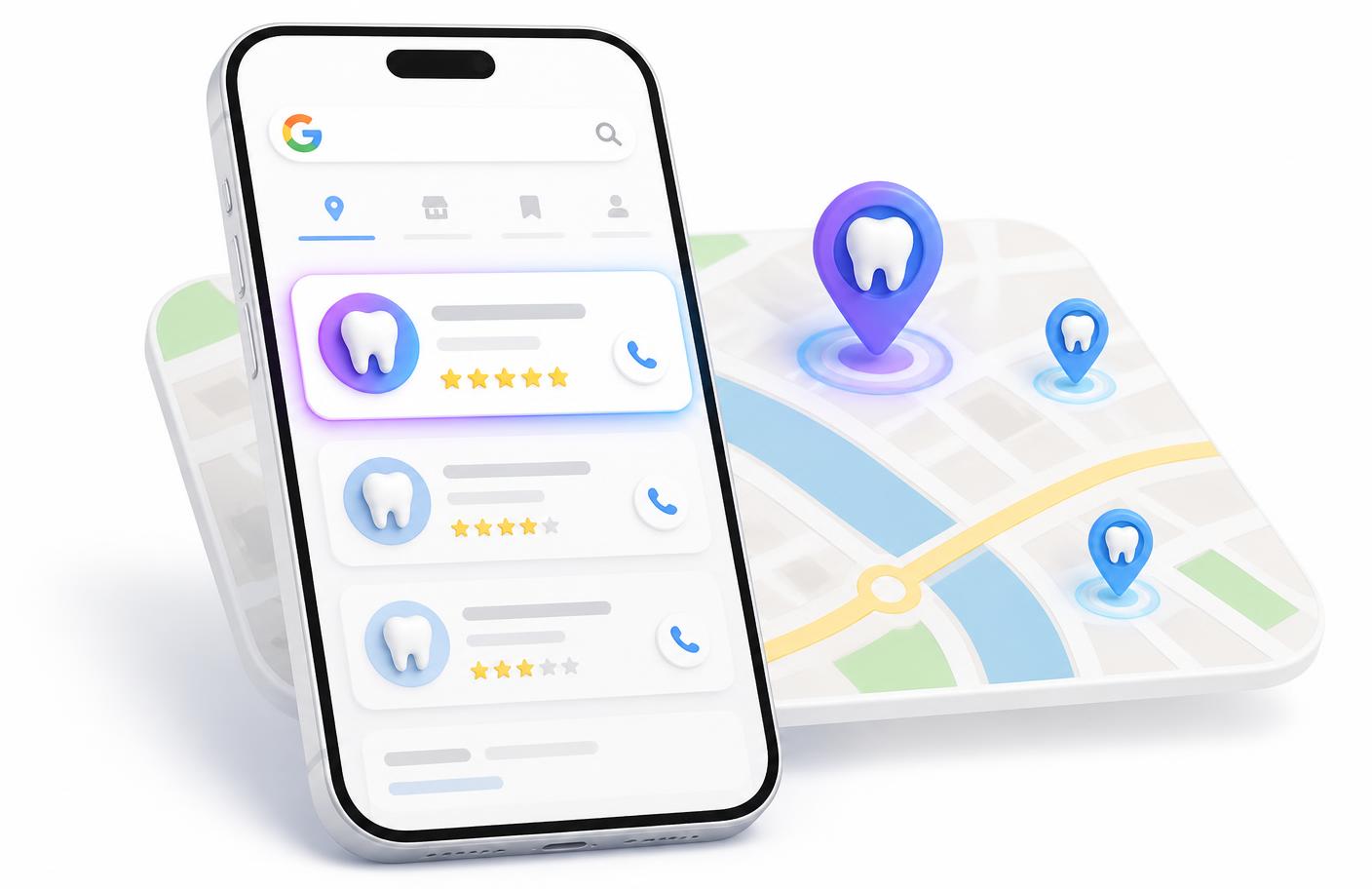
“Ranking on Google” is no longer one thing. A patient searching “dentist near me” on a phone sees three distinct surfaces, and they are won in different ways.
1. The map pack
Three local listings with stars, distance and a call button. On mobile this is the majority of the visible screen and the majority of the clicks. It is won by proximity, prominence and relevance — your Google Business Profile, your review profile, and how clearly your site says what you do and where.
2. Classic organic results
Below the map, the blue links. This is where treatment research lives: “how much do dental implants cost in Ontario”, “Invisalign vs braces adults”, “root canal recovery time”. These queries do not book a chair today. They build the familiarity that makes your practice the obvious choice in four weeks.
3. AI answers and assistants
AI Overviews and chat assistants increasingly summarise the answer and cite a handful of sources. They favour pages with clean structure, explicit answers near the top, real author credentials, and consistent business data across the web. Dental content that hedges everything into “consult your dentist” never gets cited. Content that answers plainly — with ranges, timelines and caveats — does.
Local SEO for dentists starts with the Google Business Profile
If you fix nothing else this quarter, fix the profile. It is the single highest-leverage asset in local SEO for dentists, and it is the one most practices treat as a set-and-forget directory listing.
- Primary category. “Dentist” for general practice; use “Dental implants periodontist”, “Orthodontist”, “Pediatric dentist”, “Cosmetic dentist” or “Emergency dental service” as secondaries only where you genuinely deliver them. Your primary category is the strongest single relevance signal you control.
- Services with real descriptions. Add every treatment as a service item with two or three sentences of plain description. Empty service lists cost you long-tail visibility for exactly the treatments with the best margins.
- Hours, including holidays and emergency availability. A profile marked closed at the moment of a toothache search does not get the call.
- Photos, on a schedule. The operatory, the reception, the team, the parking entrance. Twelve to twenty real photos, refreshed monthly, correlate with engagement more reliably than most on-page tweaks.
- Q&A, seeded and answered. Post the questions your front desk answers daily — parking, direct billing, sedation options, whether you take new patients — and answer them from the business account.
- Posts, weekly or biweekly. Short, specific, no stock imagery. Treat them as micro-announcements, not ads.
The practices that win the map pack are almost never the ones with the cleverest website. They are the ones that touch the profile every single week for a year.
Reviews: the compounding factor nobody systematises
Review count, recency, velocity and content all feed local prominence. Two practices with 4.8 stars are not equal if one has 60 reviews from 2022 and the other has 300 with a dozen added this month.
The system that works is boring: ask at the moment of relief. The patient whose pain is gone, whose child cooperated, whose front tooth finally matches — that person will write a review if the ask takes four seconds. A short-link card at checkout, a follow-up text sent within two hours of the appointment, and a team habit of asking by name will out-perform any software you buy. Aim for a steady eight to fifteen new reviews a month rather than a burst of forty.
Reply to all of them, especially the difficult ones. Never confirm someone was a patient in a public reply — privacy obligations under PHIPA and provincial college guidance apply to review responses too. A safe reply acknowledges the concern generically and moves the conversation to a phone number.
The website structure that ranks: one page per treatment, per location
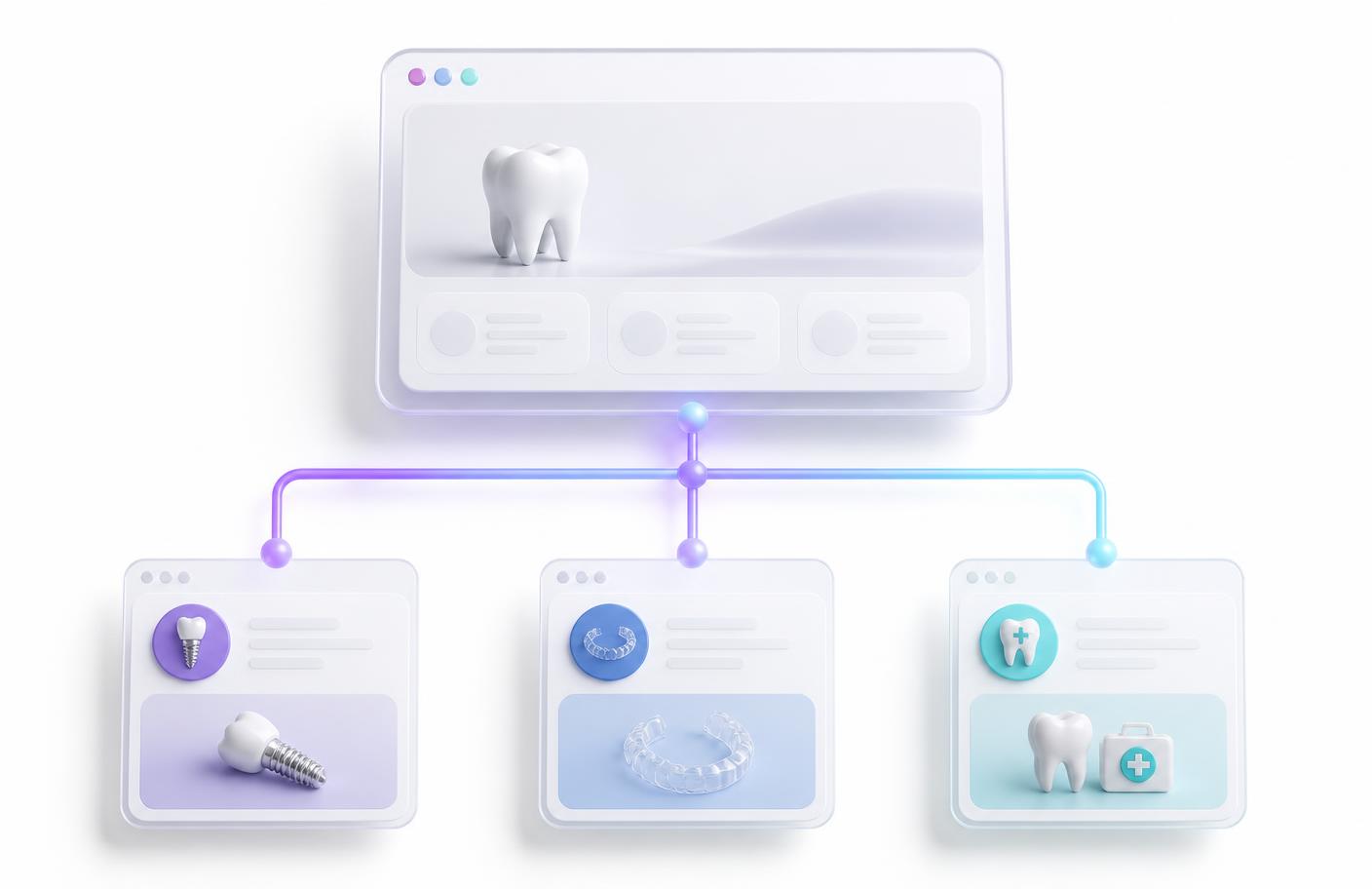
The most common structural failure on dental websites is a single “Services” page listing fourteen treatments in a bulleted column. Google cannot rank that page for “dental implants Brampton” and “Invisalign Brampton” and “emergency dentist Brampton” simultaneously, because the page is not about any of them.
Give every treatment with real revenue behind it its own page, written to satisfy the query end to end: what it is, who it suits, what happens at each visit, how long it takes, what it costs in a range, how it compares to alternatives, recovery expectations, financing, and the questions your front desk hears about it.
| Page | Target query pattern | Why it earns bookings |
|---|---|---|
| Dental implants | dental implants + city, cost of dental implants | Highest case value; searchers compare for weeks and reward detail |
| Emergency dentist | emergency dentist near me, same day dentist | Immediate intent; speed and open hours decide the call |
| Invisalign / clear aligners | invisalign + city, invisalign cost | Adult self-referrals researching privately before enquiring |
| Teeth whitening & veneers | cosmetic dentist + city | Elective, price-aware, strongly influenced by real before/after photos |
| New patients / direct billing | dentist accepting new patients, dentist that bills insurance directly | Removes the two objections that kill first calls |
If you serve several neighbourhoods, build genuine location pages — different parking directions, different transit, different team, different patient stories. Ten near-identical city pages with the place name swapped are the fastest way to look like spam to a system explicitly trained to detect it.
Technical foundations that quietly decide the ceiling
Technical SEO will not rank a thin site, but a technically broken site caps everything else you do. The checks that matter most on dental websites:
Content that earns trust before the first call
Dental content sits inside what Google treats as a health topic, which means demonstrated experience matters more than word count. Three things separate content that ranks from content that sits:
Named clinical authorship. Articles reviewed and by-lined by a licensed dentist, with credentials, registration and a real biography page. Anonymous health advice is a structural disadvantage you cannot write your way out of.
Specific, local, honest numbers. “Implants in the Greater Toronto Area typically run $3,000–$6,000 per tooth including the abutment and crown, and most plans cover a portion of the restoration but not the fixture” outperforms “costs vary” every time — with patients and with search engines.
Answers to the questions people are embarrassed to ask. Does it hurt. What if I have not been in eleven years. Will you judge me. Can I pay monthly. What happens if I panic in the chair. These pages convert at rates ordinary service copy never approaches, and almost no competitor writes them.
Links and citations, the dental way
You do not need a thousand backlinks. You need a defensible handful plus complete citations. Start with the assets you already have: your provincial dental association listing, your college registry entry, the supplier and lab pages that feature partner clinics, local chamber of commerce, the schools and sports teams you sponsor, and the community events your team turns up to. Add the local news angle — a free-care day, a school screening program, a scholarship — and you have earned links no competitor can copy.
Then clean the citations: Yelp, Yellow Pages, RateMDs, Opencare, Apple Maps, Bing Places, and any health directory that already lists you incorrectly. Consistency here is unglamorous and it is exactly what unblocks stubborn map rankings.
Measure booked chairs, not rankings
Position tracking is a diagnostic, not a result. The reporting that keeps a dental SEO program honest tracks four numbers:
| Metric | How to capture it | Healthy trend |
|---|---|---|
| Calls from search | Call tracking number on the site, profile calls in GBP insights | Rising month over month, with fewer wasted rings |
| Booked new patients | Practice management software, tagged by source at intake | Source question asked at every booking |
| Cost per new patient | Total marketing spend ÷ new patients attributed | Falling as organic share grows |
| Treatment mix | Which service pages precede which booked procedures | Higher-value cases shifting toward organic |
Add one habit that costs nothing: have the front desk ask “how did you find us?” and record it. Six months of that data beats any attribution model on the market.
A realistic 90-day sequence
Days 1–30 — foundation. Full audit of the profile, site and citations. Fix NAP everywhere. Rebuild categories and services on the profile. Compress images and remove render-blocking scripts. Install call tracking and set the intake source question. Publish or rewrite the two highest-value treatment pages.
Days 31–60 — depth. Remaining treatment pages, one per week. Launch the review request routine with the whole team trained on the ask. Add Dentist and MedicalProcedure schema. Start weekly profile posts and photo uploads. Begin the local link list — associations, sponsorships, suppliers.
Days 61–90 — compounding. Patient-question content around the top treatments. Internal links from every article to the matching service page. Second wave of technical fixes based on real field data. First honest report: calls, booked patients, cost per patient, treatment mix.
Expect movement in the map pack inside six to ten weeks in a mid-competition suburb, and three to six months for competitive downtown cores. Anyone promising page one in thirty days is describing an outcome they cannot control.
What dental SEO costs in Canada
For a single-location practice, credible monthly programs land between $1,500 and $4,000 CAD. Multi-location groups and implant-heavy practices competing across a metro typically run $4,000–$8,000. Below roughly $1,000 you are usually buying report automation rather than work — someone has to write the pages, earn the links, and manage the profile every week, and those hours have a floor.
The comparison that matters is not agency fee versus agency fee. It is cost per booked patient over twelve months. Ads deliver a known number today and stop the moment the card is declined. SEO delivers a smaller number early and a larger, cheaper one that persists. Most practices should run both, then shift budget as the organic cost per patient falls below the paid one.
We will audit your Google Business Profile, treatment pages, review velocity and technical health, then show you the specific gaps between your practice and whoever currently owns your map pack.
Frequently asked questions
How much is SEO for a dentist in Canada?
Most single-location practices invest $1,500–$4,000 CAD per month for a program that includes Google Business Profile management, treatment page development, technical work and reporting. Groups or implant-focused practices competing across a metro area typically spend $4,000–$8,000. The number that matters is cost per booked new patient, which should fall steadily after the first two quarters.
Is local SEO worth it for dentists?
Yes, more than for most local businesses, because the value of a single new patient is high and the map pack concentrates demand into three slots. A practice that holds a top-three map position for “dentist near me” in its neighbourhood receives a disproportionate share of calls, and that position keeps working without per-click cost.
How long does dental SEO take to show results?
Profile and review improvements often move map rankings within six to ten weeks. Competitive treatment terms such as dental implants in a large city usually take four to eight months of consistent page building and link earning. Practices in lower-competition suburbs move faster; downtown cores move slower.
How do reviews impact local SEO for dentists?
Reviews influence prominence, one of Google’s three local ranking inputs, and they influence the human decision after the ranking. Volume, recency, velocity and the words patients use all matter, so a steady eight to fifteen reviews a month beats an occasional burst. Always reply, and never confirm someone’s patient status in a public response.
Should a dental practice run Google Ads as well as SEO?
Usually yes, at least at the start. Ads fill the chair while organic visibility is being built, and the keyword data from ad campaigns tells you which treatments to prioritise on the website. As organic cost per booked patient drops below paid, shift budget accordingly rather than switching everything off at once.
Do I need separate pages for each treatment?
Yes. A single combined services page cannot rank for implants, Invisalign and emergency care at the same time because it is not specifically about any of them. Give every revenue-significant treatment its own page covering the procedure, timeline, cost range, alternatives, recovery and common patient questions.
SEOelinks has been building search visibility for Canadian service businesses since 2014, from Brampton. No ranking guarantees, no lock-in contracts — month to month, cancel anytime.